
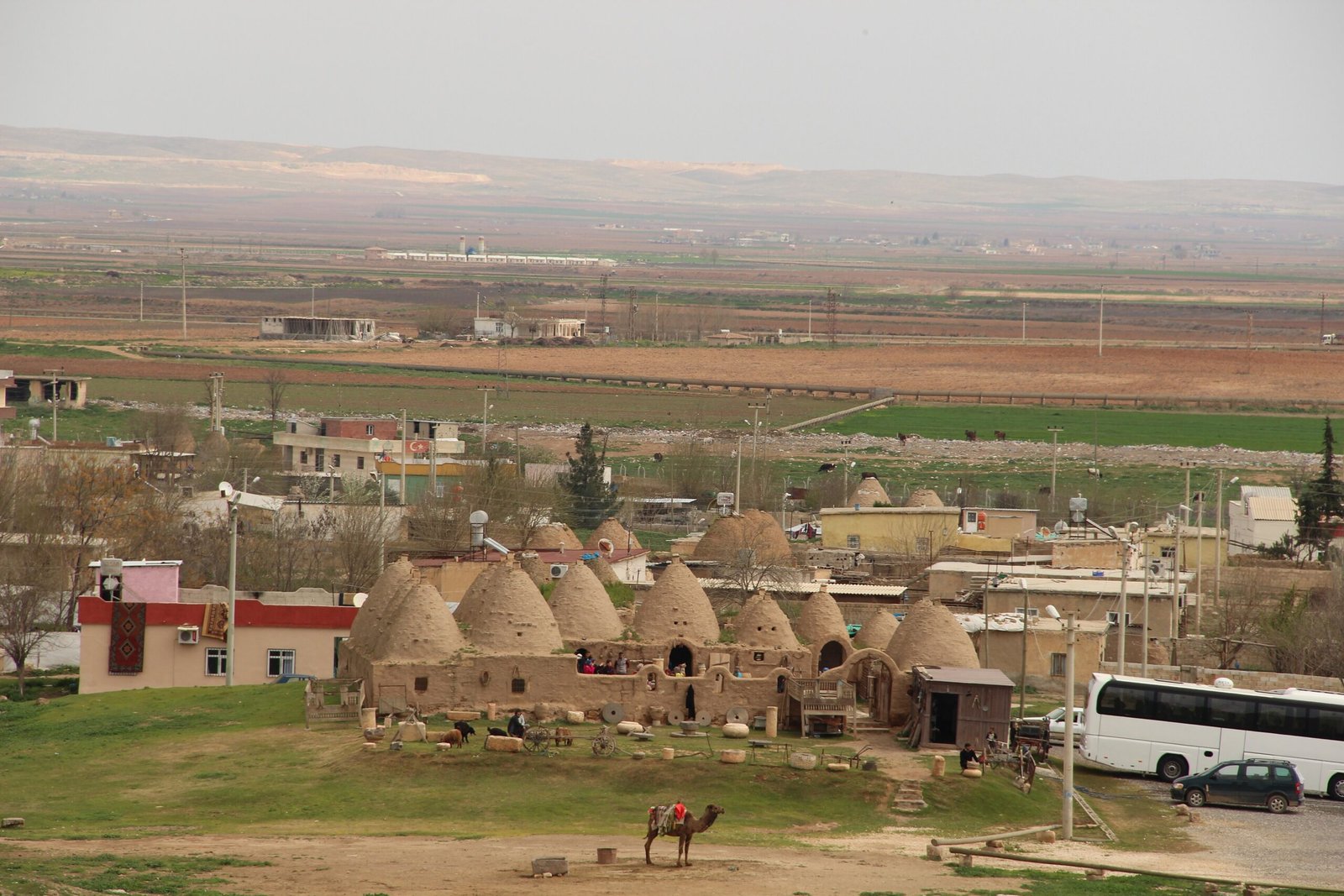
Continuously inhabited for 5,000 years on the plain of the upper Balikh river, Harran was the principal sanctuary of the Moon god Sin, the biblical stopping point of Abraham's migration from Ur, and the last pagan city of the ancient world — its distinctive beehive houses still standing today.
At a glance
Approximately 44 km south of Şanlıurfa and 10 km from the Syrian border, Harran occupies one of the longest continuously inhabited sites in the world — settled from at least 3000 BC and still a living town today. Its three great claims to significance span 5,000 years: it was the principal cult city of the Moon god Sin, whose temple here was among the most important in the ancient Fertile Crescent; it appears in Genesis as the city where Abraham's family settled during their migration from Ur to Canaan; and it maintained the last functioning pagan religion in the Near East until approximately 1050 AD, producing medieval Islamic philosophers in the process. Above ground today, the most distinctive feature is the surviving population of traditional beehive-shaped mud-brick houses — still inhabited, and built in a form essentially unchanged from ancient architectural models of the Syrian-Mesopotamian plain.
Key facts
- Location: Şanlıurfa Province, southeastern Turkey — 36°51′N 39°02′E
- Continuously inhabited: c. 3000 BC to present (~5,000 years)
- Biblical mention: Genesis 11:31, 12:4 — Abraham's family settled here from Ur of the Chaldees
- Temple of Sin: principal Moon god sanctuary, active c. 2000 BC – 1050 AD
- Harranian Sabians: last surviving pagan tradition in the Near East; mentioned in the Quran
- Medieval university: produced philosopher Thabit ibn Qurra (826–901 AD), key Greek-Arabic translator
- Beehive houses: surviving vernacular architecture unique to the Harran plain
History
Harran's ancient name — Harranu in Akkadian, meaning “road” or “crossroads” — reflects its geographical position at the junction of major trade routes linking Mesopotamia, Anatolia, Syria, and Egypt. By the second millennium BC it was already one of the most important cities of the upper Balikh valley, and its Temple of Sin rivalled in significance only the Sin temples at Ur and Nippur in Mesopotamia. The temple survived Alexander's conquest, Seleucid rule, Parthian rule, Roman annexation, and Sasanian pressure. The Umayyad caliph Marwan II rebuilt and enlarged it around 744 AD — an Islamic ruler restoring a pagan temple, testament to the political importance of maintaining the Harranians' loyalty.
The Harranians survived by becoming the “Sabians” — a people mentioned three times in the Quran as a protected monotheist group alongside Christians and Jews. Whether the Harranians were genuinely Sabian or simply adopted the identity strategically is debated, but the result was that they maintained their astral religion, priesthood, and philosophical tradition into the 10th century AD. Thabit ibn Qurra (826–901), a Harranian Sabian philosopher and mathematician, translated dozens of Greek scientific and mathematical texts into Arabic — including works of Archimedes, Apollonius, and Euclid — making him one of the most important transmission figures in the history of science. The tradition ended definitively when the Harranian community was finally forced to convert to Islam around 1050 AD.
The catastrophic defeat of the Crusader army of the County of Edessa at the Battle of Harran in 1104 AD — at which Baldwin II of Edessa was captured by the Artuqid emir Sokmen al-Kutbi near this site — briefly returned Harran to historical prominence. The medieval city walls visible today date primarily from the Ayyubid and early Mamluk periods.
What you see
The most immediately striking element of Harran is the surviving population of beehive houses — conical mud-brick structures whose distinctive silhouette marks the town from a distance across the flat plain. Built without wood (scarce on the treeless plain) using a corbelled brick technique that creates a self-supporting dome, the beehive form is directly descended from ancient building traditions of the Syrian-Mesopotamian plain and represents the most distinctive vernacular architecture of the region. Some houses are still inhabited; others have been converted for tourism. The beehive neighbourhood is small enough to explore on foot in 30–45 minutes.
The excavated ruins of the Ulu Cami mosque — built in the 8th century AD incorporating and above the ruins of the Temple of Sin — are visible in the centre of the ancient city, with the distinctive square minaret of Caliph Marwan II still standing to a considerable height. The medieval city walls with towers and gates are substantially preserved on the eastern and southern sides of the ancient tell. The citadel mound (Harran Kale) rises at the edge of the site with views over the surrounding plain. A small archaeological museum in the town houses local finds.
Practical information
- Entry: open site; some areas have nominal fees; beehive house visits typically include a guide fee
- Opening hours: effectively daylight hours; ruins accessible at all times
- Guides: local guides available in the town; Şanlıurfa-based operators run half-day and full-day tours
- Time needed: 2–3 hours for ruins, beehive houses, and museum; full day if combining with Sogmatar and Göbekli Tepe
- Facilities: tea houses and basic refreshments in the village; no significant tourist infrastructure
- Best season: spring (March–May) or autumn (September–November) — summer temperatures on the plain are extreme
Getting there
Harran is 44 km south of Şanlıurfa city centre via a direct road. Dolmuş (shared minibuses) run from Şanlıurfa's bus terminal to Harran several times daily; journey time approximately 45 minutes. Taxis and tour vehicles are readily available from Şanlıurfa. Most visitors combine Harran with Göbekli Tepe and/or Sogmatar in a full-day circuit from Şanlıurfa — several operators offer fixed-price combined tours. Harran is easily reachable as a day trip from Gaziantep (approximately 2 hours) or Diyarbakır (approximately 2.5 hours).
Nearby
- Göbekli Tepe — the world's oldest known megalithic sanctuary, 55 km northwest near Şanlıurfa
- Sogmatar — astral religion cave sanctuaries with earliest Syriac inscriptions, 30 km southeast
- Şanlıurfa (Urfa) — ancient Edessa, with Abraham's Pool of Sacred Fish and excellent archaeological museum
- Karahan Tepe — newly excavated Göbekli-era site with remarkable sculptures, 35 km east
Sources
- Green, T. (1992). The City of the Moon God: Religious Traditions of Harran. Leiden: Brill.
- Lloyd, S. and Brice, W. (1951). “Harran.” Anatolian Studies 1, pp. 77–111.
- al-Nadim (c. 988 AD). Kitab al-Fihrist — Harranian Sabian religion section.
- Parpola, S. (1993). Letters from Assyrian Scholars — references to Harran Temple.
- Wikipedia — “Harran”: en.wikipedia.org/wiki/Harran
Find it on the map
See this place and what’s around it →📷 Become a Cultural Heritage Online photographer
Share your photos of places: they stay published under your name as the author. The more they're seen, the more you get noticed — and soon a contest will reward the most appreciated photos.
Log in or sign up free to add a photo