
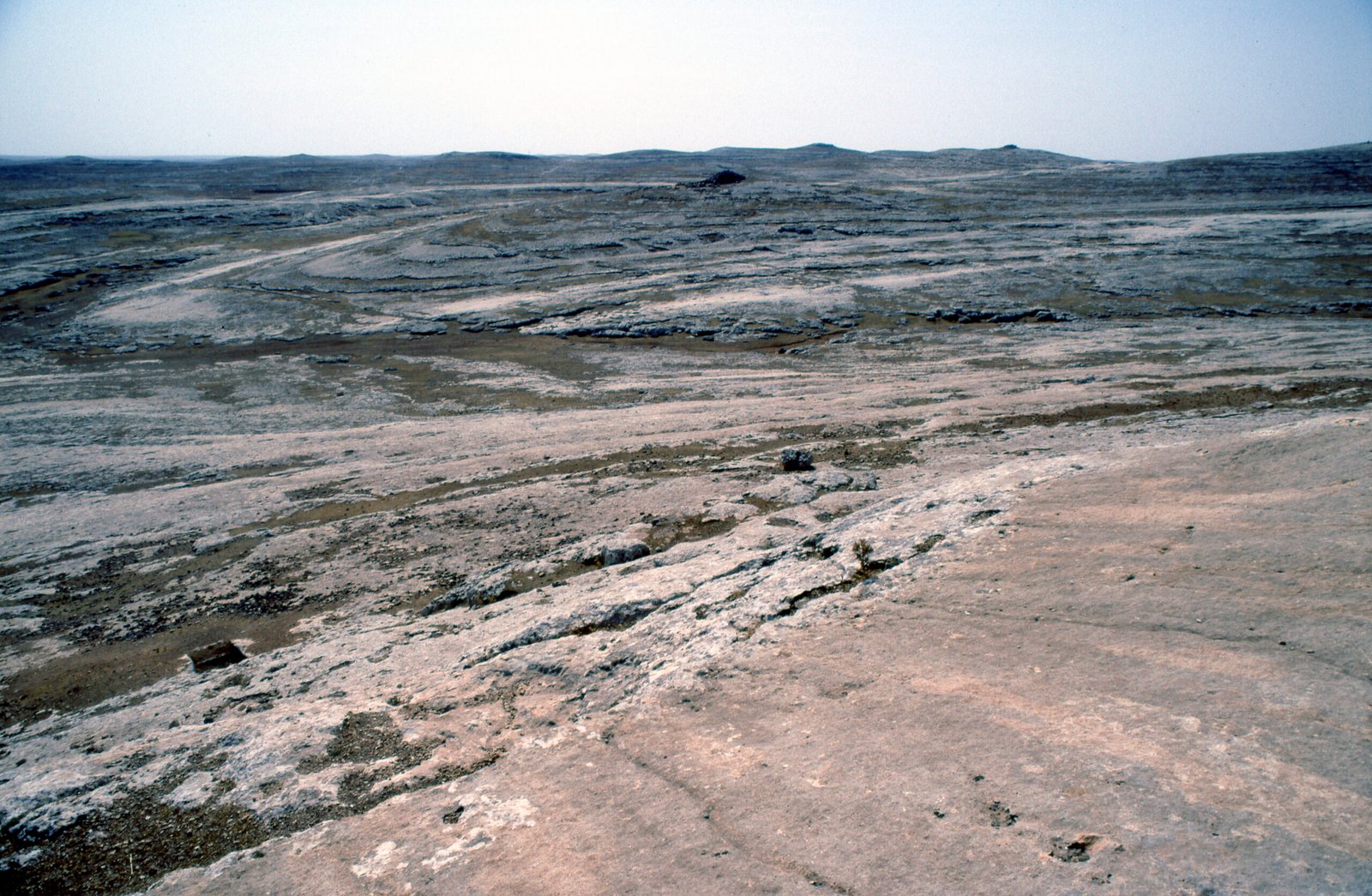
A remote hilltop complex of carved rock sanctuaries and planetary shrines on the Harran plain — the most complete surviving evidence of the ancient astral religion centred on the Moon god Sin, with inscriptions among the earliest datable documents in Syriac script.
At a glance
On the waterless Harran plain in Şanlıurfa Province, approximately 70 km southeast of Şanlıurfa (ancient Edessa), Sogmatar preserves the physical remains of the astral religion that centred on the worship of the Moon god Sin and the seven planetary deities — a tradition that persisted at nearby Harran as the last functioning pagan cult in the Near East until approximately 1050 AD. The site consists of a central sacred hill surrounded by seven satellite mounds, each associated with one of the seven classical planets. Rock-carved Syriac inscriptions on the central hill and in the satellite chamber-caves, dated palaeographically to approximately the 2nd century AD, are among the earliest datable documents in Syriac script anywhere in the world. The site receives very few visitors and is accessible only by unpaved road — one of the most atmospheric and least-known ancient religious sites in the entire Fertile Crescent.
Key facts
- Location: Harran plain, Şanlıurfa Province, southeastern Turkey — 37°04′N 38°59′E
- Period: c. 1st–3rd century AD, late Parthian / early Sasanian
- Religion: Astral cult of Moon god Sin and seven planetary deities
- Inscriptions: Old Syriac and Syriac rock carvings, c. 2nd century AD — among earliest datable Syriac documents
- Structure: central sacred hill + seven satellite planetary mounds in circular arrangement
- Political context: territory of the Aramaic-speaking Osrhoene kingdom, c. 132 BC – 244 AD
- Access: unpaved road from Harran; no public transport; very few visitors
History
Sogmatar lies in what was the territorial heartland of the Osrhoene kingdom, an Aramaic-speaking state centred on Edessa (modern Şanlıurfa) that acted as a buffer between the Roman and Parthian empires from approximately 132 BC to 244 AD. The religious practices at Sogmatar are directly connected to those of Harran, 30 km to the northwest, which hosted the most important surviving temple of the Moon god Sin in the ancient Near East. The Harranians maintained the Moon god's worship through the Christianisation of the Roman Empire, through the Islamic conquest, and into the early Abbasid period — the “Sabians” mentioned three times in the Quran were almost certainly the Harranians, who adopted the protected “people of the book” identity strategically to avoid forced conversion. This tradition finally ended around 1050 AD.
The inscriptions at Sogmatar, carved into the rock faces of the central hill and the walls of the satellite cave-shrines, record dedications to the planetary deities made by Parthian-era local rulers and priests. Their palaeographic dating to approximately the 2nd century AD makes them among the oldest surviving documents in Syriac script, placing Sogmatar at the very beginning of the written history of a language that became the liturgical language of Eastern Christianity and is still spoken by Assyrian communities today. The inscriptions were first documented by modern scholars in the late 19th century; systematic epigraphic study was conducted primarily by J.B. Segal in the mid-20th century.
The site represents the physical infrastructure of a tradition whose theological sophistication is documented in later Islamic-era sources, particularly the writings of the 10th-century scholar al-Nadim, who recorded detailed accounts of Harranian religious practice — including planetary temple arrangements, priestly hierarchies, and ritual calendars — in his encyclopaedic work the Kitab al-Fihrist. What al-Nadim describes in texts, Sogmatar preserves in stone.
What you see
The central mound rises from the flat plain and is carved with niches, inscribed panels, and a cave chamber that served as the primary sanctuary. Climbing the hill takes perhaps 15 minutes and reveals a panoramic view of the surrounding plain with the satellite mounds visible in their roughly circular arrangement — a spatial layout that embodies the seven-planet cosmology of the astral religion. The rock carvings on the central hill face include dedicatory inscriptions in Old Syriac and Syriac script, now weathered but legible to specialists. Some niches retain faint traces of relief carving.
The seven satellite mounds each contain at least one cave or rock-cut chamber with carved inscriptions identifying the planetary deity associated with that mound. The chambers are small — typically accessible by crouching — but intact. The overall landscape setting, with the arid plain stretching to the horizon in every direction and the silence broken only by wind, powerfully reinforces the isolation and remoteness that characterised the tradition's final centuries. No reconstruction or restoration has been undertaken; the site appears essentially as it did when first documented by Western travellers.
Practical information
- Access road: unpaved track from Harran; high-clearance vehicle recommended, especially after rain
- Entry: open site; no ticket or formal entry point
- Guides: strongly recommended — site interpretation is minimal; guides available in Şanlıurfa or Harran
- Water: bring your own — no water source at the site
- Time needed: 2–3 hours to explore central hill and satellite mounds
- Best combined with: Harran ruins (30 km) and Göbekli Tepe (90 km northwest) as a multi-site day from Şanlıurfa
- Photography: unrestricted; morning or late afternoon light optimal for inscription legibility
Getting there
Sogmatar is approximately 70 km southeast of Şanlıurfa city centre. The route runs south via Harran and then continues southeast on unpaved tracks; the final approach requires navigation by GPS or with a local guide who knows the road. There is no public transport to the site. The most practical approach is a hired vehicle with driver from Şanlıurfa — several operators run day tours combining Sogmatar with Harran, and the combination is well-established among specialist heritage tourists. The drive from Harran to Sogmatar takes approximately 45–60 minutes on unpaved road.
Nearby
- Harran — the Moon god's principal city, beehive houses, and Ulu Cami ruins, 30 km northwest
- Göbekli Tepe — 12,000-year-old megalithic sanctuary, 90 km northwest near Şanlıurfa
- Şanlıurfa Archaeological Museum — houses finds from Göbekli Tepe and the Balikh valley region
- Karahan Tepe — newly excavated Göbekli-era site, 35 km east
Sources
- Segal, J.B. (1953). The Syriac Inscription of Sumatar Harabesi. BSOAS 15(3).
- Green, T. (1992). The City of the Moon God: Religious Traditions of Harran. Leiden: Brill.
- al-Nadim (c. 988 AD). Kitab al-Fihrist — Harranian religion section.
- Wikipedia — “Sogmatar”: en.wikipedia.org/wiki/Sogmatar
- Drijvers, H.J.W. (1980). Cults and Beliefs at Edessa. Leiden: Brill.
Find it on the map
See this place and what’s around it →📷 Become a Cultural Heritage Online photographer
Share your photos of places: they stay published under your name as the author. The more they're seen, the more you get noticed — and soon a contest will reward the most appreciated photos.
Log in or sign up free to add a photo