

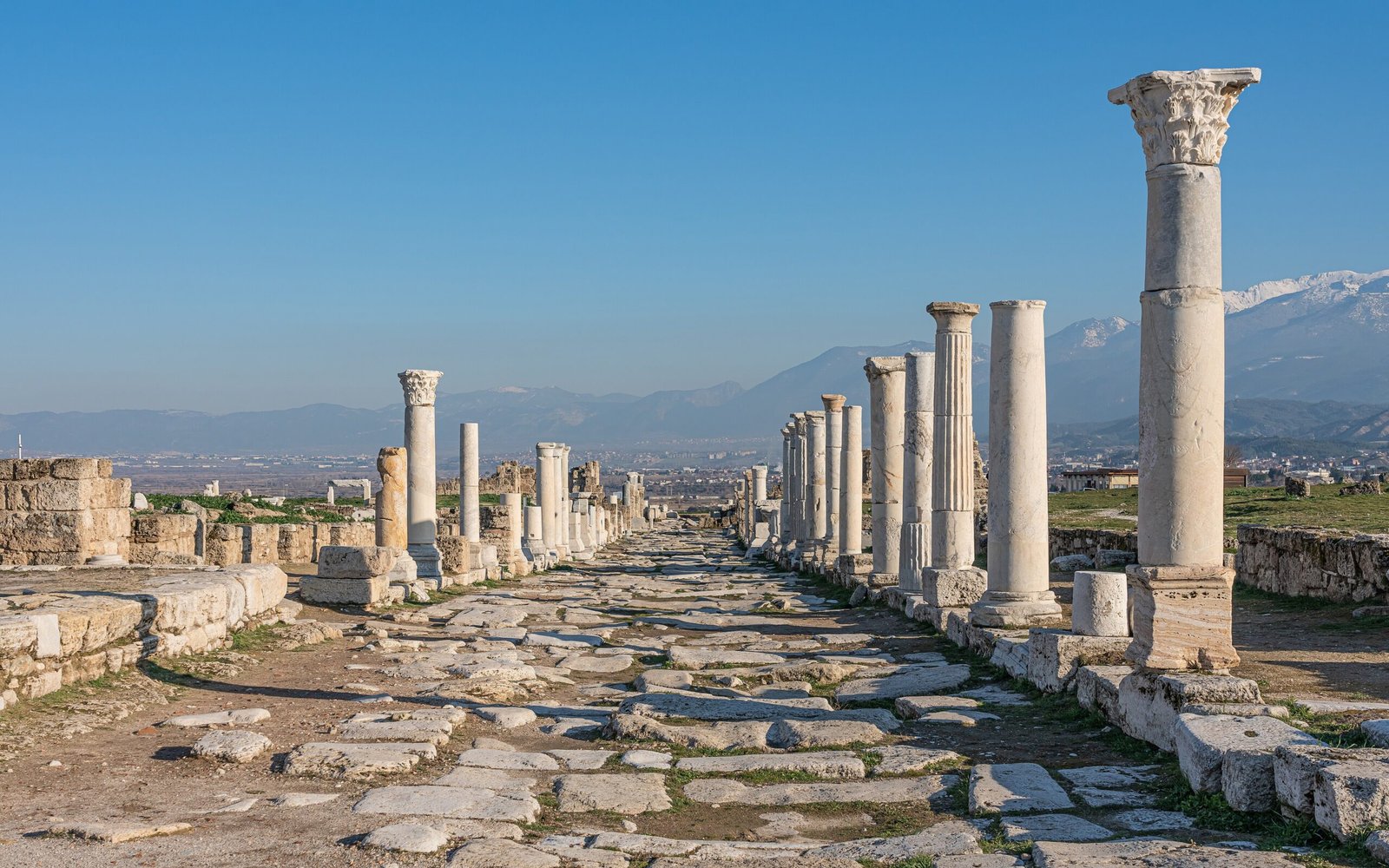
One of the wealthiest cities of Roman Asia Minor and recipient of the most famous rebuke in the New Testament, Laodicea has been spectacularly transformed since 2003 by ongoing Turkish excavations into one of the best-reconstructed ancient cities in Turkey — and the metaphor of its lukewarm water supply is now archaeologically confirmed.
At a glance
Near Denizli in the Aegean region of Turkey, immediately adjacent to the calcium carbonate terraces of Pamukkale (ancient Hierapolis), Laodicea on the Lycus was one of the most prosperous cities of Roman Asia Minor. Founded c. 261 BC by the Seleucid king Antiochus II and named for his wife Laodice, it grew into a major centre of the black wool textile trade, banking, and medicine. It is famous today as the recipient of one of the seven letters to the churches in the Book of Revelation (3:14-22), which condemns the Laodicean congregation as “lukewarm — neither hot nor cold” — an image directly referencing the city's notorious water supply problem. Turkish-led excavations since 2003 have reconstructed two theatres, a stadium, colonnaded streets, bath complexes, and two Early Christian basilicas, transforming Laodicea into one of the most extensively excavated and restored ancient cities in Turkey.
Key facts
- Location: near Denizli, Aegean Turkey — 37°50′N 29°06′E; adjacent to Pamukkale/Hierapolis
- Founded: c. 261 BC by Antiochus II Theos of the Seleucid Empire
- Period of peak prosperity: 1st–3rd century AD (Roman Imperial)
- New Testament reference: Book of Revelation 3:14–22 — one of the Seven Churches of Revelation
- Water supply: aqueduct from springs 8 km away, arriving lukewarm — the literal basis of Revelation's metaphor
- Post-60 AD earthquake: city refused imperial aid and rebuilt entirely from its own funds (noted by Tacitus)
- Excavations: ongoing Turkish excavations since 2003 led by Celal Şimşek (Pamukkale University)
History
Laodicea was founded by the Seleucid king Antiochus II around 261 BC on the south bank of the Lycus river (a tributary of the Maeander), at the junction of several major trade routes crossing western Anatolia. Under Roman rule it became extraordinarily prosperous: the geographer Strabo describes its remarkable wealth, and Cicero mentions it as a major banking centre where he exchanged funds during his proconsulship of Cilicia. The city's black glossy wool — a product of a local sheep breed unique to the Lycus valley — was traded throughout the Mediterranean and is mentioned in multiple ancient sources. The city was also home to an important medical school that developed a famous eye salve, the “collyrium of Laodicea,” referenced in Revelation 3:18 alongside the lukewarm water and the black wool in a passage of pointed local specificity.
The catastrophic earthquake of 60 AD (or possibly 62–64 AD — ancient sources vary) that devastated the Lycus valley region was met by Laodicea with a display of wealth that struck ancient writers as remarkable: the city declined the financial aid offered by the Emperor Nero and financed the entire reconstruction from its own treasury — a fact noted approvingly by Tacitus (Annals 14.27) as evidence of the city's extraordinary self-sufficiency. This wealth, paradoxically, is what makes the Revelation letter's condemnation so pointed: a congregation in a prosperous, self-sufficient city convinced of its own adequacy is precisely the target of the “lukewarm” metaphor.
A Jewish community was present in Laodicea by at least the 2nd century BC (Josephus records a decree of Laodicea protecting Jewish religious practices), and a Christian community is attested by the mid-1st century AD. The Epistle to the Colossians (4:16) refers to “a letter from Laodicea” exchanged between Paul and the Laodicean community — a letter that has not survived. Laodicea became an episcopal see and eventually the seat of one of the most important regional church councils: the Council of Laodicea (c. 363–364 AD) produced 60 canons that influenced the development of Christian liturgical practice across the Eastern churches.
What you see
The ongoing excavations led by Celal Şimşek of Pamukkale University since 2003 have transformed Laodicea from a scatter of foundations into one of the most extensively reconstructed ancient cities in Turkey. Two large Roman theatres have been substantially rebuilt using anastylosis (re-erecting original fallen stones); the Syrian-style colonnaded main street (3 km long, with re-erected column drums and entablature blocks) creates one of the most impressive ancient streetscapes in the country; a nymphaeum, multiple bath complexes, a stadium, and a monumental gateway have all been partially reconstructed. The two Early Christian basilicas — one of the largest in ancient Asia Minor — show the city's importance in early Christianity: the floor mosaics of the A Church basilica are among the finest preserved in Turkey.
The site is immediately adjacent to Pamukkale and Hierapolis, making it almost inevitably visited in combination. Hierapolis to the north had the hot springs (now the famous calcium terraces); Colossae to the east had cold spring water; Laodicea's water arrived via a still-partially-surviving stone aqueduct and was, as excavation has confirmed, supplied from springs approximately 8 km distant. Sections of the aqueduct with travertine calcium deposits from the lukewarm mineral water are visible at the site — the archaeology literally confirming the New Testament text.
Practical information
- Entry fee: combined ticket available with Hierapolis/Pamukkale; verify current prices at site
- Opening hours: typically 8:00–19:00 in summer, 8:00–17:00 in winter (verify locally)
- Getting oriented: the site is large (3+ km²) — comfortable shoes essential; rent a vehicle or join a tour for the full circuit
- Time needed: 2–3 hours for main monuments; half-day if combining with Hierapolis/Pamukkale
- Facilities: car park, basic refreshments; full services in adjacent Denizli/Pamukkale
- Combined visit: Hierapolis (Pamukkale) is 12 km to the north and almost universally visited together
Getting there
Laodicea is approximately 6 km north of central Denizli and is signposted from the main Denizli–Pamukkale road. Dolmuş services run frequently from Denizli to Pamukkale passing near the site. Denizli has a domestic airport with connections to Istanbul and Ankara, and a high-speed rail connection to İzmir (approximately 2 hours). The site is on virtually every itinerary that includes Pamukkale, and tour buses from the Aegean coast (Bodrum, Kuşadası, Marmaris) regularly include Laodicea as an add-on to Pamukkale visits. Driving from İzmir takes approximately 3 hours via the Denizli highway.
Nearby
- Hierapolis (Pamukkale) — hot springs city with calcium terraces and extensive ruins, 12 km north
- Aphrodisias — one of the best-preserved Greek cities in Turkey, 80 km west
- Colossae — nearby city addressed in Paul's letter to the Colossians; largely unexcavated mound, 18 km east
- Sardis — another of the Seven Churches of Revelation, 175 km northwest
Sources
- Şimşek, C. (2013). Laodikeia (Laodikeia ad Lycum). İstanbul: Ege Yayınları.
- Tacitus, Annals 14.27 — Laodicea earthquake and self-funded rebuilding.
- Revelation 3:14–22 — Letter to the church at Laodicea.
- Strabo, Geography 12.8.16 — description of Laodicea's wealth.
- Wikipedia — “Laodicea on the Lycus”: en.wikipedia.org/wiki/Laodicea_on_the_Lycus
Find it on the map
See this place and what’s around it →
📷 Become a Cultural Heritage Online photographer
Share your photos of places: they stay published under your name as the author. The more they're seen, the more you get noticed — and soon a contest will reward the most appreciated photos.
Log in or sign up free to add a photo