

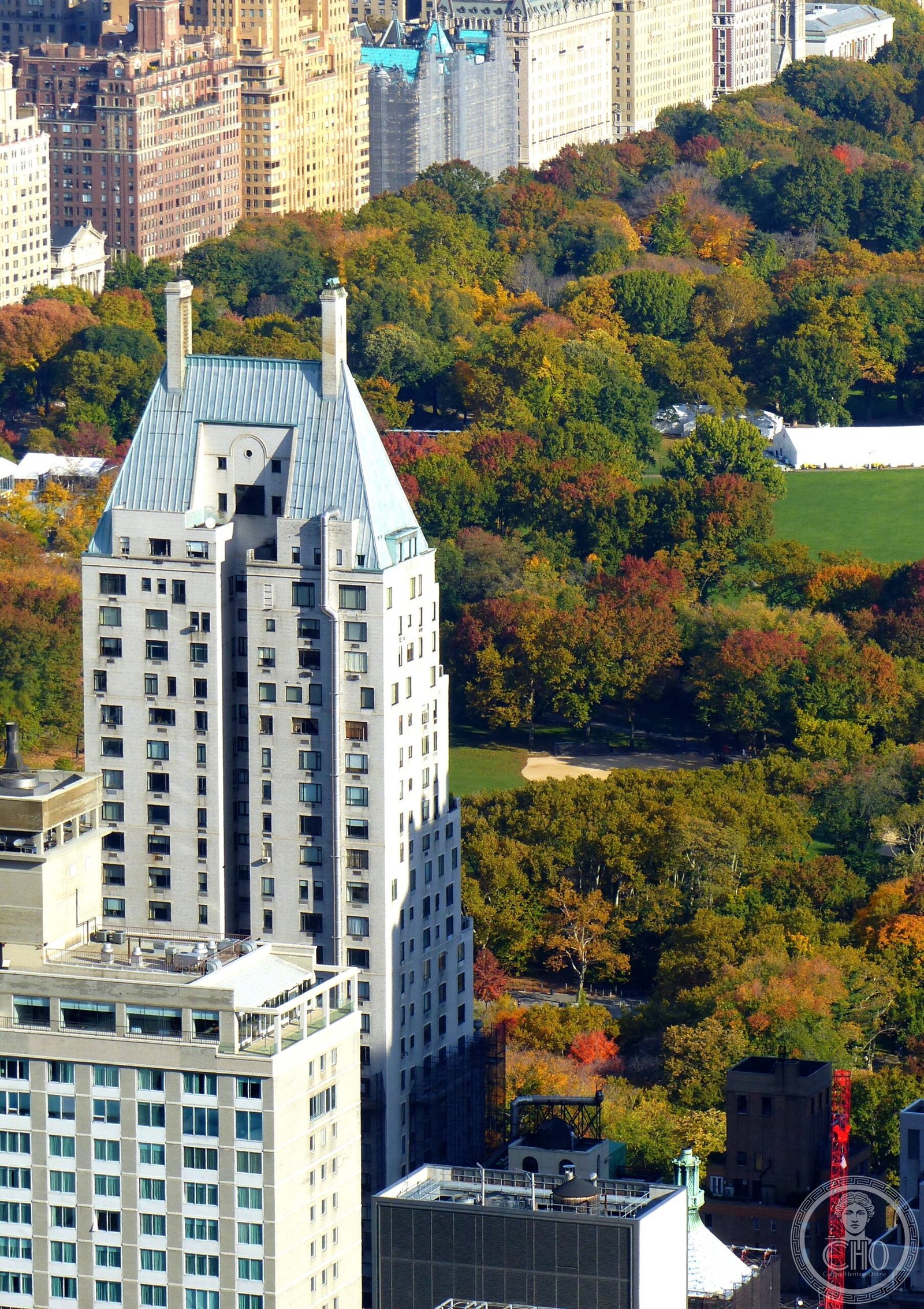
Completed in 1937, Hampshire House at 150 Central Park South belongs to the final phase of New York’s interwar skyline — a Streamline Moderne tower that softened the hard geometry of earlier Art Deco into the rounder, more aerodynamic forms that closed the decade.
At a glance
Hampshire House stands at 150 Central Park South, a 37-story Streamline Moderne residential tower occupying the west end of the Central Park South block between Sixth and Seventh Avenues, directly adjacent to the Essex House at 160. Completed in 1937 as one of the last major residential buildings to be finished before the Second World War suspended new construction in New York, the building’s curving limestone facade and rounded corner detailing place it stylistically in the final phase of the interwar Moderne — the moment when the angular severity of 1929–1931 Art Deco began to soften into the rounder profiles that the aerodynamic styling of automobiles, aircraft, and industrial design had made fashionable. Hampshire House is now a private cooperative.
Key facts
- Completed: 1937
- Address: 150 Central Park South, between Sixth and Seventh Avenues, Manhattan
- Height: 37 stories
- Style: Streamline Moderne — limestone facade, rounded corner treatments, horizontal emphasis
- Current use: Private cooperative residential apartments
- Setting: Immediately adjacent to the Essex House (160 CPS) on the same block
History
Hampshire House was developed in the mid-1930s at a moment when New York’s real estate market was beginning to recover from the worst years of the Depression. The site on Central Park South had been cleared in anticipation of the project, and construction proceeded through 1936 and 1937, yielding one of the last large residential towers to be added to the Central Park South streetscape before the building hiatus of the war years. The name recalled an English county in the tradition of Anglophilic naming that had governed much of New York’s luxury residential development since the 1880s — Hampshire in England was associated with the rural aristocratic estates of the Austen and Trollope novels that formed the cultural reference point for aspiring wealthy New Yorkers.
The building was originally operated as a residential hotel — a common New York arrangement in which private apartments and hotel services coexisted in the same building — before eventually being converted to a pure cooperative format. The Central Park South location, shared with the Essex House and Hampshire House on the same block, made it one of the most desirable residential addresses in the city: a position directly across from the southern edge of the park, with unobstructed northward views over the park’s treetops toward the Upper West Side skyline.
The 1937 completion date places Hampshire House in an interesting architectural moment: it is contemporary with Frank Lloyd Wright’s Fallingwater (completed 1939) and the first of the streamlined passenger aircraft that were beginning to redefine the aesthetics of motion and modernity. The rounded facades and horizontal emphasis of the Hampshire House facade reflect the same interest in aerodynamic form that shaped the Burlington Zephyr train (1934), the Douglas DC-3 (1935), and the industrial design work of Raymond Loewy and Henry Dreyfuss in the same years.
What you see
Hampshire House’s facade on Central Park South reads as a smoother, more continuous surface than the pilaster-dominated composition of the earlier Central Park South towers. The limestone cladding curves around the building’s corners in rounded transitions rather than the sharp angular setbacks of the 1931 Deco; windows are grouped in horizontal bands that emphasize the floor-by-floor horizontal rather than the floor-to-floor vertical. This horizontal emphasis — sometimes called the “streamline” quality — was the primary compositional departure of late-1930s Moderne from the strict verticality of the Art Deco decade that preceded it.
Standing at the corner of Central Park South and Sixth Avenue, the relationship between Hampshire House and the adjacent Essex House is immediately legible as a generational sequence: the Essex House (1931) uses vertical limestone pilasters and a more angular stepped crown; Hampshire House (1937) softens all of these elements into rounded corners, horizontal bands, and a flatter top. Together they form an involuntary museum of the trajectory from peak Deco to late Moderne — two buildings a hundred yards apart that bracket one of New York architecture’s most productive and concentrated decades.
Practical information
- Access: Private cooperative residential building; no public interior access
- Best view: From Central Park, at the path near the Pond (south entrance, 59th Street and 5th Avenue), looking southwest; both Hampshire House and the Essex House are visible as a pair in this view
- Photography: The Central Park South block benefits from afternoon westerly light; the curved corners are best captured from an oblique angle at street level
- Combine with: Walk the full Central Park South block from Fifth Avenue west to Columbus Circle — approximately 15 minutes — for the complete sequence of interwar residential towers (Essex House, Hampshire House, New York Athletic Club, and others)
Getting there
Hampshire House is at 150 Central Park South, between Sixth and Seventh Avenues. The nearest subway stations are Columbus Circle (A/B/C/D/1, about four minutes’ walk west at 59th and Eighth Avenue) and 57th Street–7th Avenue (N/Q/R/W trains, about three minutes’ walk south and then one block east). From Midtown (Times Square), take the N/Q/R/W to 57th Street–7th Avenue, three stops north. Carnegie Hall is two blocks south at Seventh Avenue and 57th Street. Central Park’s Pond entrance at 59th and Fifth Avenue is about ten minutes’ walk east along Central Park South.
Nearby
- Essex House (1931) — the adjacent Art Deco tower at 160 Central Park South, immediately east; together the two buildings represent the Deco (1931) and Streamline Moderne (1937) bookends of the pre-war residential high-rise on this block
- Carnegie Hall (1891) — the world-renowned concert hall two blocks south at 881 Seventh Avenue (57th & 7th); open for concerts year-round and for guided tours on weekday mornings
- Central Park — The Pond — the small lake at the southeast corner of Central Park, accessible from 59th Street and Fifth Avenue (about twelve minutes’ walk east); with views of the Wollman Rink and the midtown skyline from within the park
- Columbus Circle — four minutes’ walk west; the gateway intersection of Broadway, Eighth Avenue, and Central Park West, with the Maine Monument, the Deutsche Bank Center, and the Museum of Arts and Design
Sources
- White, Norval, and Elliot Willensky. AIA Guide to New York City, 5th ed. Oxford University Press, 2010.
- Stern, Robert A.M., Thomas Mellins, and David Fishman. New York 1960 and New York 1930. Rizzoli, various editions.
- New York City Landmarks Preservation Commission, Central Park South Historic District records.
Find it on the map
See this place and what’s around it →📷 Become a Cultural Heritage Online photographer
Share your photos of places: they stay published under your name as the author. The more they're seen, the more you get noticed — and soon a contest will reward the most appreciated photos.
Log in or sign up free to add a photoIs this page about you?
This page is read by travellers and heritage enthusiasts who find it on Google. Tell us how you are connected to this place and we will take it from there.