
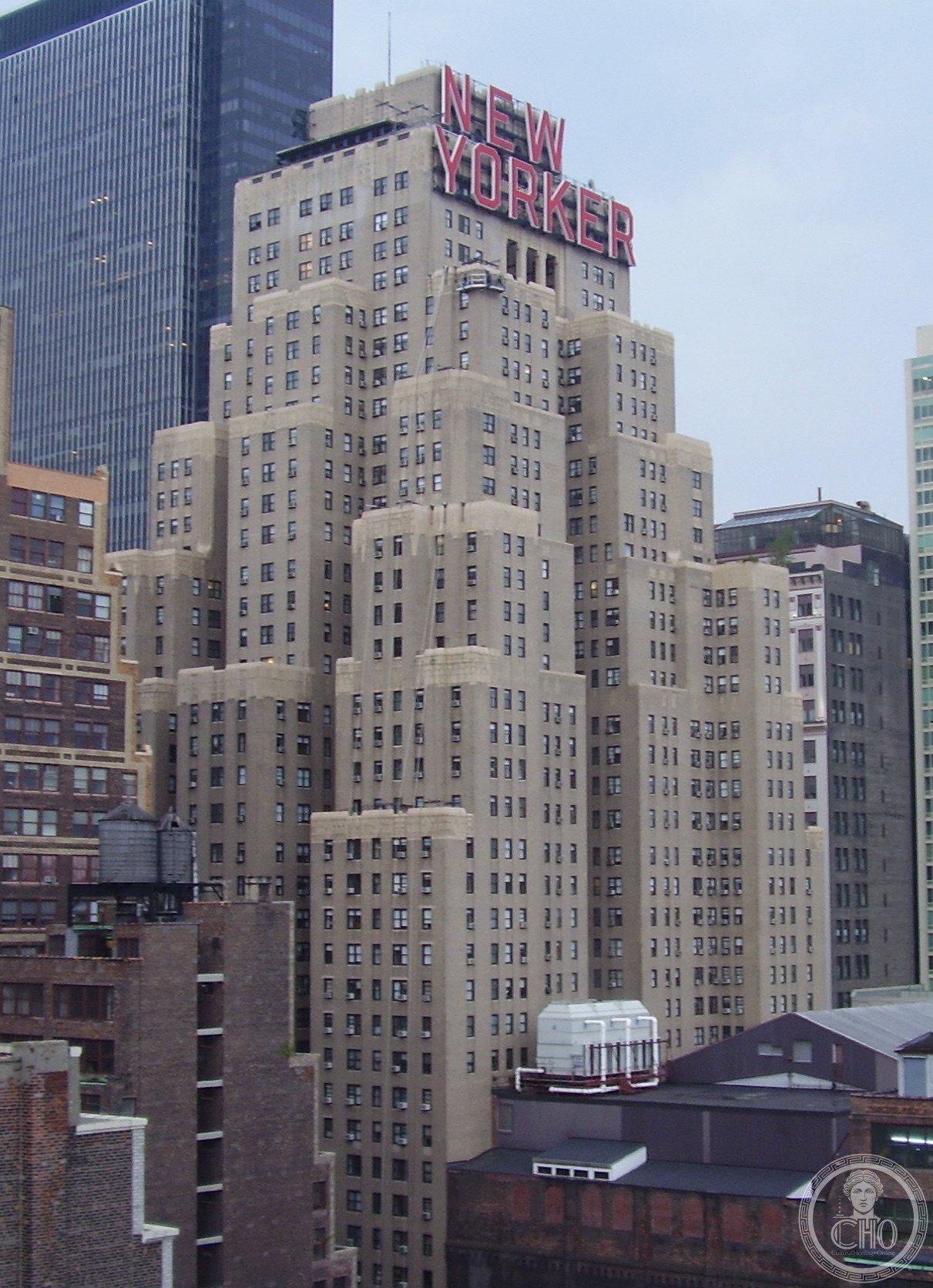
Opened on January 2, 1930, at the corner of Eighth Avenue and 34th Street, the Hotel New Yorker was one of Midtown Manhattan’s largest and most technologically ambitious hotels — and for thirteen years, the last residence of Nikola Tesla.
At a glance
The Hotel New Yorker stands at 481 Eighth Avenue, at the southwest corner of 34th Street, a block south of Madison Square Garden and Penn Station, and three blocks west of the Empire State Building. Completed in 1930 as a 43-story Art Deco tower, it opened with 2,500 rooms and its own power plant — the building generated its own electricity, supplied steam heat and ice water to every room, and operated a broadcasting station, a bank, twelve barber shops, a hospital, and a laundry. The New Yorker was built to be a city within a city, the culmination of the grand Midtown hotel ambitions of the 1920s. Today it operates as a Marriott-affiliated hotel and is listed on the National Register of Historic Places.
Key facts
- Opened: January 2, 1930.
- Address: 481 Eighth Avenue at 34th Street, Midtown Manhattan.
- Height: 43 stories.
- Style: Art Deco — brick and limestone with setback profile, geometric cornice ornament, vertical massing.
- Original rooms: 2,500 (the largest hotel in New York City at opening).
- Notable resident: Nikola Tesla (rooms 3327–3328, 1933–1943).
- Current operator: Marriott Hotels & Resorts.
- Designation: National Register of Historic Places.
History
The Hotel New Yorker was developed by a syndicate headed by Janeway & Enloe and designed in the Art Deco style that defined the skyline aspirations of late-1920s Manhattan. When it opened on January 2, 1930, with a dinner dance attended by thousands, the New Yorker was the largest hotel in New York City and one of the largest in the world. The timing was unfortunate: Wall Street had crashed three months earlier, and the Depression would make the hotel’s enormous scale a liability as much as a distinction through the 1930s. Nevertheless, the New Yorker maintained its position as a Midtown anchor for conventions, big-band dances in its ballroom, and the constant traffic of travelers arriving at Penn Station four blocks away.
In 1933, Nikola Tesla moved into rooms 3327 and 3328 on the 33rd floor, where he would remain until his death on January 7, 1943. Tesla spent his final decade in deepening poverty, largely isolated from the scientific establishment but still producing theoretical work and receiving occasional journalists. His rooms were said to contain pigeons, which he fed from the windows, and the management of the hotel treated him with patience and some deference owed to his earlier fame. When he died alone in his room, the Federal Bureau of Investigation seized his papers; his estate was eventually transferred to the Tesla Museum in Belgrade. A commemorative plaque marks the room level.
The Hilton Hotels Corporation purchased the New Yorker in 1953 and operated it until 1972, when the building was sold and went through a series of owners including the Unification Church of the Rev. Sun Myung Moon, which used it as a headquarters. The building was restored and returned to hotel use in the 1990s and has operated as a Marriott property since, the NRHP designation having been secured in 2000.
What you see
The Hotel New Yorker’s Eighth Avenue facade presents a tier of setbacks rising to a flat-topped crown — the clean vertical Deco profile that distinguishes the 1930 generation of Midtown towers from the more ornate neo-Gothic and Beaux-Arts towers of the decade before. The brick is a warm red-brown, the limestone trim picks out the window surrounds and horizontal belt courses, and the geometric ornament at the building’s crown is restrained: the New Yorker’s architectural character is one of scale and proportion rather than surface decoration. This reflects the commercial pragmatism of the Statler-era hotel aesthetic: a building that communicates modernity and solidity without the self-consciously artistic program of the Chrysler or the Empire State.
The building’s most important visual relationship is with its immediate neighbors: Madison Square Garden (the current 1968 version) across 34th Street and the Empire State Building two blocks east. From the Eighth Avenue side the New Yorker reads as the western anchor of the 34th Street corridor, its mass completing the midblock skyline between Penn Station and Herald Square. The hotel’s original ground-floor retail colonnade on Eighth Avenue, typical of late-1920s Midtown hotel design, has been substantially altered over the decades but retains something of the pedestrian scale that distinguished the original design from later hotel developments.
Practical information
- Access: Active hotel; lobby open to guests and visitors during normal business hours.
- Tesla memorial: A plaque in the lobby commemorates Tesla’s residence; the room level (33rd floor) is accessible only to guests.
- Best view: From the west side of Eighth Avenue looking east, particularly from the Penn Station footbridge or the upper levels of Madison Square Garden; also from the Empire State Building observation deck looking west.
- Photography: The full tower height is best captured from a distance; the Eighth Avenue entrance facade is well-lit in the morning.
Getting there
The Hotel New Yorker is at the corner of 34th Street and Eighth Avenue. The nearest subway station is 34th Street–Penn Station (A/C/E trains), directly adjacent at Eighth Avenue — the hotel’s Eighth Avenue entrance is about one minute’s walk from the subway exit. Penn Station (1/2/3 and Long Island/NJ Transit/Amtrak) is directly across 33rd Street, one block south. The 34th Street station on the B/D/F/M/N/Q/R/W lines (Herald Square, Sixth Avenue) is three blocks east. From Midtown East (Grand Central Terminal), take the S shuttle to Times Square and the A/C/E train to 34th Street–Penn Station. The Empire State Building is three blocks east at 34th and Fifth Avenue.
Nearby
- Empire State Building (1931) — three blocks east at 34th Street and Fifth Avenue; the Art Deco tower that defines the Midtown Manhattan skyline; observation decks on the 86th and 102nd floors.
- Penn Station / Madison Square Garden — immediately adjacent; Penn Station beneath Madison Square Garden is one of the busiest rail terminals in the world; the current MSG arena (1968) replaced the original 1910 Penn Station whose demolition prompted the New York City Landmarks Preservation Law.
- Macy’s Herald Square (1902) — the flagship store at 34th Street and Broadway, three blocks east; the world’s largest department store at opening; the building has a 1902 original section and a series of later additions in brick and terracotta.
- Javits Convention Center — ten minutes’ walk northwest along Ninth Avenue at 34th Street; the large glass-and-steel convention center (1986) on the Hudson River edge of Midtown.
Sources
- Seifer, Marc J. Wizard: The Life and Times of Nikola Tesla. Citadel Press, 1996.
- National Register of Historic Places, Hotel New Yorker nomination, 2000.
- White, Norval, and Elliot Willensky. AIA Guide to New York City, 5th ed. Oxford University Press, 2010.
- Gray, Christopher. “Streetscapes: The Hotel New Yorker.” The New York Times.
Find it on the map
See this place and what’s around it →📷 Become a Cultural Heritage Online photographer
Share your photos of places: they stay published under your name as the author. The more they're seen, the more you get noticed — and soon a contest will reward the most appreciated photos.
Log in or sign up free to add a photoIs this page about you?
This page is read by travellers and heritage enthusiasts who find it on Google. Tell us how you are connected to this place and we will take it from there.