
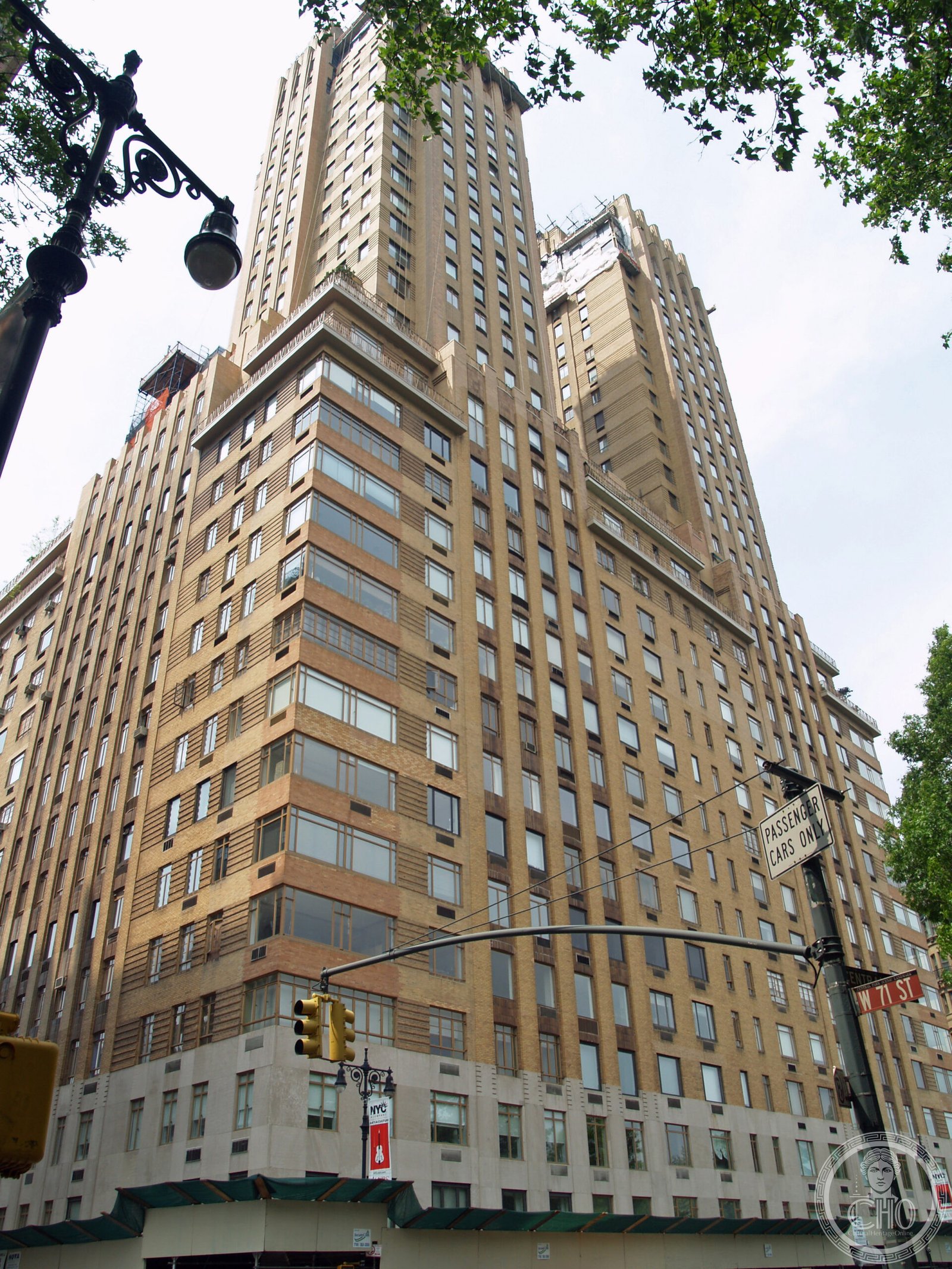
Four twin-towered Art Deco buildings define the Central Park West skyline between 71st and 96th Streets; The Majestic at 115, completed in 1931 by the Chanin organization and architect Jacques Delamarre, was the first — the template for the residential Deco silhouette that still frames the park’s western edge.
At a glance
The Majestic occupies the full block front at 115 Central Park West between West 71st and West 72nd Streets, its thirty-story twin towers rising from a lower base that fills the lot’s full width. Built by the Chanin Construction Company and completed in 1931 during the Great Depression, the building replaced an earlier hotel of the same name on the site. Architect Jacques Delamarre gave the building a facade of buff brick and limestone organized with Art Deco pilasters and spandrels, and the twin-tower profile — a response to both New York’s 1916 zoning setback requirements and the desire to maximize park-facing apartments — became the compositional vocabulary that the subsequent CPW towers (San Remo, Eldorado) would also adopt. The building is listed on the National Register of Historic Places as part of the Central Park West Historic District.
Key facts
- Completed: 1931
- Address: 115 Central Park West, between West 71st and West 72nd Streets, Manhattan
- Developer: Chanin Construction Company (Irwin Chanin)
- Architect: Jacques Delamarre
- Height: 30 stories (twin towers)
- Style: Art Deco — buff brick and limestone, vertical pilasters, twin-tower setback profile
- Current use: Private cooperative residential apartments
- Designation: National Register of Historic Places (Central Park West Historic District)
History
The site at 115 Central Park West had housed the original Hotel Majestic, a large Victorian residential hotel that was a well-known address on the park in the late nineteenth and early twentieth centuries. By the late 1920s Irwin Chanin, one of the most prolific builders in Depression-era New York, acquired the site with the intention of replacing it with a modern cooperative apartment building that would capitalize on the westward movement of wealthy residents from Fifth Avenue toward the park’s western edge. The name was retained to honor the site’s history and appeal to its existing constituency.
Construction began in 1930 and the building was completed in 1931, a period of severe economic contraction that made cooperative apartment sales a particular challenge. Chanin’s response to slow initial sales was to convert some units to rental — a pattern repeated elsewhere in the portfolio — and the building eventually filled over the course of the decade. The twin-tower form that Delamarre designed for The Majestic — two vertical towers rising from a shared base with a setback on the lower floors — proved commercially and aesthetically successful enough to be adopted in slightly varied form for three subsequent buildings on the same avenue: the San Remo (1930, Emery Roth), the Eldorado (1931, Margon & Holder), and later the Beresford (1929, Emery Roth), though the Beresford preceded the others and uses a different tripartite composition.
The Majestic has housed a long roster of prominent residents in the arts, entertainment, and public life. The building appears in popular fiction as the kind of grand Central Park West address that connotes old wealth and cultural prestige without the more visible ostentation of a Fifth Avenue building. In the middle decades of the twentieth century it attracted Broadway producers, musicians, and performers alongside the financial and corporate executives who made up the core of the cooperative’s owner population.
What you see
From Central Park, The Majestic’s twin towers appear as a double vertical accent framing the building’s broad lower base, their buff brick shafts articulated with limestone spandrels and pilasters that reinforce the upward movement at every story. The towers step back once each as they approach their crowns, a move that reduces the silhouette to two relatively slender shafts at the uppermost floors. Unlike the San Remo’s more elaborate temple-top crowns, The Majestic’s towers end simply — clean brick setbacks without the Classical or Gothic temple finials that Emery Roth favored. The effect is cooler and more strictly geometric, more in keeping with the strict Art Deco program than with the eclectic historicist tendency that persisted in some contemporary towers.
The base of the building, running the full block front on Central Park West, presents a sequence of slightly rusticated brick piers at street level, with a continuous limestone band at the second floor that anchors the composition horizontally before the towers begin their independent vertical rises. Entry is through a lobby that has been selectively modernized but retains its original ceiling height and some of its Deco metalwork. Because the building is a private cooperative, the lobby is accessible only to residents and their guests; the full architectural impact is experienced from the park or from the sidewalk on Central Park West.
Practical information
- Access: Private cooperative residential building; no public interior access
- Best view: From the paths inside Central Park opposite West 71st–72nd Streets, especially in winter when the park’s tree canopy thins to reveal the full twin-tower profile; also from the sidewalk directly in front on Central Park West
- Photography: The building is best photographed in the morning with light from the east falling on the Central Park West facade; late afternoon puts the facade in shadow
- Time needed: 15–20 minutes to photograph from the park and sidewalk; combine with the nearby Central Park Lake walk and The Dakota
Getting there
The Majestic is at 115 Central Park West, on the west side of the park between West 71st and West 72nd Streets. The nearest subway station is 72nd Street on the B/C lines (Central Park West), directly in front of the building on the same block; this station is also the nearest to Strawberry Fields and the Bethesda Fountain entrance to the park. From Columbus Circle (A/B/C/D/1), take the B or C train two stops north to 72nd Street — approximately four minutes. From Grand Central Terminal, take the S shuttle to Times Square and transfer to the B or C train uptown. The American Museum of Natural History at 79th Street is seven minutes’ walk north along Central Park West.
Nearby
- The Dakota (1884) — the landmark Victorian apartment building at 1 West 72nd Street, immediately adjacent on the same block; site of John Lennon’s residence and the Strawberry Fields memorial opposite in Central Park
- San Remo (1930) — the twin-tower Art Deco residential by Emery Roth at 145–146 Central Park West, two blocks north; with more elaborate temple crowns over each tower than the Majestic’s cleaner setback tops
- American Museum of Natural History — the encyclopedic natural history collection at Central Park West and West 79th Street, seven minutes’ walk north; the Rose Center for Earth and Space (Hayden Planetarium) is its most recent addition
- New-York Historical Society — New York’s oldest museum at 170 Central Park West (77th Street), housing paintings, decorative arts, and historical collections from the Dutch colonial period forward
Sources
- Stern, Robert A.M., Gregory Gilmartin, and Thomas Mellins. New York 1930. Rizzoli, 1994.
- National Register of Historic Places nomination, Central Park West Historic District, 1986.
- Gray, Christopher. “Streetscapes: The Majestic.” The New York Times, various dates.
- New York City Landmarks Preservation Commission records, 115 Central Park West.
Find it on the map
See this place and what’s around it →📷 Become a Cultural Heritage Online photographer
Share your photos of places: they stay published under your name as the author. The more they're seen, the more you get noticed — and soon a contest will reward the most appreciated photos.
Log in or sign up free to add a photoIs this page about you?
This page is read by travellers and heritage enthusiasts who find it on Google. Tell us how you are connected to this place and we will take it from there.