

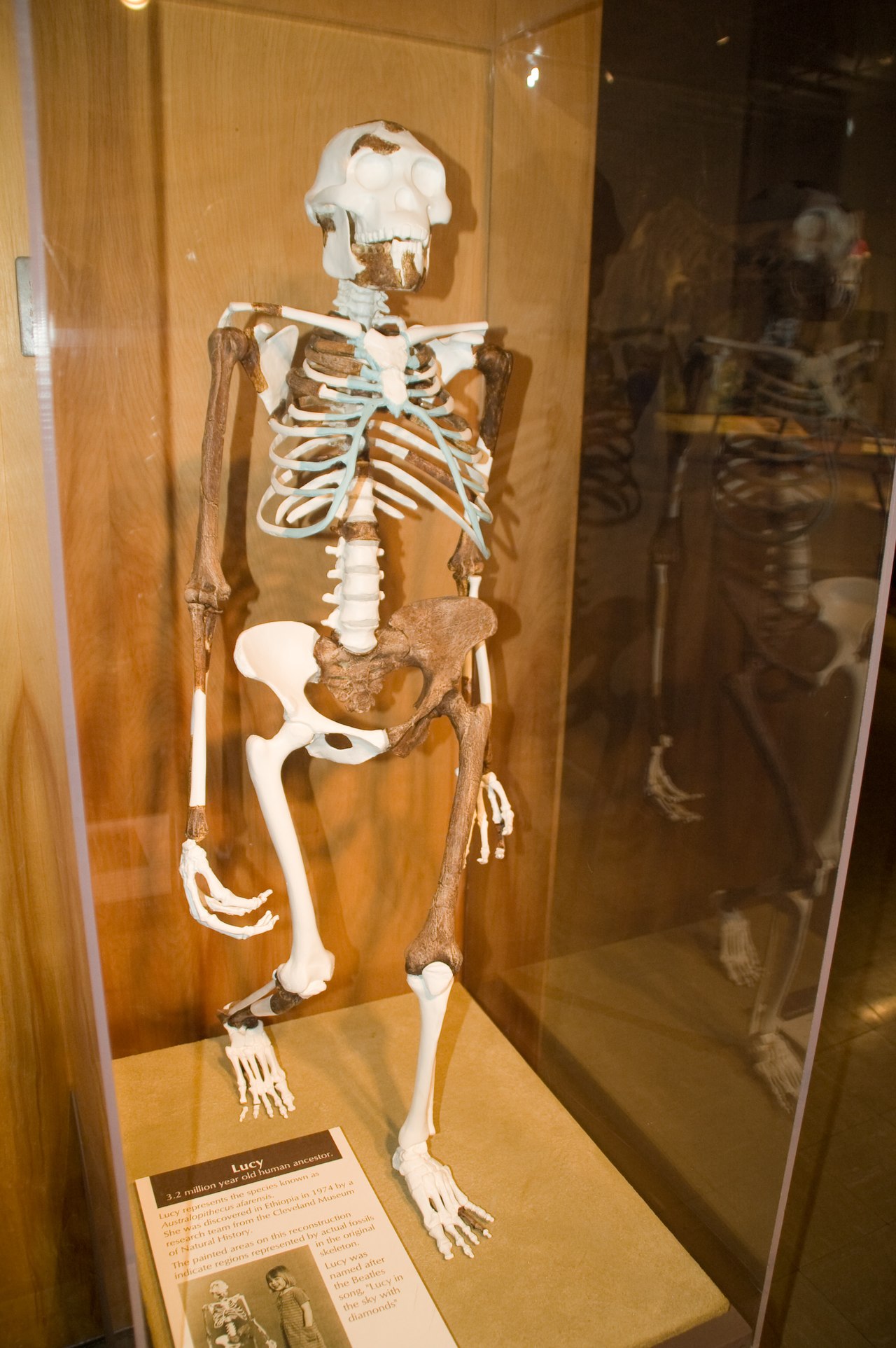
A series of Pliocene sediment exposures in Ethiopia’s Afar Depression where Donald Johanson discovered “Lucy” on 24 November 1974 — the 3.2 million year old partial skeleton of Australopithecus afarensis that proved bipedal walking evolved approximately 3 million years before the large human brain, and remains the most famous individual in the entire human fossil record.
At a glance
Near the Awash River in the arid lowland of Ethiopia’s Afar Region, the fossil site of Hadar — a series of Pliocene sediment exposures eroding continuously on the margins of a dry river valley — has yielded, since 1973, hundreds of specimens of Australopithecus afarensis, the species to which the most famous individual in the human fossil record belongs: “Lucy” (specimen AL 288-1), a female approximately 1.1 metres tall who walked upright on two legs and lived 3.2 million years ago. Lucy’s discovery on 24 November 1974, by Donald Johanson and Tom Gray, established for the first time that bipedal walking (the defining human characteristic) evolved millions of years before the enlargement of the brain — overturning a century of assumptions about how human evolution had proceeded. Hadar has no UNESCO listing of its own but is part of the broader Lower Awash Valley paleoanthropological landscape; the site remains active for research.
Key facts
- Lucy (AL 288-1): 40% complete skeleton of a female Australopithecus afarensis; age: approximately 3.2 million years; height: approximately 1.1 metres; brain size: approximately 400-500 cc (comparable to a chimpanzee)
- Discovery date: 24 November 1974 (Donald Johanson and Tom Gray); named “Lucy” after the Beatles song “Lucy in the Sky with Diamonds” playing in camp that evening
- Key finding: Knee joint, hip bones, and foot bones confirm bipedal walking, while small brain and long arms confirm ape-like features — proving bipedalism preceded brain enlargement by approximately 3 million years
- Additional finds: “First Family” (AL 333), at least 13 A. afarensis individuals buried together, 1975; hundreds of further specimens over 40+ years of excavation
- Location: Hadar, Afar Region, Ethiopia; approximately 300 km northeast of Addis Ababa; GPS: 11.1167 N, 40.5833 E
- Lucy original: National Museum of Ethiopia, Addis Ababa (AL 288-1 occasionally displayed; high-quality cast on permanent display)
- Site access: Remote desert; 4WD required; typically accessed via organised research expeditions or specialist tours from Addis Ababa
Lucy and the proof of bipedalism
On the morning of 24 November 1974, Donald Johanson of Case Western Reserve University and his student Tom Gray were surveying a dry gully in the Hadar fossil beds when Gray spotted a small bone fragment: the proximal end of a left femur. Looking around, they found more fragments — part of a skull, a lower jaw, ribs, vertebrae, the pelvis. Over the following three weeks, Johanson’s team recovered 52 fragments representing approximately 40% of a single skeleton — an extraordinary completeness for a hominin fossil of that age. The skeleton belonged to a female of small body size; she was named “Lucy” after the Beatles song “Lucy in the Sky with Diamonds” that was playing on a tape recorder in the expedition camp on the evening of the discovery.
Analysis of Lucy’s bones revealed the combination that made her scientifically revolutionary: the anatomy of her knee joint — the angle at which the femur meets the tibia — was identical to that of modern humans and entirely distinct from the knee anatomy of chimpanzees; her hip bones and the base of her spinal column showed adaptations to upright walking; her foot bones showed an arch and non-grasping big toe. Lucy walked upright, bipedally, on two legs, just as modern humans do. But her brain (estimated at approximately 400-500 cubic centimetres) was no larger than a chimpanzee’s, and her arm bones were long and curved, suggesting she also climbed trees. The significance was immediate and vast: the prevailing model of human evolution in 1974 held that bipedal walking and brain enlargement had co-evolved together, as a “package.” Lucy demolished that model. Bipedalism came first, by approximately 3 million years. The large brain came later.
Johanson named the species Australopithecus afarensis in 1978, recognising it as distinct from Dart’s South African Australopithecus africanus. The species is now known from dozens of specimens across East Africa, ranging in age from approximately 3.9 to 2.9 million years, and is widely accepted as a direct ancestor of the Homo lineage — the species from which humans, through a series of still-debated intermediate forms, ultimately descended. Lucy herself is housed at the National Museum of Ethiopia in Addis Ababa; a high-quality cast is on permanent display, while the original fragile bones are only occasionally exhibited. The Cleveland Museum of Natural History, where Johanson was based, holds a cast that has been displayed in numerous international exhibitions.
What the Hadar site looks like
Hadar is a harsh, arid landscape in the Afar Depression — one of the hottest, driest, and most geologically active places on Earth. The Afar Depression sits at the junction of three tectonic plates (the African, Arabian, and Somali plates) and is slowly pulling apart, which is why the ancient lake sediments that once covered the area are now eroded into a series of exposed badlands: gullies and ravines cutting through layers of light-coloured tuff, clay, and sandy sediment that preserve the fossil record of millions of years. The fossil-bearing exposures at Hadar are scattered along the margins of a seasonal river valley; erosion continuously brings new fossils to the surface, which is why the site has remained productive for over 40 years of systematic survey.
There is no permanent visitor infrastructure at Hadar. The site is located approximately 300 km northeast of Addis Ababa in the Afar Region, accessible only by 4WD vehicle over rough tracks; the journey from Addis Ababa takes approximately 8-10 hours. Active fieldwork continues under the Hadar Research Project, which has operated since the 1990s in collaboration with the Ethiopian Authority for Research and Conservation of Cultural Heritage (ARCCH). Visitors wishing to understand the significance of Hadar are strongly recommended to visit the National Museum of Ethiopia in Addis Ababa, where Lucy and the Hadar collections are displayed in a dedicated Paleoanthropology Gallery, and where excellent interpretation of the site and its finds is available.
Practical information
- Lucy original fossils: National Museum of Ethiopia, King George VI Street, Addis Ababa; Paleoanthropology Gallery; open Tue-Sun 08:30-17:00; entry approx. ETB 200 (2026)
- The Hadar site: not accessible to independent visitors; the site is in a remote, uninhabited desert zone; access is via organised research expeditions or specialist paleoanthropology tours
- Field research: conducted under permits from the Ethiopian Authority for Research and Conservation of Cultural Heritage (ARCCH)
- Best visitor gateway: the National Museum of Ethiopia in Addis Ababa is the definitive destination for understanding Lucy and the Hadar collections
- Climate: Afar Depression is extremely hot (40+ C in summer); fieldwork is typically conducted October-January
Getting there
Hadar is approximately 300 km northeast of Addis Ababa in the Afar Region of Ethiopia. The route from Addis Ababa runs northeast via Dessie and Bati, then east into the Afar Depression toward the town of Hadar (near Eloaha). The last sections of the route are on rough tracks requiring a 4WD vehicle; the total journey takes approximately 8-10 hours from Addis Ababa. There is no public transport to the site. The Ethiopian National Museum in Addis Ababa — where Lucy is housed — is the practical destination for the vast majority of visitors; it is located in the centre of Addis Ababa and is accessible by taxi from all parts of the city. Addis Ababa is served by Bole International Airport with direct flights from many African and European hubs.
Nearby
- National Museum of Ethiopia, Addis Ababa — permanent display of Lucy (AL 288-1) and Hadar collections; definitive visitor destination for anyone wishing to see the finds from Hadar; approximately 300 km southwest
- Middle Awash fossil sites — Aramis (discovery site of Ardipithecus ramidus, 4.4 million years old), Maka, and Bouri; the broader Lower Awash Valley is one of the world’s richest paleoanthropological zones; sites are in the same general region as Hadar
- Laetoli — Tanzania; discovery site of the Laetoli footprints (3.6 million years, Australopithecus afarensis); the fossilised footprints of upright-walking hominins contemporary with Lucy, approximately 1,000 km south
Sources
- Johanson, D.C. & Taieb, M. (1976). “Plio-Pleistocene hominid discoveries in Hadar, Ethiopia.” Nature, 260(5549), 293-297.
- Johanson, D.C. et al. (1978). “A new species of the genus Australopithecus (Primates: Hominidae) from the Pliocene of eastern Africa.” Kirtlandia, 28, 1-14.
- Johanson, D. & Edey, M. (1981). Lucy: The Beginnings of Humankind. Simon and Schuster.
- Kimbel, W.H. & Delezene, L.K. (2009). “‘Lucy’ redux: a review of research on Australopithecus afarensis.” Yearbook of Physical Anthropology, 52, 2-48.
- Ethiopian Authority for Research and Conservation of Cultural Heritage (ARCCH): arcch.gov.et
Find it on the map
See this place and what’s around it →📷 Become a Cultural Heritage Online photographer
Share your photos of places: they stay published under your name as the author. The more they're seen, the more you get noticed — and soon a contest will reward the most appreciated photos.
Log in or sign up free to add a photo