

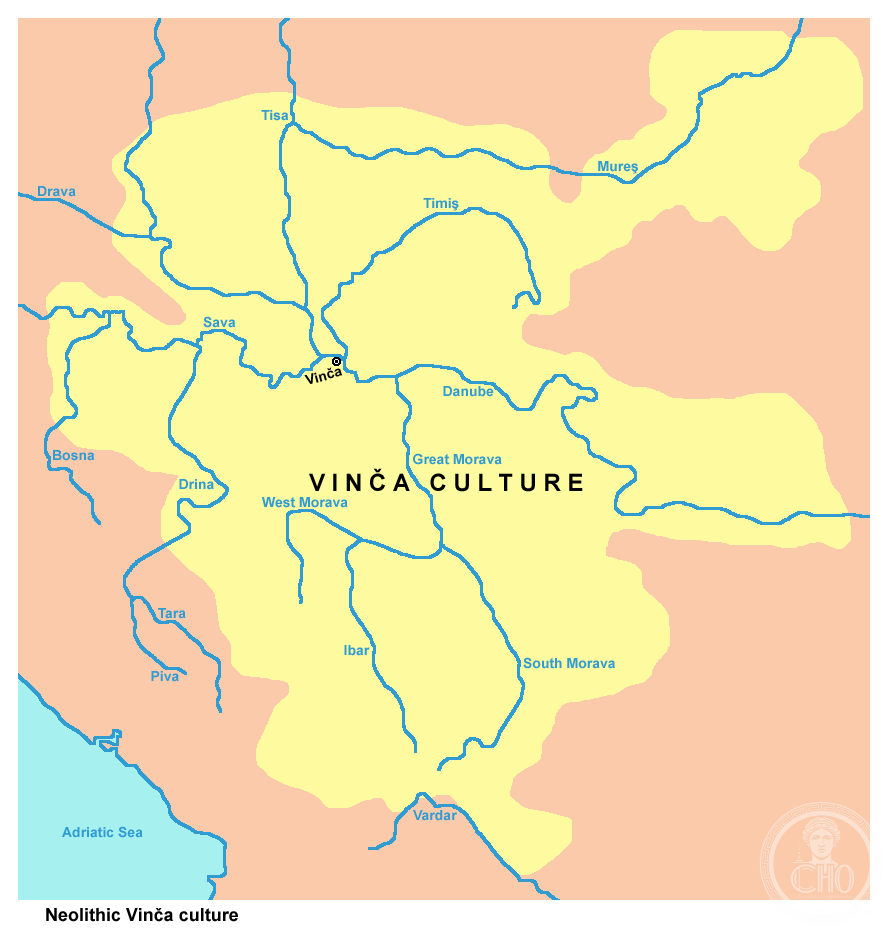
Fourteen kilometres downstream from Belgrade, the tell of Vinca is the type-site of the Vinca culture — one of the most sophisticated prehistoric cultures in Europe — and the source of approximately 700 abstract symbols on clay tablets and pottery that some archaeologists identify as the world’s oldest writing system, predating Sumerian cuneiform by over a millennium.
At a glance
On a low bluff above the right bank of the Danube approximately 14 km downstream from Belgrade, the tell (artificial mound created by successive habitation layers) of Vinca has been excavated since 1908. The Vinca culture — extending across modern Serbia, Bulgaria, Romania, and North Macedonia from c. 5700 to 4500 BCE — represents an extraordinary level of prehistoric sophistication: large planned settlements of up to 2,000 inhabitants, fired clay technology, early copper smelting, long-distance trade networks, and a complex abstract symbol system of approximately 700 signs found on clay tablets, figurines, and pottery. Whether these symbols constitute a proto-writing system predating Sumerian cuneiform by more than a millennium is one of the most contested questions in prehistoric archaeology. The Vinca tell itself — a mound approximately 10 metres high and 9 hectares in area — is partially excavated and visible above the river.
Key facts
- Period: c. 5700–4500 BCE (Late Neolithic / Chalcolithic)
- First excavated: 1908 by Miloje Vasic, University of Belgrade; major excavations continued through the 20th century
- Settlement size: Tell mound approximately 10 m high and 9 ha; Vinca-culture settlements reached up to 2,000 inhabitants
- Symbol system: c. 700 abstract signs on clay tablets, figurines, and pottery from Vinca-culture sites across southeastern Europe
- Controversy: Mainstream archaeology classifies the symbols as proto-writing or symbolic notation; a minority view (Haarmann et al.) identifies them as the oldest true writing
- Finds: National Museum of Serbia, Belgrade; on-site museum at Vinca village
- Location: Right bank of the Danube, 14 km east of central Belgrade
History
Excavations at Vinca began in 1908 under Miloje Vasic, who identified a deep stratigraphic sequence of habitation layers extending through several metres of compacted earth — the accumulated debris of perhaps two thousand years of continuous occupation. Vasic initially connected the site to the Bronze Age; subsequent work in the 1930s and later by the Belgrade University team established the correct chronology: Neolithic and Chalcolithic, broadly contemporary with or slightly later than the early Neolithic sites of Anatolia. The Vinca culture — named after this type-site — extended across a large region of southeastern Europe and is characterised by large, planned settlements, sophisticated ceramic production, early copper working, and distinctive stylised anthropomorphic figurines.
The “Vinca script” or “Old European script” was identified as a distinct category of symbolic production by the archaeologist Marija Gimbutas and later studied systematically by the classicist Shan Winn in his 1981 doctoral dissertation. The approximately 700 signs — geometric, abstract, and combinatory — appear on a wide range of objects from Vinca-culture sites throughout southeastern Europe. The critical question is whether their consistent use in fixed combinations constitutes a true writing system (capable of encoding language) or a more restricted symbolic notation (capable of encoding categories or identities but not full language). Harald Haarmann’s 1990 study argued for the former, dating the system to approximately 5500–5300 BCE — which would make it the oldest writing in the world by a significant margin. The mainstream consensus, represented by Andrew Robinson and others, holds that while the signs are culturally significant, they do not meet the threshold of a full writing system. The controversy remains unresolved and continues to generate scholarly and popular interest.
The Vinca culture declined c. 4500 BCE, possibly due to a combination of climate change, soil exhaustion from intensive agriculture, and the arrival of new populations from the steppes. The tell was eventually abandoned and silted over by river deposits; subsequent occupation in the Roman period and medieval period added further layers. The mound as it appears today — visible from the road above the Danube — represents this entire accumulated history.
What you see
The Vinca tell is located in the village of Vinca, which is now effectively an eastern suburb of Belgrade. A small on-site museum near the top of the mound presents finds from the excavation, including ceramic fragments, figurines, and replicas of the symbol-bearing tablets; the original finds are in the National Museum of Serbia in Belgrade (Trg Republike 1a). The mound itself is partially open to visitors, with a section of the archaeological trench preserved to show the stratigraphy of occupation layers; interpretation panels explain the chronology and the nature of the finds. The Danube is visible from the top of the mound, providing a sense of the site’s original position above the river.
The most important collection of Vinca-culture finds — including the clay tablets bearing the symbolic signs, the extraordinary terracotta figurines, and the copper objects — is displayed in the National Museum of Serbia in Belgrade, a 30-minute drive from the site. The museum provides the essential interpretive context for understanding what the site represents.
Practical information
- Address: Vinca Archaeological Site, village of Vinca, municipality of Grocka, Belgrade, Serbia
- Opening hours: On-site museum: check current hours with the National Museum of Serbia before visiting; the mound itself is accessible
- Entry fee: Small fee for the on-site museum
- On site: On-site museum with finds and replicas; preserved excavation trench; river views from the mound top
- Photography: Permitted
- Accessibility: The mound path is uneven; the on-site museum is accessible at ground level
Getting there
The Vinca tell is located in the village of Vinca, approximately 14 km east of central Belgrade along the right bank of the Danube. By public transport from Belgrade, take bus line 311 (Zeleni Venac to Vinca) or bus 410/411 from Vozdovac; journey time approximately 40–60 minutes. By car, follow Pancevaicki put or the riverside road east from Belgrade; the site is signed from the village. The site is easily combined with a day trip from Belgrade. Parking is available near the on-site museum.
Nearby
- Lepenski Vir (Djerdap gorge): The Mesolithic site with fish-deity sculptures, approximately 2.5 hours south along the Danube — the two sites together trace the arc of prehistoric Danube civilisation
- National Museum of Serbia (Belgrade): The principal repository for Vinca-culture finds, including the symbol-bearing clay tablets
- Belgrade Fortress (Kalemegdan): The medieval and Roman fortress at the confluence of the Sava and Danube, 14 km west, with an archaeological museum
- Grocka municipality villages: The Danube bank east of Belgrade offers quiet riverside restaurants and orchards accessible from the same road
Sources
- Winn, S.M.M. (1981). Pre-Writing in Southeastern Europe: The Sign System of the Vinca Culture. Western Publishers, Calgary.
- Haarmann, H. (1990). Early Civilisation and Literacy in Europe. Mouton de Gruyter.
- Robinson, A. (2009). The Story of Writing. Thames & Hudson (chapter on disputed Vinca script).
- Lazarovici, G. et al. (2011). The Vinca culture: an overview. Documenta Praehistorica 38.
- National Museum of Serbia: narodnimuzej.rs
Find it on the map
See this place and what’s around it →📷 Become a Cultural Heritage Online photographer
Share your photos of places: they stay published under your name as the author. The more they're seen, the more you get noticed — and soon a contest will reward the most appreciated photos.
Log in or sign up free to add a photo