
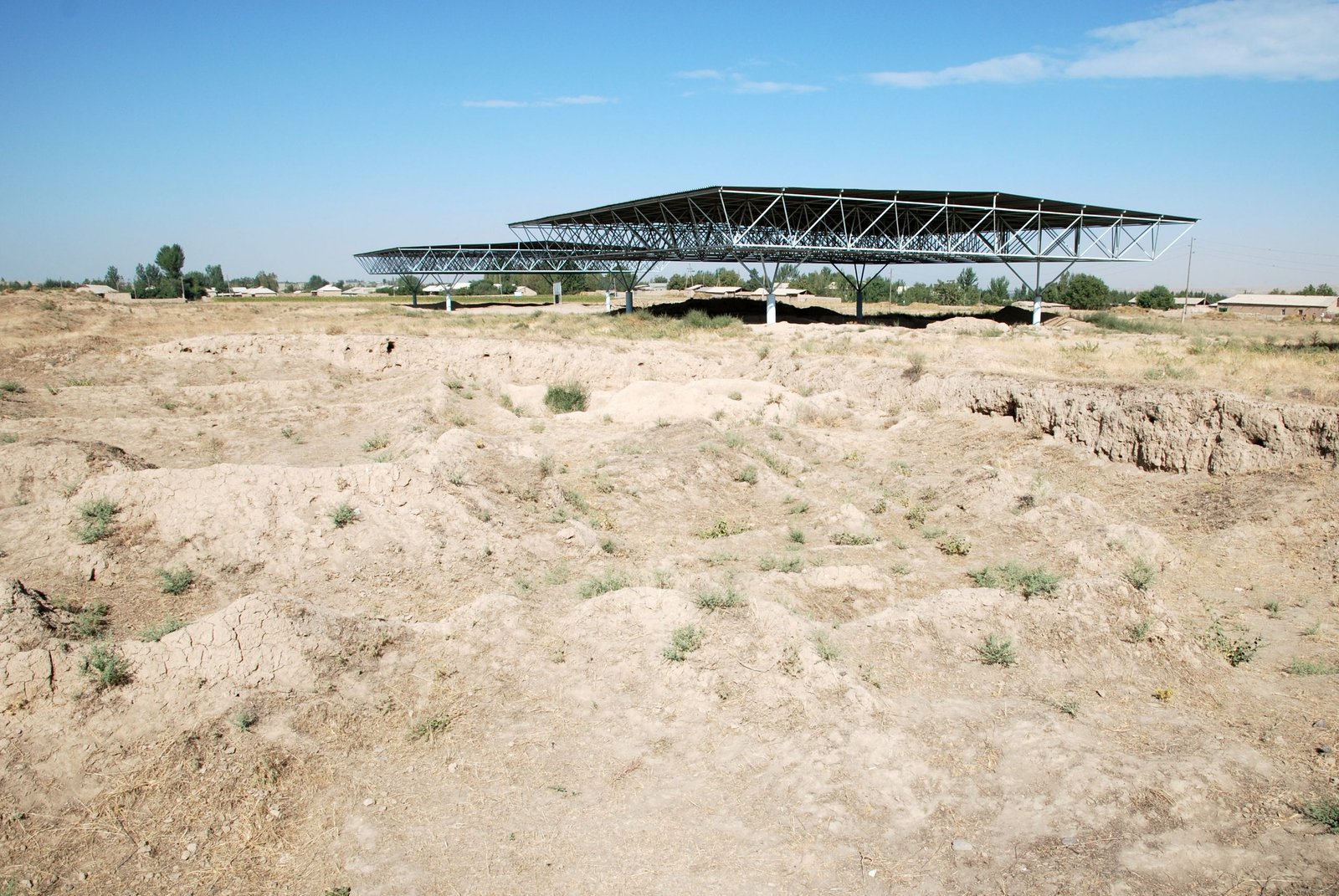
Sarazm is the oldest known large settlement in Central Asia and a UNESCO World Heritage Site: a proto-urban community of farmers, metalworkers, and long-distance traders that flourished in the Zerafshan Valley of northern Tajikistan from approximately 3500 to 2200 BCE, connecting the emerging civilisations of the Near East, the Iranian plateau, and the Indus Valley at the dawn of the Bronze Age.
At a glance
Discovered in 1976 by Tajik archaeologist Abdullojon Isakov and inscribed as a UNESCO World Heritage Site in 2010, Sarazm (meaning “where the land begins” in Tajik) covers approximately 100 hectares of the Zerafshan river valley, around 15 kilometres west of Panjikent. Occupied continuously for over 1,300 years, it provides the earliest archaeological evidence of sedentary agricultural communities and advanced metal-working in Central Asia, and served as a critical node in a transcontinental exchange network that predated the Silk Road by more than 2,000 years. The site’s most celebrated find, the “Princess of Sarazm,” a burial assemblage of extraordinary jewellery, offers a vivid portrait of social complexity and long-distance trade in the early Bronze Age world.
Key facts
- Coordinates: 39.5233° N, 67.6450° E — Zerafshan Valley, Sughd Province, northern Tajikistan
- Occupation: c. 3500–2200 BCE (Chalcolithic to Early Bronze Age), four stratigraphic phases
- UNESCO: World Heritage Site since 2010 (criterion III, IV)
- Discovery: Abdullojon Isakov, 1976; excavations ongoing (Tajik-French joint missions)
- Area: Approximately 100 hectares; excavated area covers several major sectors
- Signature find: “Princess of Sarazm” burial (c. 2200 BCE) — gold, silver, carnelian, and turquoise jewellery
- Trade connections: Lapis lazuli from Badakhshan, copper from Iran, carnelian from the Indus Valley
History
In the Zerafshan (“Gold-bearing”) river valley of northern Tajikistan, approximately 15 kilometres west of the town of Panjikent — itself renowned for its medieval Sogdian palace paintings — the site of Sarazm has yielded, since its discovery in 1976 by the Tajik archaeologist Abdullojon Isakov, evidence of the oldest complex urban settlement in all of Central Asia. The community occupied approximately 100 hectares of the valley floor from roughly 3500 to 2000 BCE, across four main archaeological phases, and is identified by archaeologists as a “meeting point” at which the early Bronze Age cultures of the Near East, the Iranian plateau, the Indus Valley, and the Central Asian steppe exchanged technologies and ideas more than 5,000 years ago — long before the Silk Road is traditionally thought to have begun.
The excavations at Sarazm have revealed large multi-room mudbrick buildings with plastered and painted walls; evidence of copper and lead smelting; and a rich metallurgical tradition producing ornaments and tools in copper, silver, and gold. Lapis lazuli ornaments imported from the mines of Badakhshan (northeastern Afghanistan) and ceramics showing clear parallels with contemporary cultures as distant as Mesopotamia, the Jiroft culture of Iran, and the Indus Valley Civilisation demonstrate that Sarazm was an intermediary node in a continental exchange network. The most spectacular single find is the “Princess of Sarazm,” a female burial of approximately 2200 BCE containing an elaborate assemblage of gold, silver, carnelian, and turquoise jewellery that establishes the high social status of at least some women in the late Chalcolithic world of Central Asia and reveals connections to jewellery traditions extending from Mesopotamia to the Indian subcontinent.
Sarazm was abandoned around 2200 BCE, probably due to a combination of climate change (aridification) and the disruption of the trade networks on which its specialised metalworking economy depended. Its legacy, however, persisted in the cultures that followed: the Bactria-Margiana Archaeological Complex (BMAC), the Iron Age cultures of the steppe, and ultimately the Sogdian merchants who centuries later transformed the Zerafshan Valley into the commercial heartland of Central Asia.
What you see today
The visible remains at Sarazm are those typical of a mudbrick settlement in an arid climate that has escaped later urban overbuilding: low tells and exposed foundation plans of multi-room domestic and communal structures, their mudbrick walls still standing in places to a height of one to two metres. Excavations in several sectors have revealed large residential compounds with internal courtyards, storage areas, hearths, and evidence of metalworking activity — slag heaps, copper droplets, crucible fragments — immediately adjacent to living spaces, indicating a community in which craft production was embedded in domestic life rather than segregated into workshop districts. Painted wall plaster in ochre and black geometric designs preserves fragments of a decorative tradition that connects Sarazm to the painted-pottery cultures of the Iranian plateau.
The on-site museum (small, but well-curated) displays the most important portable finds, including a reconstruction of the “Princess of Sarazm” burial assemblage: the gold diadem, silver and carnelian necklaces, and turquoise pendants that made this burial one of the richest ever found in prehistoric Central Asia. The original jewellery is held in the National Museum of Antiquities of Tajikistan in Dushanbe. The overall landscape — the green valley floor, the loess terraces, the distant mountains — gives a vivid sense of why this particular location, at the point where the river valley widens and irrigated agriculture becomes possible at scale, was chosen for the first large settlement in Central Asia.
Practical information
- Open: Site is accessible during daylight hours; museum hours vary (confirm locally)
- Entry: Small admission fee for foreigners; museum ticket usually included
- Guided tours: Available through travel agencies in Panjikent or Dushanbe; recommended, as on-site interpretation signage is limited
- Photography: Permitted on the open site; check museum rules for interior photography
- Best time to visit: April–June and September–October; summer temperatures in the valley exceed 35°C and the site has no shade
- Facilities: Minimal on-site; bring water, sun protection, and sturdy footwear for uneven terrain
Getting there
Sarazm lies approximately 15 kilometres west of Panjikent on the road towards Samarkand (Uzbekistan). From Panjikent, shared taxis and local marshrutka (minibus) services run regularly; the journey takes 20–30 minutes. Panjikent is connected by road to Dushanbe (approximately 4–5 hours by shared taxi or bus through the Anzob Pass, or via Uzbekistan which is faster but requires a visa). The nearest airport for international arrivals is Samarkand (Uzbekistan), roughly 70 kilometres west; Dushanbe International Airport is the alternative for those flying into Tajikistan directly. Note: crossing the Tajikistan-Uzbekistan border at the Panjikent/Samarkand crossing is generally smooth for tourist visas but confirm current status before travel.
Nearby
- Panjikent (Sogdian ruins): 15 km east — ruins of a 5th–8th century CE Sogdian city with celebrated palace frescoes, now partly displayed in the Hermitage (St. Petersburg) and the National Museum (Dushanbe)
- Rudaki Museum, Panjikent: Dedicated to the 9th-century Persian poet Abu Abdallah Rudaki, born near Panjikent; important for understanding the region’s later literary legacy
- Samarkand (Uzbekistan): Approximately 70 km west — the Silk Road city of Timur (Tamerlane), with the Registan, Gur-e-Amir, and the Shah-i-Zinda necropolis; a natural pairing with a visit to Sarazm for the full arc from prehistory to the Islamic Golden Age
- Iskanderkul Lake: High-altitude glacier lake in the Fan Mountains south of Panjikent; a natural detour for those travelling the Zerafshan Valley
Sources
- UNESCO World Heritage List, “Sarazm,” Reference 1141, inscribed 2010 — whc.unesco.org
- Isakov, A. I., Sarazm: K voprosu stanovleniya rannezemledelcheskikh kultur Zerafshanskoy doliny [Sarazm: On the Question of the Formation of Early Agricultural Cultures of the Zerafshan Valley], Dushanbe, 1991
- Lyonnet, B., “Sarazm (Tajikistan): ceramics (Chalcolithic and Bronze Age),” Iranica Antiqua, Vol. XXXIX, 2004
- Wikipedia, “Sarazm” — en.wikipedia.org/wiki/Sarazm
- National Museum of Antiquities of Tajikistan, Dushanbe — permanent collection, “Princess of Sarazm” jewellery assemblage
Find it on the map
See this place and what’s around it →📷 Become a Cultural Heritage Online photographer
Share your photos of places: they stay published under your name as the author. The more they're seen, the more you get noticed — and soon a contest will reward the most appreciated photos.
Log in or sign up free to add a photo