

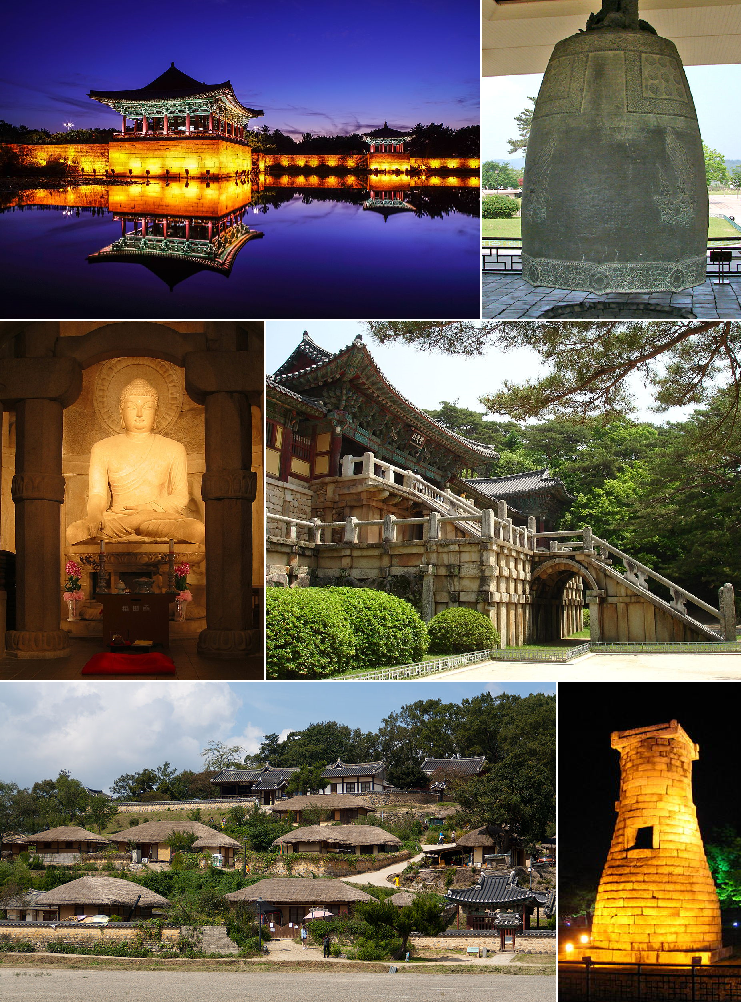
For nearly a millennium the capital of the Silla Kingdom, Gyeongju is one of Asia’s great open-air archaeological cities — its streets, parks, and surrounding hills densely layered with royal burial mounds, Buddhist temples, stone pagodas, and cliff-carved Buddhas that earned it the sobriquet “the museum without walls.”
At a glance
Gyeongju served as the royal capital of the Silla Kingdom for almost 1,000 years (57 BCE – 935 CE). UNESCO inscribed the Gyeongju Historic Areas as a World Heritage Site in 2000, recognising five distinct monument clusters: the Namsan Belt (outdoor Buddhist sculpture and temple sites), the Wolseong Belt (the palace complex and Cheomseongdae observatory), the Tumuli Park Belt (royal burial mounds including Daereungwon), the Hwangnyongsa Belt (site of a once-gigantic 9-storey wooden pagoda destroyed by the Mongols in 1238), and the Sanseong Belt (defensive mountain fortresses). Together they document the full arc of Silla civilisation and its synthesis of indigenous shamanic culture with Buddhism imported from China and Central Asia.
Key facts
- Location: Gyeongju city, North Gyeongsang Province, South Korea — approximately 380 km south-east of Seoul
- UNESCO inscription: 2000 (World Heritage Site, five monument clusters)
- Period: Silla Kingdom 57 BCE – 935 CE; prehistoric remains predate the kingdom
- Burial mounds: over 150 royal and aristocratic tumuli within city limits; Daereungwon park contains 23 large mounds up to 23 metres high
- Cheomseongdae Observatory: built c. 632–647 CE under Queen Seondeok; one of the oldest surviving astronomical observatories in East Asia, 9.4 metres tall, 362 granite stones in 27 courses
- Hwangnyongsa Temple: founded 553 CE; 9-storey wooden pagoda (c. 645 CE) reportedly 80 metres tall before Mongol destruction in 1238
- Gyeongju National Museum: original Silla gold crowns and the Emille Bell (771 CE, the largest surviving Korean bell)
- Peak population: estimated 1 million inhabitants in the 8th century, one of the largest cities in East Asia at the time
History
According to the Samguk Sagi (Chronicle of the Three Kingdoms), the Silla Kingdom was founded in 57 BCE by Bak Hyeokgeose in the Gyeongju basin, then known as Saro or Geumseong. The early Silla state was one of three competing kingdoms on the Korean peninsula (alongside Goguryeo in the north and Baekje in the south-west) and for several centuries the weakest of the three. The royal tombs of the early Silla period (c. 3rd–6th centuries CE) — massive earthen mounds covering wooden burial chambers filled with gold crowns, jade ornaments, glass vessels from Central Asia, and iron weapons — reveal a society shaped by shamanistic kingship and far-reaching trade connections across the Silk Roads.
Buddhism arrived in Silla in 527 CE, later than in the other kingdoms, but was adopted with remarkable intensity: the court patronised some 500 temples in and around the capital within two centuries. The Hwarang warrior-scholar corps became the institutional basis of Silla military expansion. In 668 CE, Silla allied with Tang dynasty China to defeat both Goguryeo and Baekje, unifying the Korean peninsula under the Unified Silla Kingdom (668–935 CE). The capital Gyeongju grew into one of the largest cities in East Asia, with a population estimated at around 1 million at its 8th-century height — comparable to Tang Chang’an, Byzantine Constantinople, and Abbasid Baghdad.
The golden age of Unified Silla produced Bulguksa Temple and Seokguram Grotto under King Gyeongdeok (r. 742–765 CE) and the major Korean historical chronicles. The kingdom declined in the 9th century through aristocratic factional struggles and peasant revolts. In 935 CE King Gyeongsun surrendered Silla peacefully to Wang Geon, founder of the Goryeo dynasty, ending 992 years of Silla rule and beginning Gyeongju’s gradual transformation from active capital to cultural heritage landscape.
What you see
Gyeongju’s heritage is distributed across roughly 13 square kilometres of the modern city and its surrounding mountains. Tumuli Park (Daereungwon): twenty-three grassy burial mounds; the excavated Cheonmachong (“Heavenly Horse Tomb”) is open for entry, displaying reproductions of the gold crown and the famous “Flying Horse” painted birch-bark saddle flap — one of the few surviving examples of Silla painting. Cheomseongdae: a 9.4-metre bottle-shaped granite tower; its precise original function — astronomical observation, symbolic monument, or sundial — remains debated. Anapji Pond (Donggung Palace): an artificial ornamental lake built 674 CE as part of a detached palace complex, excavated in the 1970s and yielding 33,000 artifacts including roof tiles, Buddhist figurines, and a wooden boat. Namsan: a twin-peaked mountain ridge (494 metres) covered with over 150 Buddhist monuments carved into granite boulders and cliff faces across seven centuries; the density of religious imagery is unequalled in Korea. Seokguram and Bulguksa (20 minutes from the city centre): Seokguram’s central granite Buddha faces east toward the sea, executed with geometric precision using a harmonic system of proportions; Bulguksa’s paired stone staircases ascending to the main gate are among the most photographed architectural compositions in Korea.
Practical information
- Opening hours: Sites vary; Tumuli Park and Cheomseongdae open daily 09:00–22:00; Bulguksa 07:00–18:00 (summer); Seokguram 06:30–18:00
- Admission: Most sites &won;3,000–6,000; combined passes available; some outdoor sites free
- Gyeongju National Museum: free admission; original gold crowns and Emille Bell; essential companion to the outdoor sites
- Best season: Spring (April–May, cherry blossoms on burial mounds) and autumn (October–November); major Gyeongju Cultural Festival in October
- Time needed: Minimum 2 full days for the main UNESCO clusters; 3–4 days including Namsan hiking trails
- Language: English signage at major sites; audio guides in English, Japanese, Chinese
Getting there
Gyeongju is served by KTX high-speed rail from Seoul (Gyeongju station, approximately 2 hours 10 minutes) and from Busan (25 minutes). The city also has a Singyeongju KTX station on the Gyeongbu High Speed Line (10 minutes from the city centre by bus). From Seoul by express bus, the journey takes approximately 3.5 hours. Renting a bicycle within the city is practical and atmospheric; local buses connect the major monument clusters. Gyeongju combines well with a visit to Busan (approximately 1 hour by KTX).
Nearby
- Bulguksa Temple — Korea’s finest Buddhist temple complex, on the slopes of Mount Toham (UNESCO 1995)
- Seokguram Grotto — granite-domed cave shrine with a 3.5-metre seated Buddha of extraordinary geometric precision (UNESCO 1995)
- Gochang, Hwasun and Ganghwa Dolmen Sites — UNESCO-inscribed prehistoric megalithic burial monuments in south-western Korea
Sources
- UNESCO World Heritage List, “Gyeongju Historic Areas,” whc.unesco.org, inscription 2000
- National Museum of Korea, Gyeongju Branch, permanent collection documentation
- Pratt, Keith, and Richard Rutt. Korea: A Historical and Cultural Dictionary. Routledge, 1999
- Wikipedia, “Gyeongju,” “Silla,” “Bulguksa Temple,” en.wikipedia.org (consulted 2026)
Find it on the map
See this place and what’s around it →📷 Become a Cultural Heritage Online photographer
Share your photos of places: they stay published under your name as the author. The more they're seen, the more you get noticed — and soon a contest will reward the most appreciated photos.
Log in or sign up free to add a photo