
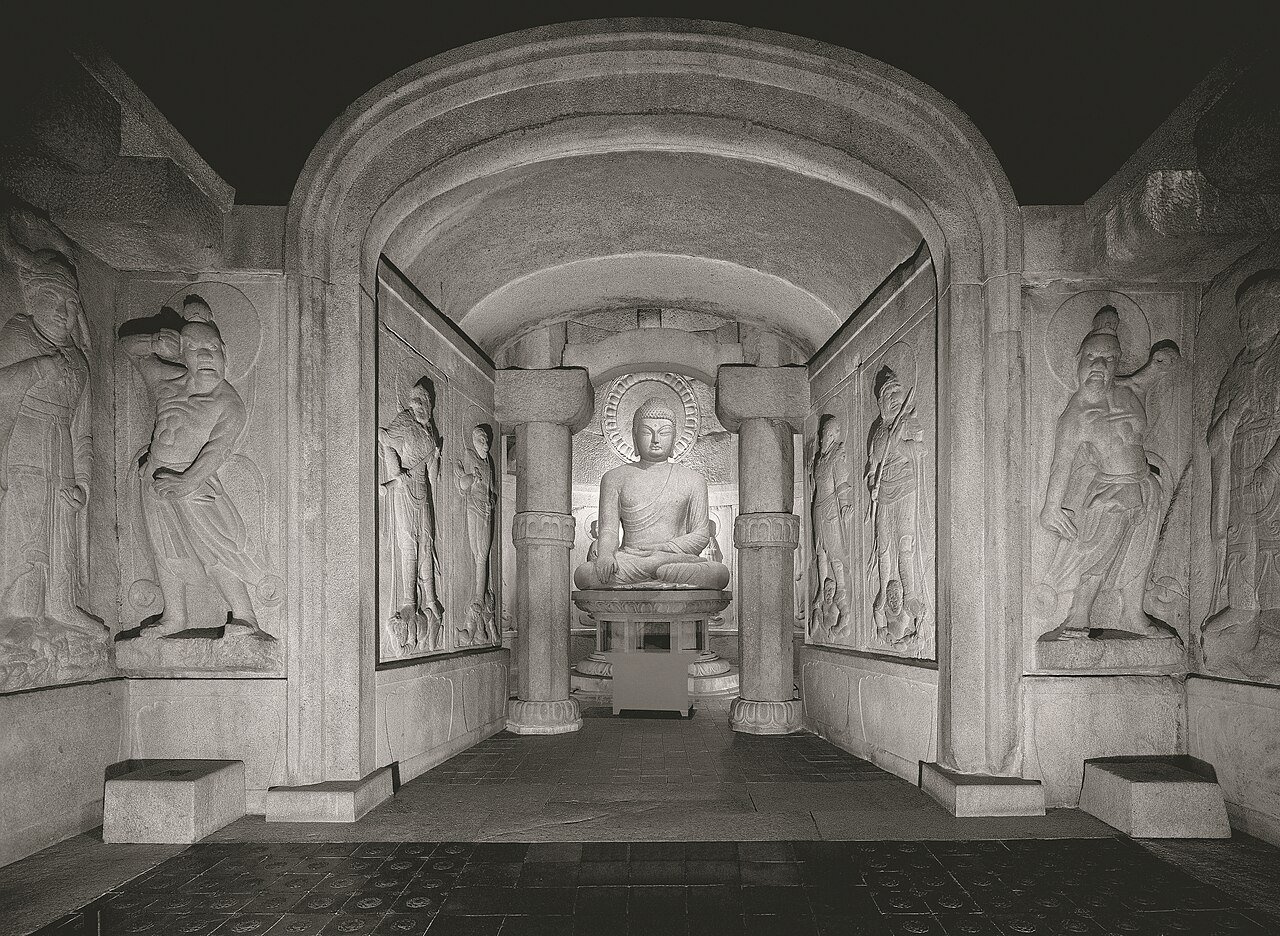
On the summit of Mount Toham east of ancient Gyeongju, the Seokguram Grotto houses the finest granite Buddha image in East Asia: a masterpiece of Unified Silla mathematics and faith, built in 751 AD to face the sunrise over the sea from the perfect geometry of an artificial cave.
At a glance
Seokguram is an artificial cave temple built between 751 and 774 AD on the eastern slope of Mount Toham in North Gyeongsang Province, South Korea. Commissioned by Prime Minister Kim Daeseong and constructed by craftsmen of the Unified Silla Kingdom, it houses a single monumental seated Buddha in white granite approximately 3.5 metres tall, whose proportions were calculated with geometric precision derived from the diameter of the domed rotunda. The cave and the adjacent Bulguksa temple were jointly inscribed as UNESCO World Heritage Sites in 1995.
The Seokguram Buddha is widely considered the supreme achievement of Korean Buddhist art, and among the finest stone Buddha images anywhere in East Asia. The cave orientation is aligned east, toward the sea, positioned so the rising sun on the vernal equinox illuminates the Buddha face directly, fusing Buddhist iconography with Silla royal ideology: the Buddha protecting the kingdom from the eastern sea.
Key facts
- Period: 751–774 AD (Unified Silla Kingdom)
- Location: Mount Toham, Gyeongju, North Gyeongsang Province, South Korea
- UNESCO inscription: 1995 (as part of Gyeongju Historic Areas)
- Main Buddha height: Approximately 3.5 m, carved from a single block of white granite
- Rotunda diameter: 6 m (the module for all proportional calculations)
- Elevation: 750 m above sea level, on the summit ridge of Mount Toham
- Rediscovery: 1909, by a postman who accidentally found the sealed cave
History
Kim Daeseong, Prime Minister of the Unified Silla Kingdom, began construction of both Seokguram and Bulguksa in 751 AD, reportedly as acts of Buddhist merit for his parents in his current and previous lives. The cave was completed by the state after his death in 774 AD. The Silla Kingdom extraordinary investment in Buddhist art reflected a state-sponsored religious programme in which the Buddha protection was formally invoked for the kingdom defence: Seokguram, facing the East Sea from a mountain summit, was in this sense a spiritual fortress guarding the coast.
The cave was sealed during the long Joseon Dynasty (1392–1897), which suppressed Buddhism and redirected state patronage toward Confucian institutions. Stripped of its monastic community and with its forest path overgrown, Seokguram was effectively forgotten. In 1909, a postman carrying mail along the ridge accidentally uncovered the entrance. Japanese colonial authorities attempted restoration beginning in 1913, dismantling and reassembling parts of the structure and applying cement mortar to seal perceived cracks. The cement, by trapping moisture and preventing the granite natural breathing, worsened condensation inside the cave. A major restoration in 1961–64 sealed the grotto and installed mechanical climate control; managing the cave microclimate remains an ongoing conservation challenge.
UNESCO inscription in 1995 recognised Seokguram as a masterpiece of human creative genius, noting the mathematical sophistication of the stone dome construction and the exceptional quality of the Buddhist sculpture as together forming one of the supreme monuments of East Asian heritage.
What you see
The approach is itself an experience: a 3-kilometre forest path climbing through pine and cedar from Bulguksa temple, or a shorter walk from the Seokguram car park. The cave complex consists of a rectangular antechamber connected by a short corbelled passage to the main domed rotunda. The antechamber walls bear relief carvings of the Eight Guardians and two pairs of fierce guardian kings (dvarapalas) flanking the entrance. Inside the passage are Brahma and Indra in high relief. The domed rotunda houses the main Buddha, seated in dhyana mudra on a lotus throne, with ten standing bodhisattvas and disciples carved around the rotunda wall behind him, each individualised in posture and expression.
Visitors today view the main Buddha through a glass partition installed during conservation work. The grotto is visible from the antechamber, with excellent sightlines to the main figure, the relief carvings, and the domed ceiling. The surrounding mountain environment, including the eastward view over Gyeongju toward the sea and the ancient stone-paved approach paths, is as important to the experience as the cave itself.
Practical information
- Address: Gyeongju, Bulguksa-ro, Gyeongju-si, Gyeongsangbuk-do, South Korea
- Opening hours: Daily, 06:30–18:00 (summer); 07:00–17:30 (winter)
- Admission: Combined Bulguksa and Seokguram ticket approximately 6,000 KRW
- Photography: Permitted outside; flash prohibited inside the grotto area
- Recommended visit time: Half day combined with Bulguksa temple (3 km away)
Getting there
Gyeongju is served by KTX from Seoul (approximately 2 hours) and Busan (approximately 35 minutes). From Gyeongju station, Bus 12 runs to Bulguksa (approximately 35 minutes) and continues to the Seokguram car park. Taxis from Gyeongju city centre take approximately 25 minutes. From Bulguksa, a forest path of 3 km leads up to the grotto.
Nearby
- Bulguksa Temple — 3 km west; 8th-century Silla Buddhist temple complex, UNESCO co-inscribed with Seokguram; features the Dabotap and Seokgatap stone pagodas
- Gyeongju National Museum — 15 km west; definitive collection of Silla gold crowns, bronze bells, and royal tomb goods
- Tumuli Park (Daereungwon) — 15 km west; royal burial mounds of the Silla Kingdom rising from the city centre of Gyeongju
- Anapji Pond (Donggung Palace) — 16 km west; restored ornamental garden of the Silla royal palace, particularly evocative when lit at night
Sources
Find it on the map
See this place and what’s around it →📷 Become a Cultural Heritage Online photographer
Share your photos of places: they stay published under your name as the author. The more they're seen, the more you get noticed — and soon a contest will reward the most appreciated photos.
Log in or sign up free to add a photoIs this page about you?
This page is read by travellers and heritage enthusiasts who find it on Google. Tell us how you are connected to this place and we will take it from there.