
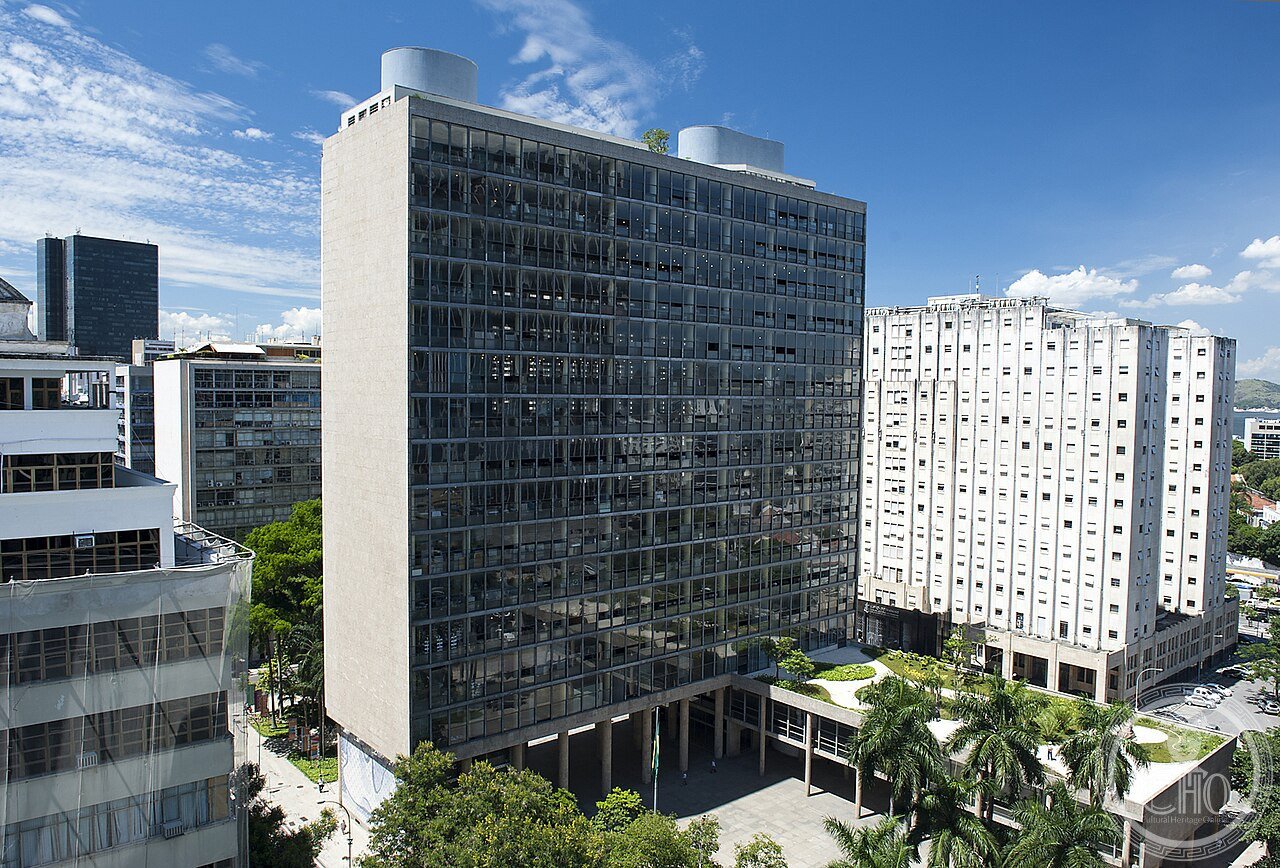
The Gustavo Capanema Palace — built between 1937 and 1945 as Brazil’s Ministry of Education and Health — is the founding monument of Latin American Modernism and one of the most consequential buildings of the twentieth century. Commissioned by the Getúlio Vargas government and developed by a Brazilian team led by Lúcio Costa and Oscar Niemeyer with Le Corbusier serving as design consultant, the sixteen-storey tower in central Rio de Janeiro translated the five points of Modern Architecture into tropical reality. Pilotis lift the building three storeys above street level, opening the ground plane to public passage. Adjustable brises-soleil — movable aluminium louvres described as the first of their kind in the world — filter the fierce carioca sun across broad glass façades. The landscaped grounds were designed by Roberto Burle Marx, introducing native Brazilian plants to public garden design. Inside, monumental azulejo tile murals by Cândido Portinari fuse Modernist abstraction with Brazilian cultural imagery. Now housing the Ministry of Culture and listed as a UNESCO World Heritage candidate, the palace remains the physical proof that Modernism could be both universal and unmistakably of its place.
At a glance
- Type
- Government office building
- Period
- 1937–1945
- Style
- Brazilian Modernism
- Location
- Rua da Imprensa 16, Centro, Rio de Janeiro, Brazil
- Coordinates
- 22.9092° S, 43.1738° W
- Architect(s)
- Lúcio Costa, Oscar Niemeyer, Affonso Eduardo Reidy, Jorge Machado Moreira, Carlos Leão, Ernâni Vasconcelos; Le Corbusier (consultant)
Overview
Commissioned as the headquarters of Brazil’s newly created Ministry of Education and Health, the building was conceived as an instrument of national cultural policy under Getúlio Vargas. The team assembled by Lúcio Costa — all young Brazilian architects, several trained in Europe — produced a design that went through multiple iterations with Le Corbusier during his 1936 visit to Rio. The result stood the Five Points of Modern Architecture in a tropical context, demonstrating that Corbusian principles could generate a genuinely Brazilian architecture rather than a mere copy of European originals.
History
Construction began in 1937 on a cleared city block in central Rio de Janeiro. Le Corbusier had visited Brazil in 1936 as a consultant and produced influential sketches, but the final design is firmly the work of the Brazilian team. The building was completed in 1945 and named the Palácio Gustavo Capanema after the minister who commissioned it. It was added to Brazil’s tentative UNESCO World Heritage list in 1996. In recent decades it has functioned as the headquarters of the Ministry of Culture, and it continues to host public exhibitions and cultural events in its ground-floor public spaces.
Architecture & Design
The tower rises sixteen storeys on a rectangular footprint, its broad north façade sheathed entirely in glass and protected by adjustable horizontal aluminium brises-soleil — a climate-responsive innovation that would influence architecture worldwide. The south façade, by contrast, is rendered in granite mosaic. On the ground level, pilotis raise the building clear of the street, creating a shaded public loggia. Roberto Burle Marx’s tropical garden, planted with species indigenous to Brazil, wraps the base of the building. Cândido Portinari’s vast azulejo murals — covering more than 1,000 square metres inside and out — depict Brazilian nature and labour in a style that bridges Modernist abstraction and social realism.
Cultural significance
The palace is universally recognised as the birth certificate of Brazilian Modernism and the first major public Modernist building in the Americas. It launched the careers of Oscar Niemeyer and Affonso Eduardo Reidy, and established the creative partnership between architecture, landscape, and the visual arts that would define Brazilian cultural production for a generation. The building’s influence is traceable in the design of Brasília and in Modernist public architecture across Latin America, Asia, and Africa.
Visiting today
The Gustavo Capanema Palace is open to the public on weekdays, with free entry to the ground-floor public spaces and gardens. Guided tours of the interior — including Portinari’s murals and the pilotis level — are available on selected days. The building is located in the Centro neighbourhood, close to the Cinelândia metro station and the Theatro Municipal do Rio de Janeiro.
Getting there
The palace is a five-minute walk from Cinelândia station on Metro Line 1 (orange line). Multiple bus lines stop on Rua da Imprensa and the adjacent Avenida Graça Aranha. By car, paid parking is available in the Cinelândia area. From Santos Dumont Airport the journey takes approximately 15 minutes by taxi or rideshare.
Sources & resources
Find it on the map
See this place and what’s around it →Record researched and written by Luigi De Marchi for Cultural Heritage Online, 2026.
📷 Become a Cultural Heritage Online photographer
Share your photos of places: they stay published under your name as the author. The more they're seen, the more you get noticed — and soon a contest will reward the most appreciated photos.
Log in or sign up free to add a photoIs this page about you?
This page is read by travellers and heritage enthusiasts who find it on Google. Tell us how you are connected to this place and we will take it from there.