

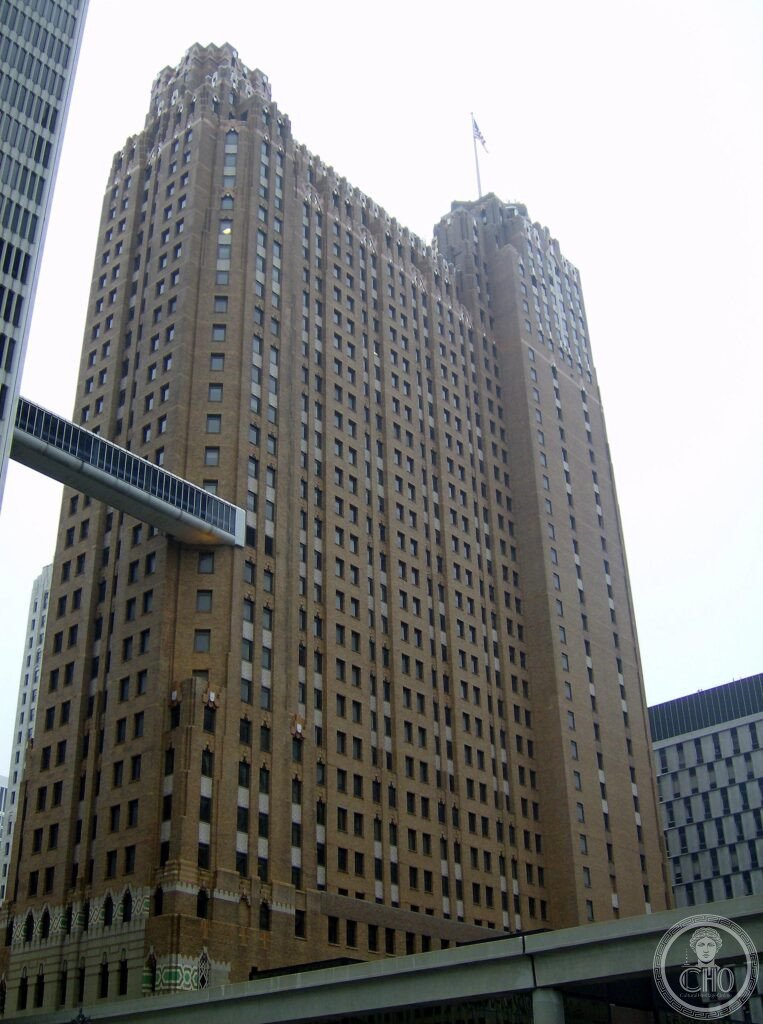
When Union Trust Company opened its new headquarters on Griswold Street in 1929, Detroit had its cathedral: forty storeys of copper-brick and Pewabic Pottery tile rising from the financial district floor, the interior a blaze of Aztec-inflected mosaic designed by one of the most inventive architects of the American Art Déco moment.
At a glance
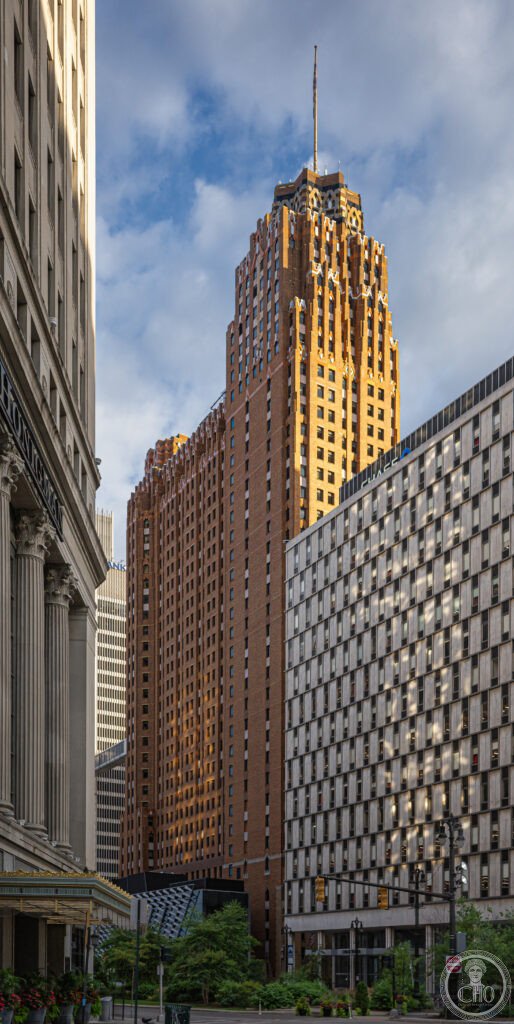
The Guardian Building stands at 500 Griswold Street in downtown Detroit, at the heart of the block the city’s financiers built in the decade before the Great Depression changed everything. Designed by Wirt C. Rowland of the firm Smith, Hinchman & Grylls and completed in 1929 for the Union Trust Company, it rises 40 storeys (496 feet) in a style that borrows the massing principles of the American commercial skyscraper and recoats them entirely in a material vocabulary unlike any other building in the United States. The warm, copper-toned exterior brick — laid in a polychrome pattern with Teco terracotta detail — gives the tower a colour at sunset that has no parallel on the Detroit skyline. The lobby, with its Pewabic Pottery tile vaulting and Aztec-derived mosaics, is one of the great interior spaces of 1920s America. Designated a National Historic Landmark in 1989, it operates today as commercial office space with ground-floor retail and guided public tours.
Key facts
- Architect: Wirt C. Rowland (1878–1946) of Smith, Hinchman & Grylls
- Client: Union Trust Company (later Union Guardian Trust)
- Completed: 1929
- Height: 40 storeys, 496 ft (151 m)
- Style: Art Déco (Aztec-inflected polychrome)
- Materials: copper-tone brick, Teco terracotta, Pewabic Pottery tile
- Address: 500 Griswold Street, Detroit, MI 48226
- GPS: 42.3297, −83.0458 — Google Maps
- Designation: National Historic Landmark (1989); Michigan State Historic Preservation
- Use: Commercial offices, ground-floor retail, public tours
History
Detroit in the 1920s was riding the automotive boom to a prosperity that expressed itself architecturally in a cluster of downtown skyscrapers concentrated on Griswold Street and its immediate neighbours. The motor city’s banks and insurance companies were flush with capital derived from the Ford, General Motors, and Chrysler supply chains, and they commissioned buildings that would announce that prosperity to anyone arriving in the city. Wirt C. Rowland, who had trained in an era of Beaux-Arts rationalism and now found himself working through the possibilities of the Art Déco moment, saw the Union Trust commission as a chance to build something genuinely new.
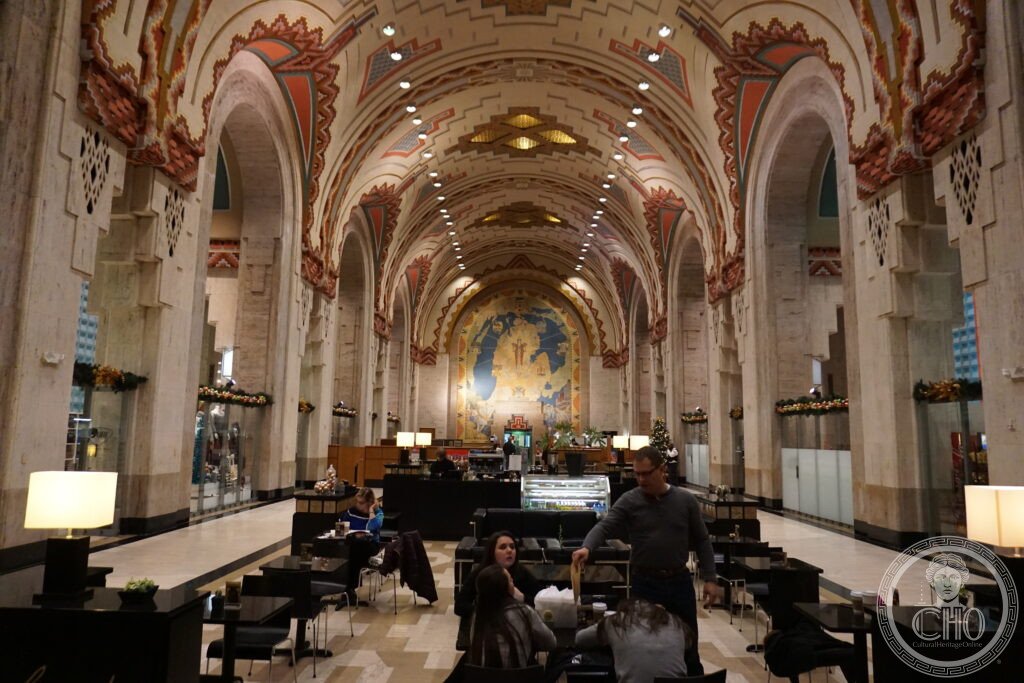
Rowland’s decision to use Pewabic Pottery — a Detroit studio founded in 1903 by Mary Chase Perry Stratton, known for its iridescent glazed tiles — was not merely a gesture toward local craft. It was a deliberate programme: the entire lobby vault is surfaced in Pewabic tile, and the chromatic range of the exterior brick was selected to harmonise with it. The interior mosaics, designed with reference to Aztec ornament then newly visible to American architects through archaeological publications and the 1922 touring exhibition of Mexican art, create a decorative programme of extraordinary density without ever becoming merely encyclopaedic. The result is a building whose interior temperature — literally warm, from the amber and orange of the tile — is unlike anything else on the American skyscraper interior.
The Union Trust Company survived the Depression in altered form, but the building’s financial history was less important to subsequent generations than its architectural significance. Designated a Michigan State Historic Site in 1973 and a National Historic Landmark in 1989, it passed through several owners before its current configuration as a commercial office address with active public programming. Tours of the lobby and the upper floors operate regularly and are the primary way visitors engage with the building’s interiors.
What you see
From Griswold Street, the Guardian Building presents a vertical shaft of warm brick that steps back as it rises, following the Art Déco setback logic mandated by the 1916 New York zoning ordinance that had reshaped skyscraper form across the country. The polychrome brickwork — coursed in alternating bands of orange-buff and copper-brown — catches the afternoon light in a way that flat limestone or terracotta cladding cannot, and gives the building a presence that changes through the day. The entrance arch is framed in Teco terracotta in a geometric-floral Déco vocabulary, and the transition from the street level to the interior is one of the most studied moments in the building.
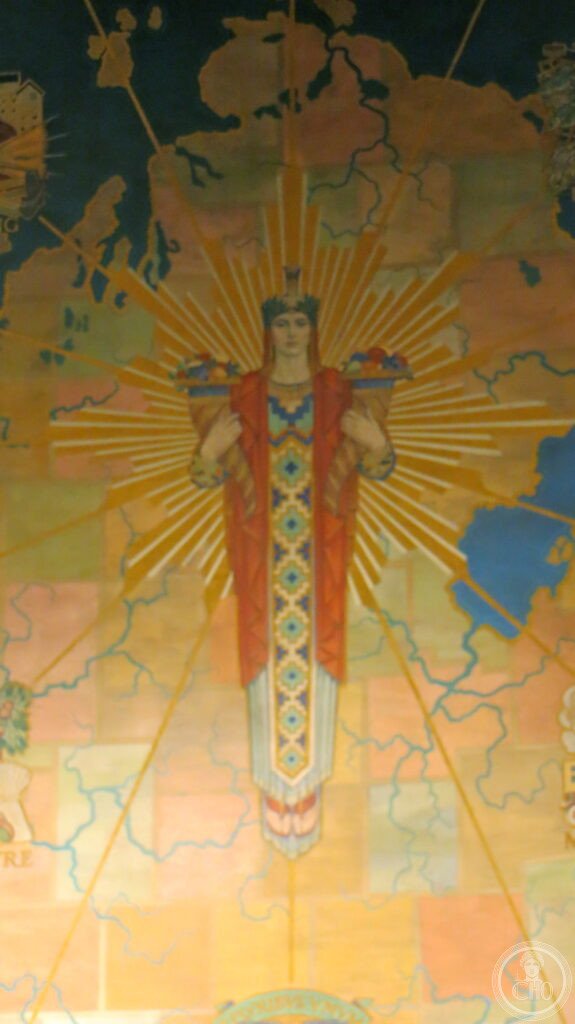
The lobby is the climax. The vault overhead surfaces every square inch in Pewabic Pottery tile — amber, rust, and gold — in a continuous canopy that arches over the banking floor below. The mosaics on the walls and pilasters draw from Aztec and Mayan ornamental sources without copying them directly: stepped geometric forms, stylised feathers, and angular zoomorphic detail create a visual field that is unmistakably American in its sources while being entirely original in its synthesis. The scale is immense; the warmth of the material is domestic.
Practical information
- The lobby is accessible during standard business hours; a visitor centre operates on the ground floor.
- Guided tours of the interior, including access to upper-floor observation areas, are offered regularly — check the building management website for current schedules.
- Photography of the lobby interior is generally permitted without flash.
- The building is fully occupied as commercial office space; upper floors require tour access.
- Nearest parking: Campus Martius Park garage, two blocks north.
Getting there
The Guardian Building is at 500 Griswold Street in the Detroit Financial District, one block south of Campus Martius Park. The Detroit People Mover (monorail) stops at the Financial District station, half a block east. Detroit Metropolitan Wayne County Airport (DTW) is 26 miles southwest; the FAST bus connects to downtown in approximately 50 minutes, and taxi or rideshare takes 30–45 minutes depending on traffic.
Nearby
- Penobscot Building — 1 block north on Griswold, 1928 Art Déco tower with the famous red sphere
- Campus Martius Park — 2 blocks north, Detroit’s central public square with the Michigan Soldiers’ and Sailors’ Monument (1872)
- Detroit Riverwalk — 4 blocks south, the refurbished waterfront promenade along the Detroit River
- Detroit Institute of Arts — 2.5 miles north, home of Diego Rivera’s 1933 Detroit Industry murals
Photo gallery
Sources
- Historic Detroit (historicdetroit.org): Guardian Building — Wirt C. Rowland / Smith Hinchman & Grylls; Union Trust Company commission; 1929; Pewabic Pottery tile programme; Aztec-derived mosaics; National Historic Landmark 1989
- SAH Archipedia (sah-archipedia.org): Guardian Building entry — polychrome brick, Teco terracotta, setback massing; significance within Detroit’s 1920s commercial district
- National Register of Historic Places (NRHP): Guardian Building (NHL) — designation 1989; architectural description; significance criteria A and C
- Pewabic Pottery (pewabic.org): institutional history — Mary Chase Perry Stratton founding 1903; Guardian Building commission
Find it on the map
See this place and what’s around it →📷 Become a Cultural Heritage Online photographer
Share your photos of places: they stay published under your name as the author. The more they're seen, the more you get noticed — and soon a contest will reward the most appreciated photos.
Log in or sign up free to add a photoIs this page about you?
This page is read by travellers and heritage enthusiasts who find it on Google. Tell us how you are connected to this place and we will take it from there.