
The Desert That Sings
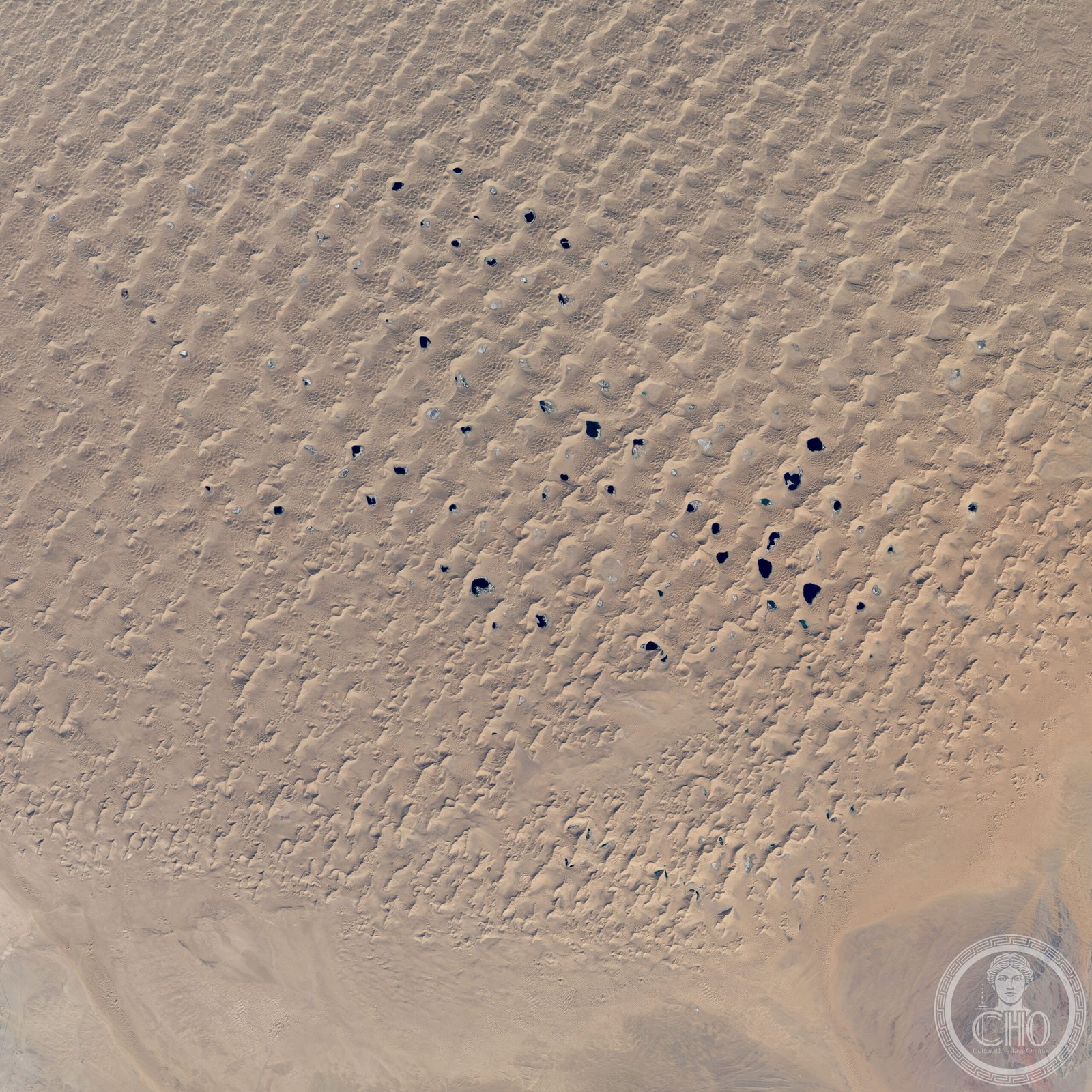
In the Alxa region of Inner Mongolia, the Badain Jaran Desert rises in dunes of surreal height, their crests curving against the sky at over 500 metres — the tallest stationary sand dunes on Earth. Between them, more than 140 lakes shimmer in the desert basin: some blue, some green, some rust-red with algae, each fed by groundwater whose origin geologists are still debating. On certain days, the dunes emit a deep, resonant hum — the “singing sands” — a phenomenon caused by avalanching sand grains that can be heard kilometres away.
Geology of a Giant Dunefield
Badain Jaran’s megadunes are shaped by the interplay of prevailing northwesterly winds and the basin topography of the Alashan plateau. Unlike migrating dunes, these are anchored — stabilised by subsurface moisture and the cohesion of coarser sand layers — which has allowed them to grow to their extraordinary height over thousands of years. The desert covers approximately 49,000 square kilometres, making it China’s third largest.
The Mystery of the Lakes
The interdune lakes of Badain Jaran range from shallow seasonal pans to permanent deep-water bodies with remarkably high salinity and temperature. Their water source is one of the most debated questions in Chinese hydrogeology: theories range from deep artesian aquifers fed by Qilian Mountain snowmelt to ancient connate water trapped beneath the desert since the Pleistocene. Satellite analysis has detected faults beneath the desert that may channel water upward into the dune basins.
Desert Ecology
Despite its apparent hostility, Badain Jaran supports a surprising range of life. The lakes sustain endemic algal communities, migratory waterbirds including bar-headed geese and whooper swans, and populations of the critically endangered relict gull. Camel caravans historically crossed this desert; today wild Bactrian camels (Camelus ferus) — critically endangered — roam the periphery of the dune system.
UNESCO Recognition
Inscribed in 2024 under natural criteria vii and viii, the Badain Jaran Desert was recognised for its superlative natural phenomena — the world’s tallest megadunes, the mystery lakes, and the singing sands — and for its outstanding representation of Earth’s aeolian processes operating at a scale and intensity unmatched elsewhere on the planet.
Visiting Badain Jaran
The desert is accessed from Ejina Banner in Inner Mongolia or from Zhangye in Gansu Province. A 4WD circuit takes visitors into the dune interior, reaching the main lake clusters and the highest dune crests accessible by camel or on foot. Camping overnight in the dunes — when the silence and the Milky Way meet the singing sands — is the defining Badain Jaran experience.
Getting There
The nearest airport is Ejina (Dalain Hob) with connections to Hohhot and Beijing. Alternatively, Zhangye in Gansu (1.5 hr flight from Xi’an or Beijing) serves as a gateway: a 4WD day from Zhangye reaches the desert edge. Organised desert tours depart from both cities. Summer temperatures exceed 45°C; spring and autumn are optimal.
Context in the Gobi and Silk Road
Badain Jaran lies within the broader Gobi Desert system and is part of the Silk Road landscape of Inner Asia. The ruins of Khara-Khoto (Heicheng), the lost Black City of the Tangut Xi Xia kingdom, are located 100 km to the north — a ghost city buried by sand dunes that Marco Polo may have passed. The desert is a landscape of deep time, where geological, ecological, and historical layers accumulate in visible strata.
Find it on the map
See this place and what’s around it →📷 Become a Cultural Heritage Online photographer
Share your photos of places: they stay published under your name as the author. The more they're seen, the more you get noticed — and soon a contest will reward the most appreciated photos.
Log in or sign up free to add a photo