
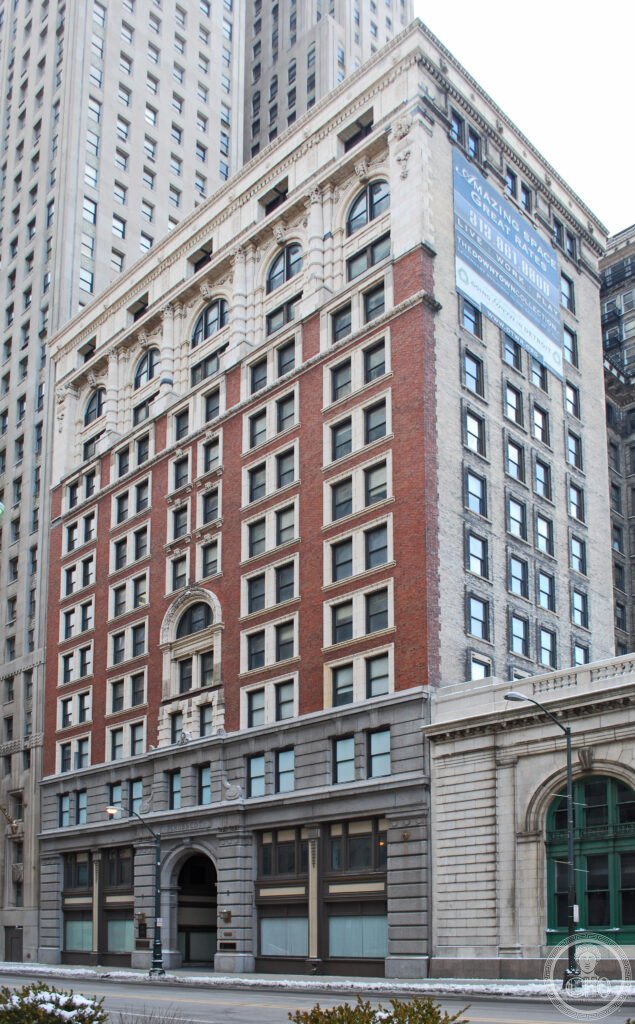
For most of the mid-twentieth century, if you looked up from the Detroit River at night, the highest light in the city skyline was a red sphere: the beacon atop the Penobscot Building, 47 storeys and 565 feet above the Griswold Street financial district, where Harvey D. Campbell had assembled the most ambitious commercial programme in the city.
At a glance
The Penobscot Building occupies 645 Griswold Street in the heart of Detroit’s Financial District, one block from the Guardian Building and two from the Campus Martius. It is in fact two buildings: a ten-storey base structure completed in 1905 by Donaldson and Meier for businessman Harvey D. Campbell, and a 37-storey Art Déco tower added in 1928 by Smith, Hinchman & Grylls that transformed the combined structure into Detroit’s tallest building (47 storeys, 565 feet / 173 metres). That distinction it held for several decades. The illuminated red sphere at the summit — a navigational and visual landmark visible from the river and from Windsor, Ontario across the strait — has defined the Detroit night skyline since 1928. The building is listed on the National Register of Historic Places.
Key facts
- Original building (1905): Donaldson and Meier, architects; 10 storeys
- Tower addition (1928): Smith, Hinchman & Grylls, architects
- Client: Harvey D. Campbell
- Combined height: 47 storeys, 565 ft (172 m)
- Style: Art Déco (1928 tower); Beaux-Arts base (1905)
- Address: 645 Griswold Street, Detroit, MI 48226
- GPS: 42.3301, −83.0481 — Google Maps
- Designation: National Register of Historic Places
- Landmark feature: Illuminated red sphere at summit, visible from Detroit River
History
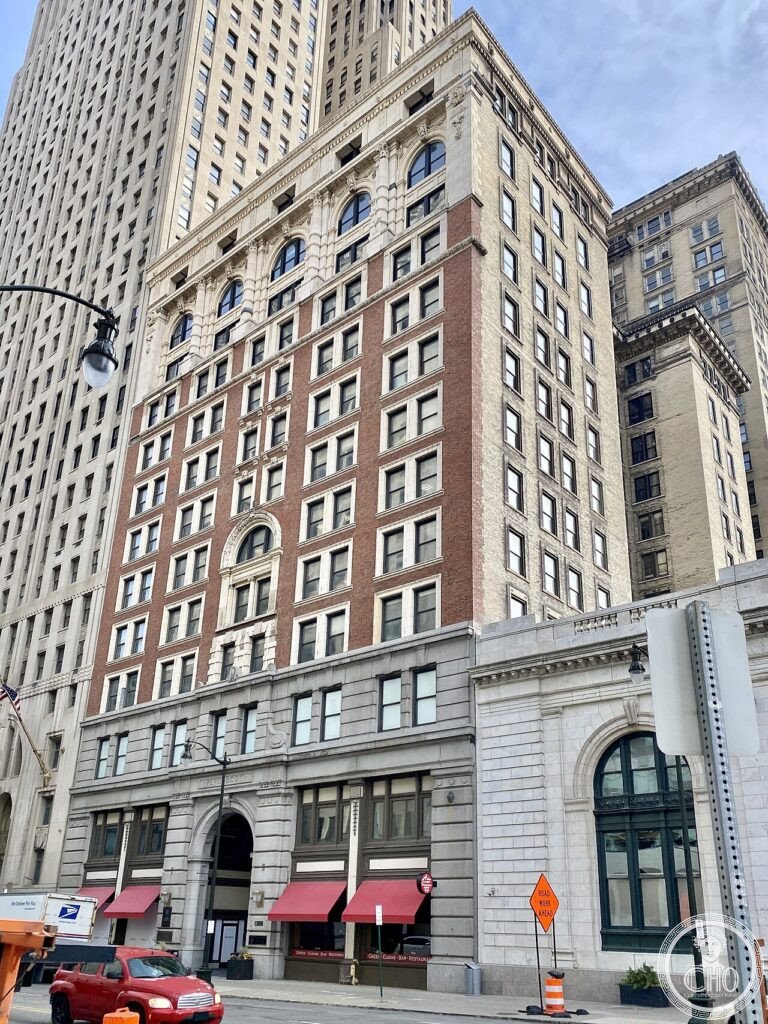
Harvey D. Campbell was a Michigan businessman who understood before most of his contemporaries that the Griswold Street corridor — running from the river north to Campus Martius — was going to be the axis of Detroit’s commercial ambition. His first building on the site, completed in 1905 by Donaldson and Meier, was a competent Beaux-Arts commercial block of ten storeys: adequate for the market of the moment, but not the monument Campbell had in mind. When the automobile boom of the 1920s transformed Detroit’s financial fortunes beyond all previous expectation, Campbell moved quickly to capitalise on both the location and the moment.
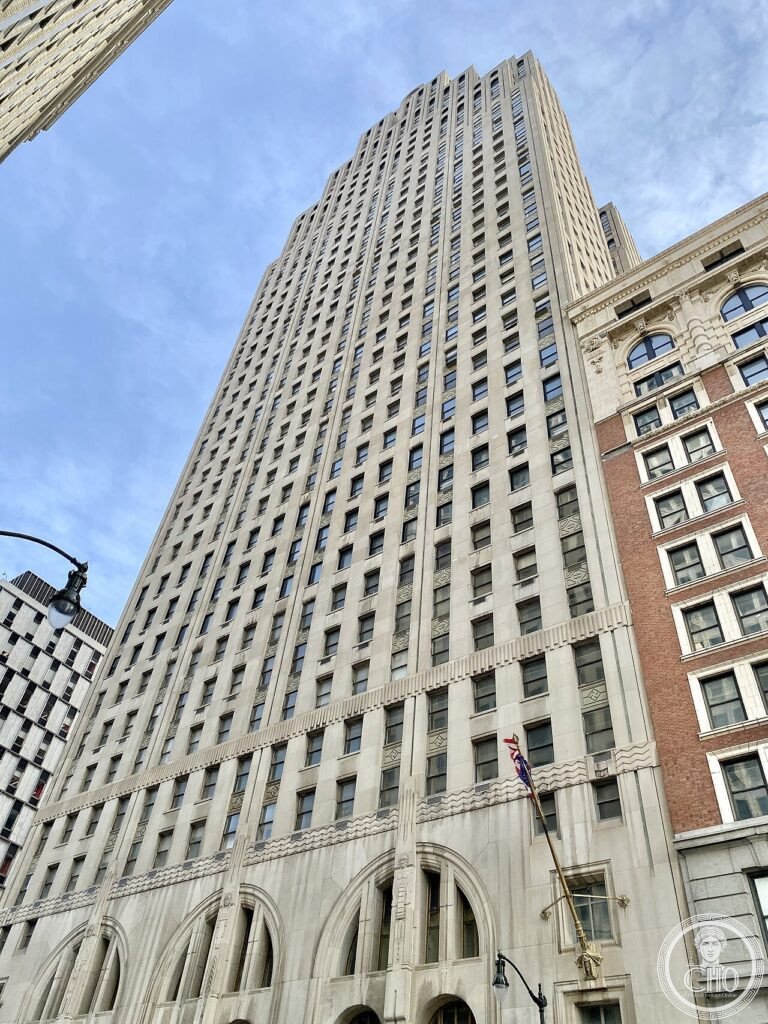
The commission to Smith, Hinchman & Grylls — the same firm producing Wirt C. Rowland’s Guardian Building one block south at the same time — produced a 37-storey Art Déco tower that rose from the 1905 base and overtopped every other structure in the city. The tower’s Déco vocabulary is more restrained than the Guardian’s polychrome exuberance: limestone facing, vertical emphases, and setback massing in the conventional American skyscraper manner. What distinguishes the Penobscot is its silhouette — the sheer height, the slight taper, and the red sphere at the summit that Campbell installed as both advertisement and beacon.
The sphere — originally functioning as an aircraft warning light for the approach to Grosse Ile airport across the river — became immediately the most recognisable single element on the Detroit skyline. Detroit remained for decades a one-newspaper, one-sports-franchise, one-tallest-building city; the Penobscot’s height was part of the civic identity in a way that is difficult to reconstruct now that it is no longer the record-holder. The building is listed on the National Register of Historic Places and continues to operate as commercial office space.
What you see
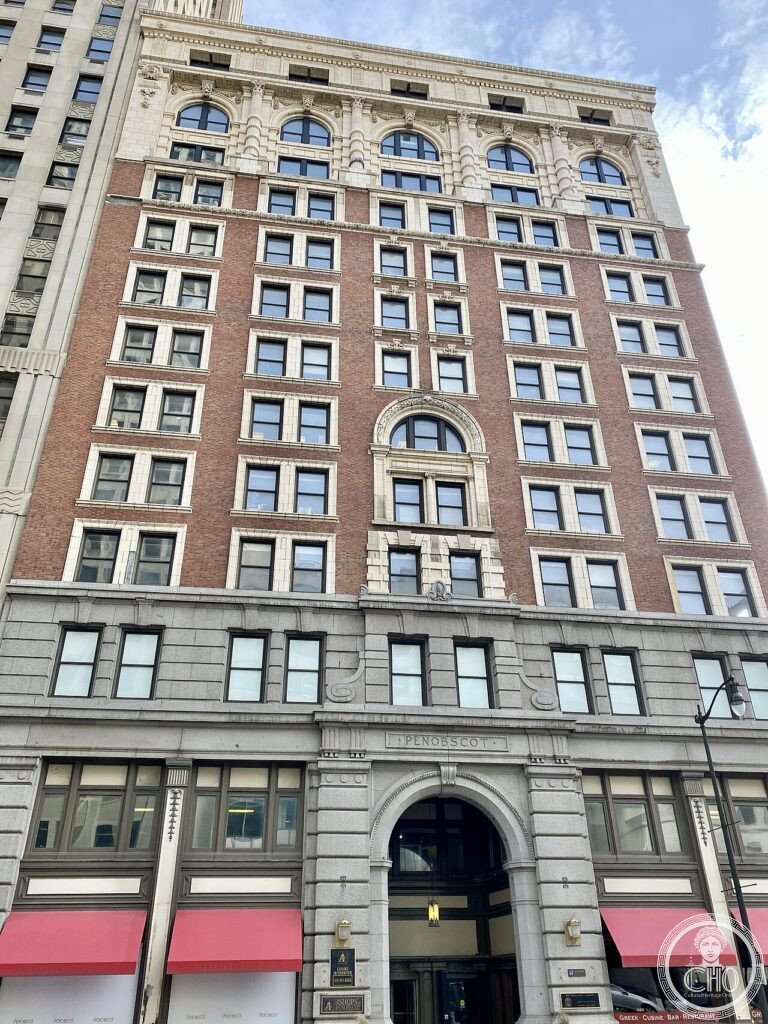
From Griswold Street, the Penobscot presents two distinct registers: the lower ten storeys of the 1905 base — in a restrained Beaux-Arts manner, with arched windows and classical detail at the cornice — and the Art Déco tower that rises above it. The transition between the two is handled by a setback at the tenth floor that the 1928 architects used to reframe the entire composition, so that what you see from street level reads predominantly as the tower rather than as a hybrid.
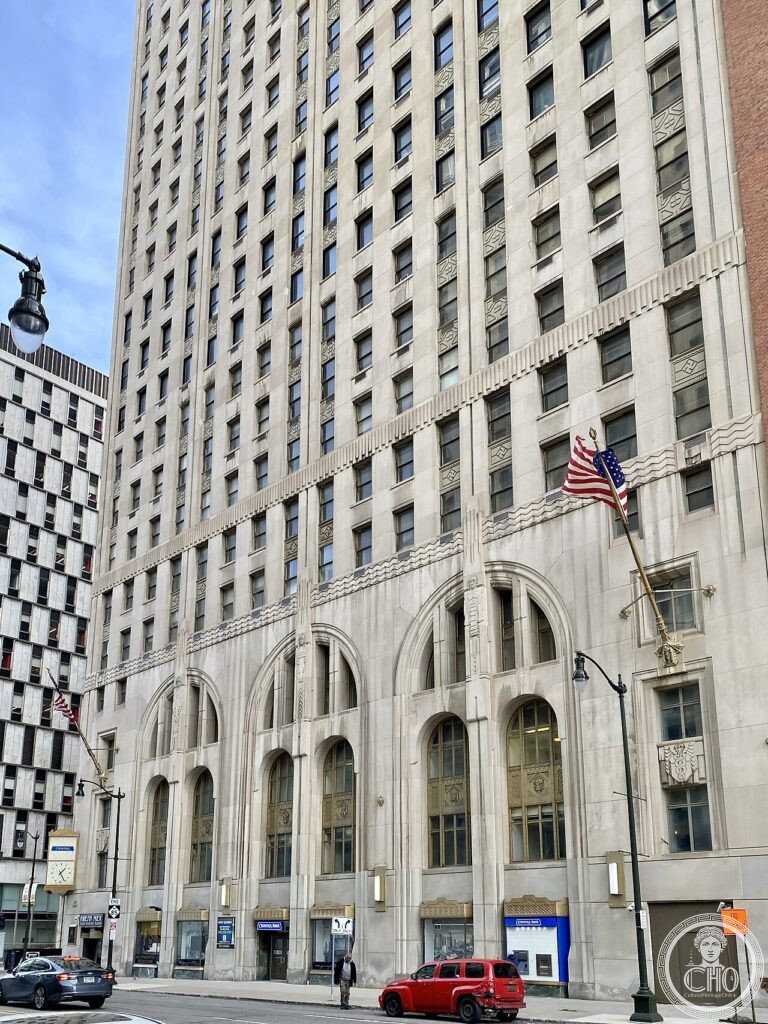
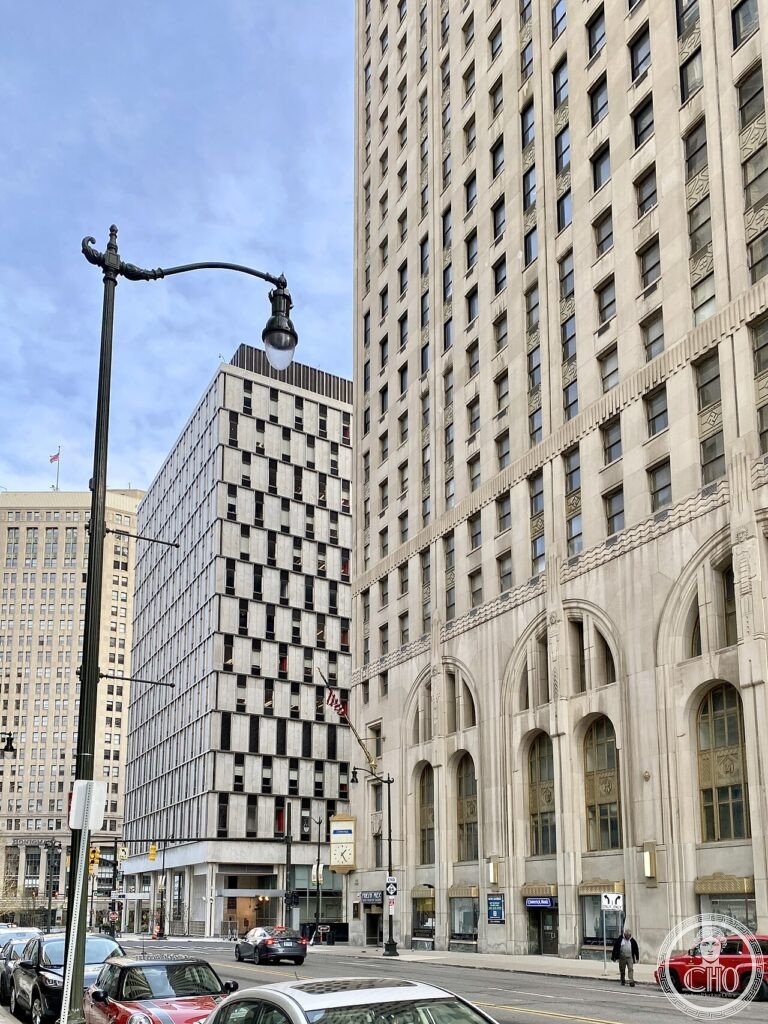
The tower itself is faced in limestone, with the characteristic vertical striations of the Déco skyscraper — piers slightly more pronounced than spandrels, pushing the eye upward through the 37 additional storeys. The setbacks at the upper floors are proportioned conservatively; the building’s claim on the skyline rests on its height rather than on the dramatic ornamental programme of the Guardian Building one block south. At night, the red sphere at the summit turns the Penobscot into a lighthouse: a single glowing point above the financial district that has oriented sailors, pilots, and Detroiters since 1928.
Practical information
- The building operates as commercial office space; the lobby is accessible during business hours.
- The red sphere is best seen from the Detroit Riverwalk (4 blocks south) or from the Windsor waterfront across the river.
- The People Mover Financial District station is half a block east.
- Campus Martius Park, the central gathering space of downtown Detroit, is one block north.
Getting there
The Penobscot Building is at 645 Griswold Street, one block north of the Guardian Building and two blocks south of Campus Martius Park. The Detroit People Mover (Financial District station) stops directly adjacent. Detroit Metropolitan Wayne County Airport (DTW) is 26 miles southwest; downtown connections by FAST bus (approximately 50 minutes) or rideshare (30–40 minutes).
Nearby
- Guardian Building — 1 block south, Wirt C. Rowland’s 1929 Aztec-Déco “Cathedral of Finance”
- Campus Martius Park — 1 block north, Detroit’s central civic square
- Cadillac Square — 2 blocks east, historic commercial heart of early Detroit
- Detroit Riverwalk — 4 blocks south, 3.5-mile refurbished waterfront promenade
Photo gallery
Sources
- Historic Detroit (historicdetroit.org): Penobscot Building — 1905 base (Donaldson and Meier) + 1928 tower (Smith, Hinchman & Grylls); Harvey D. Campbell client; 47 storeys 568 ft / 173 m; red sphere summit; NRHP listing
- National Register of Historic Places (NRHP): Penobscot Building — registration form; architectural description; period of significance
- SAH Archipedia (sah-archipedia.org): Penobscot Building entry — site analysis; relationship to Guardian Building and Detroit Financial District
- Burton Historical Collection, Detroit Public Library: Harvey D. Campbell business records; Griswold Street commercial development 1900–1930
Find it on the map
See this place and what’s around it →📷 Become a Cultural Heritage Online photographer
Share your photos of places: they stay published under your name as the author. The more they're seen, the more you get noticed — and soon a contest will reward the most appreciated photos.
Log in or sign up free to add a photoIs this page about you?
This page is read by travellers and heritage enthusiasts who find it on Google. Tell us how you are connected to this place and we will take it from there.