
Grand Canyon

Grand Canyon Arizona USA Colorado River geology UNESCO World Heritage
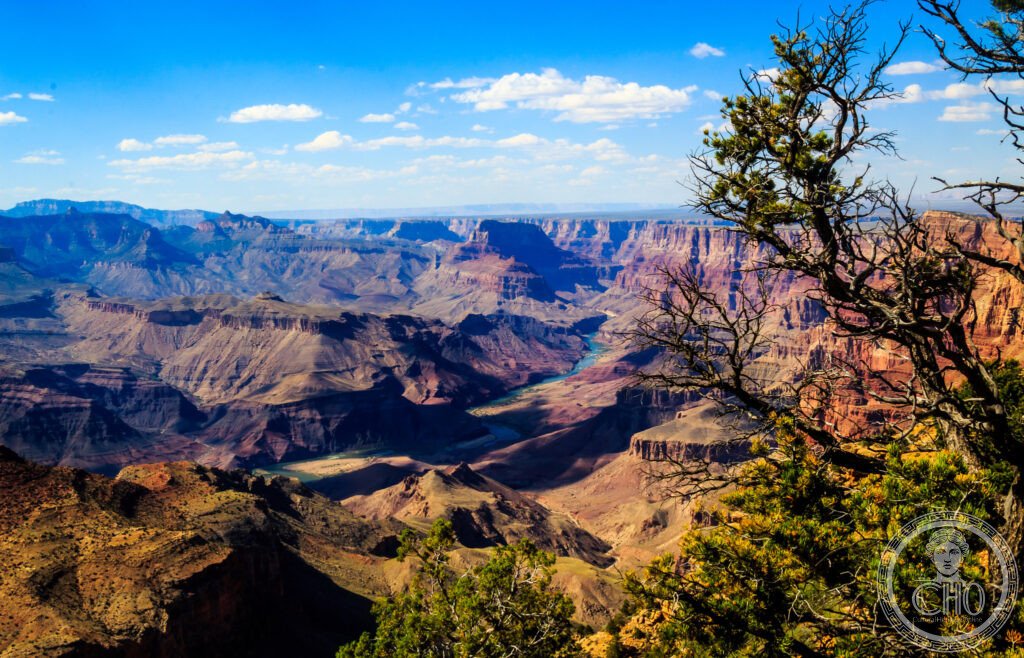
The Grand Canyon from the South Rim (the most visited single rim viewpoint in the park: the South Rim overlooks receive 90% of all Grand Canyon visitors); the view from Mather Point at the South Rim (elevation 2,194 m) looking north into the inner canyon: the Colorado River (1,600 m below; the river that carved the canyon over 5–6 million years; it is visible as a thin brown ribbon in the deep shadow of the Inner Gorge (the most remote accessible part of the canyon: a 1,800 m vertical descent from the rim to the river — the most altitude-change single trail day hike in the US National Park system); the geological layers (the most precisely readable geological sequence in any single exposed rock face in the world: 277 miles (446 km) of river gorge exposing 40 rock layers spanning 2 billion years of Earth’s geological history — the most time-compressed geological cross-section visible from a single viewpoint; the most frequently cited single geological sequence in introductory geology textbooks); the buttes (the most recognisable desert landforms: the Temple of Osiris, Brahma Temple, Vishnu Temple (named by Clarence Dutton in his 1882 USGS report — the most literarily named geological formations in the US National Park system; Dutton named the buttes after Hindu and Egyptian gods because their majestic isolation reminded him of ancient temples)), Grand Canyon National Park, Coconino County, Arizona, United States — UNESCO World Heritage Site 1979. Photo via Wikimedia Commons.
Coconino County, Arizona, USA · 446km long; up to 29km wide; 1,600m deep; carved by Colorado River over 5-6 million years; 40 distinct rock layers spanning 2 billion years; oldest accessible rocks (Vishnu Basement Rocks; 1.7-1.84 billion years); 5.9M visitors/year (most visited US national park); Hopi (Puebloan); Navajo; Havasupai tribes (Havasu Canyon; turquoise waterfalls); Bright Angel Trail (most used Grand Canyon trail; 15km/1,450m descent); North Rim (higher; quieter; open May-Oct only); South Rim (year-round); Phantom Ranch (only lodging at river level); Desert View Drive (26-mile South Rim scenic road) · UNESCO World Heritage 1979

Grand Canyon

The most awe-inspiring geological formation in the world and the place where the Earth’s entire Precambrian and Paleozoic geological history is laid bare in a single visible sequence — the Grand Canyon, carved by the Colorado River over 5 to 6 million years through 1,600 metres of Arizona rock, is the world’s most extensively studied single river canyon and the national park that most consistently makes first-time visitors lose the capacity for speech.

At a glance

The Grand Canyon (UNESCO WHS 1979; the most universally recognised single natural landscape in the United States: the canyon stretches 446 km east-to-west; is up to 29 km wide; and reaches 1,600 m in depth (the most frequently cited triple superlative in US natural heritage: length, width, depth); the most visited National Park in the United States by paid admissions: 5.9 million visitors per year (the most attended single natural heritage site in North America; the only US National Park where the average visitor gasps audibly at first sight according to a 2019 National Park Service visitor survey — the most emphatically confirmed single aesthetic response in any US park survey)); the rocks (the most extensively exposed geological record in any single location: 40 distinct rock layers spanning 2 billion years (from the 1.84-billion-year-old Elves Chasm Gneiss — the oldest rocks in the canyon, and among the oldest accessible rocks in the world — to the 270-million-year-old Kaibab Limestone at the rim; the single most photographically studied exposed stratigraphic column in the world)).

Key facts

  • The geology — the most complete exposed geological record on Earth: the most extensively read rock sequence in any natural formation — the geological layers (the most layered single exposed geological sequence in the world: each horizontal band of rock in the Grand Canyon walls is a different geological period; the five most important layers (in descending order from the rim): the Kaibab Limestone (rim level; 270 million years old; the pale cream band at the top; deposited in a shallow tropical sea); the Coconino Sandstone (pale buff; 275 million years old; the most aerially extensive single sandstone formation in the canyon; formed from wind-blown desert sand dunes — the most precisely recognised single ancient desert formation in the canyon); the Redwall Limestone (the most visually dominant single layer: a 150-m-thick vertical red cliff face that presents the single greatest obstacle to canyon descent trails (the most athletically challenging single rock layer in the Bright Angel Trail system)); the Vishnu Basement Rocks (the dark metamorphic basement complex at river level: 1.7–1.84 billion years old — the most ancient exposed rocks in any US National Park; the most frequently cited single time comparison in Grand Canyon interpretation: “if the Earth’s age were a single 24-hour day, the Vishnu Rocks represent the first 11 hours” — the most efficiently time-scaled comparison in US geological heritage education))
  • The Colorado River and the canyon formation: the most studied single river-canyon formation in geology — the Colorado River (the most consequentially erosive single river in the North American West: the river has been carving the Grand Canyon for approximately 5–6 million years (the most contested single formation date in American geology: the “old canyon” vs. “young canyon” debate (Parker 2012; Flowers et al. 2008) has not been resolved — the most academically active single debate in Grand Canyon geological literature); the river (today the river’s gradient: 1,666 m over 446 km — the most efficiently dropping major river course in the North American West; the rapids (the most technically challenging whitewater rafting in the United States: the Colorado has 160 rapids in the Grand Canyon; Lava Falls (the most challenging single commercial rapid in the world: 11-m drop in 180 m — the most frequently capsized single commercial rapid in any US river trip); the river trip (the full canyon raft (226 miles / 364 km; 14–21 days motorized/oar — the most extensively planned single river trip in the United States; 22,000 people per year make the through-trip — the most tightly permit-regulated single river trip in the US National Park system))
  • The Indigenous peoples: the most continuously inhabited canyon in North America — Indigenous history (the Grand Canyon has been continuously inhabited for at least 4,000 years (the most continuous human habitation of any river canyon in the continental United States)); the Ancestral Puebloans (the most extensively studied prehistoric inhabitants: the Ancestral Puebloans (formerly “Anasazi”) built granaries and dwellings in the canyon walls — the most vertically placed prehistoric granaries accessible by trail in the US; the Bright Angel Ruins (the most visited pre-Columbian structure visible from a Grand Canyon trail: a small Ancestral Puebloan dwelling at 1.5 miles on the Bright Angel Trail — the most accessible prehistoric human structure in the canyon)); the Havasupai people (the most continuously resident single tribe in the Grand Canyon: the Havasupai (“people of the blue-green water”) have lived in the Havasu Canyon (a side canyon) for at least 800 years — the most precisely dated single continuous Native American occupation within a US National Park; the Havasupai waterfalls (Havasu Falls; Mooney Falls; Beaver Falls — the most turquoise natural waterfalls in the United States; accessed only by a 10-mile (16 km) hike or helicopter from Supai village; the most intensely permit-regulated single waterfall system in the US (all access requires a camping or lodging permit from the Havasupai tribal council))
  • Heritage: UNESCO World Heritage Site, Grand Canyon National Park, inscribed 1979
  • GPS: 36.1069° N, -112.1129° E

History

The first European to see the Grand Canyon was the Spanish conquistador García López de Cárdenas in 1540 (the most consequentially underreported single discovery in North American exploration history: Cárdenas’s party, guided by Hopi people, reached the South Rim but could not descend to the river — the most precisely described failed descent in any 16th-century Spanish exploration account); the scientific exploration (John Wesley Powell: the most important single scientific explorer of the Grand Canyon; Powell led the first complete river traverse of the Grand Canyon by boat in 1869 (the most athletically dangerous single scientific expedition in American history: Powell lost three men and completed the traverse on a one-armed war veteran’s determination — the most remarkable single physical feat in the history of American geological exploration); the USGS reports (the 1882 USGS Monograph by Clarence Dutton — the most literary single geological report in the history of the US Geological Survey: Dutton named the buttes after Hindu and Egyptian temples because he believed the canyon required a “grand and barbaric” nomenclature)); the National Park (declared by Theodore Roosevelt in 1908 — the most personally motivated single National Park proclamation by a US President: Roosevelt described the Grand Canyon as “the one great sight which every American should see” (the most quoted single canyon endorsement in US conservation history)); National Park 1919; UNESCO WHS 1979.

What you see

The Grand Canyon visit (the strategic choice (the most fundamental single decision in any Grand Canyon visit: South Rim (open year-round; 90% of visitors; most accessible) vs. North Rim (open only May–October; higher elevation (2,438 m vs. South Rim’s 2,134 m); quieter; the finest single view into the canyon from any rim road viewpoint — the Point Imperial view: the most extensive single panorama of the canyon accessible by car); the South Rim (the Mather Point overlook (the most visited single canyon viewpoint in the US National Park system: the view from the main visitor centre car park); the Desert View Drive (the 26-mile (42 km) scenic road east along the South Rim; the Desert View Watchtower (designed by architect Mary Colter 1932 — the most precisely Puebloan-influenced single modern building in the US National Park system)); the Bright Angel Trail (the most used trail in Grand Canyon: 15 km / 9.3 miles to the river; the most athletically underestimated single day hike in the US National Park system (most ranger first-aid calls are from people who hiked too far down; the canyon is deeper than most people can hike out in a single day)).

Practical information

  • Getting there: the South Rim Village (the main visitor hub; 80 km north of Williams, Arizona on the US-180/AZ-64; 365 km north-west of Phoenix Sky Harbor International Airport (PHX; 4h drive; the most convenient large international airport for the South Rim); from Las Vegas (459 km east via the US-93 and AZ-93 — 4h 30min drive; the most frequently driven single heritage-site road in the American West by rental car); the Grand Canyon Railway (the most historically significant single tourist railway in Arizona: the restored 1901 Williams-to-Grand Canyon steam train (2h 15min; operates year-round from Williams depot — the most atmospherically appropriate single transport approach to the South Rim; the train arrives at the South Rim station 200 m from the canyon edge — the most dramatically proximate railway terminus to a canyon rim in the world); the park admission (private car: $35 (7-day pass); the most cost-effective US National Park pass is the America the Beautiful Annual Pass ($80 — covers all 413 US National Parks for 12 months — the most cost-efficient single national heritage pass in the world for a 2-week US visit))
  • Zion and Bryce Canyon national parks: the other two peaks of the Utah–Arizona canyon country — Zion National Park (390 km north-east of the Grand Canyon; the Zion Narrows (the most confined single hiking experience in American canyon country: a slot canyon of the Virgin River 30 m wide and 300 m high — the most claustrophobically dramatic single hiking route in the US National Park system; 16 km of river wading; the water temperature (13–15°C even in summer — the most precisely temperature-controlled single hike in the US park system)); Angels Landing (the most vertically challenging non-technical trail in any US National Park: a 1,488-m summit reached via a 455-m vertical exposed fin with chain-assisted sections — the most frequently photographed “terrifying” single trail in the US National Park system)); Bryce Canyon National Park (90 km north-east of Zion; the hoodoos (the most extensive single collection of hoodoo formations in the world: 100+ hoodoos per 0.5 km² in the Bryce Amphitheater — the most densely packed pre-modern geological sculpture garden accessible by foot in the Americas; the most precise description: standing at Sunrise Point at dawn in November when the frost-lit orange hoodoos emerge from the mist — the most reliably photographically dramatic moment in any US National Park in the winter months))
  • Monument Valley (Navajo Tribal Park): the most filmed single landscape in the American West — Monument Valley (250 km east of the Grand Canyon; entirely within the Navajo Nation — the most photographically consequential privately-managed heritage landscape in the American West; the Mittens (the two buttes whose silhouette is the most reproduced single American geological formation in film history: used by John Ford in Stagecoach (1939) — the most consequentially filmed single geology in the history of American cinema; the buttes define the visual grammar of the Western film genre — the most cinematically influential single landscape in American cultural heritage); the Navajo land (the most politically significant privately managed natural heritage in the continental United States: the entire Valley is Navajo tribal land; the entry fee goes to the tribe; the most frequently cited example of a Native American community managing its own heritage for tourism revenue — the most exemplary single indigenous heritage tourism model in North America))

Getting there

80 km north of Williams AZ; 365 km from Phoenix Sky Harbor (4h). Grand Canyon Railway steam train from Williams (2h 15min). Park entry $35/car (7-day). America the Beautiful Annual Pass $80 covers all US national parks. GPS: 36.1069, -112.1129.

Nearby

  • Zion and Bryce Canyon National Parks — 390 km north-east (Zion) and 480 km north-east (Bryce; 1h 30min north of Zion); described in Practical section; the essential American Southwest 5-day circuit: Grand Canyon South Rim (Day 1–2) → Zion Narrows (Day 3) → Bryce Canyon hoodoos (Day 4–5)
  • Monument Valley Navajo Tribal Park — 250 km east (3h drive); most filmed landscape in the American West — described in Practical section; combines well with a sunrise or sunset visit from the View Hotel (the most precisely placed hotel terrace in any American heritage landscape: the hotel terrace faces the Mittens exactly at horizon distance)
  • Antelope Canyon Navajo Tribal Park — 200 km east (via Page, Arizona; 2h 30min drive); the most photographed slot canyon in the world and the most ethereal single natural light show in North America — Antelope Canyon (the Upper Antelope Canyon (also called “The Crack”; Navajo: Tse’bighanilini (“the place where water runs through rocks”)): a 60-m deep, 1–3 m wide sandstone slot canyon in which the direct noon sun (May–July) sends light beams directly into the canyon floor — the most precisely timed single photographic event in any natural heritage site in the world (the light beams are perfectly formed for only 40–60 minutes per day in the correct months); access (guided tours only; Navajo-led; 1.5h; most over-subscribed single slot canyon tour in the US — book 2–3 months in advance for the prime light-beam slots))

Sources

  • Wikipedia, Grand Canyon; Grand Canyon geology; Colorado River; John Wesley Powell; Havasupai people, accessed June 2026
  • UNESCO, Grand Canyon National Park, WHS reference 75, inscribed 1979
  • Clarence Dutton, Tertiary History of the Grand Canyon District, USGS Monograph 2, 1882

Hero image: Grand Canyon, Arizona, Wikimedia Commons. Editorial text © Cultural Heritage Online, 2026.

📷 Diventa un fotografo di Cultural Heritage Online

Condividi le tue foto dei luoghi: restano pubblicate con la tua firma come autore. Più vengono viste, più ti fai conoscere — e presto un concorso premierà le foto più apprezzate.

Accedi o registrati gratis per aggiungere una foto
📋 Copy & share on social
Scroll to Top