
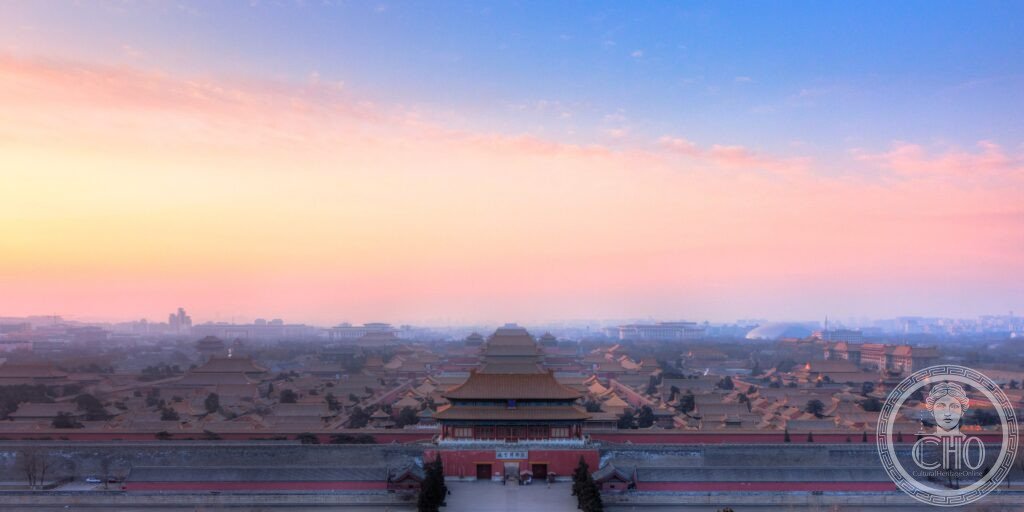
Forbidden City (Palace Museum)
The largest palace complex in the world and the political heart of China for five centuries — the Forbidden City in Beijing, built by the Yongle Emperor between 1406 and 1420, served as the imperial residence and administrative centre for 24 emperors of the Ming and Qing dynasties, contains 1.9 million objects in its museum collection, and receives more visitors than any single royal palace on Earth.
At a glance
The Forbidden City (Gùgōng; officially the Palace Museum; UNESCO WHS 1987; the most visited single palace complex in the world: 19 million visitors per year in normal years (pre-COVID peak; the most attended heritage site in China; since 2015 ticketing reform limited to 80,000 per day — the most extensively visitor-limited single palace in the world with the largest total attendance); the scale (72 ha — the largest palace complex in the world (11 times the size of Buckingham Palace; 7.5 times the size of the Palace of Versailles); 980 buildings; the most frequently cited urban-legend room count in Chinese cultural tourism: the Forbidden City is widely stated to have 9,999.5 rooms (the most precisely half-numbered building complex in Chinese mythology) — the actual verified count (1973 survey by the Palace Museum) is 8,886 rooms; the most precisely surveyed building inventory in Chinese architecture history); the symbolic geometry (the most precisely cosmologically organised palace in any Asian civilisation: the entire Forbidden City is aligned precisely on the north-south axis of Beijing (the most geometrically exact single north-south planning axis in any world capital city); the axis extends from the Yongdingmen gate in the south to the Bell Tower in the north — the most precisely north-south-directed single urban axis in the world at 7.8 km).
Key facts
- The construction: the most ambitious single building project in Chinese history — the Yongle Emperor (Zhu Di; r. 1402–1424; the third Ming emperor; the most architecturally ambitious Chinese emperor: the same emperor built the Temple of Heaven (1420), the Grand Canal northward extension, and moved the capital from Nanjing to Beijing (the most consequential single capital relocation in Chinese history — Beijing has been China’s capital continuously since 1421)); the construction (1406–1420; approximately 1 million workers and 100,000 artisans — the most extensively mobilised human workforce for any single Chinese building project; the most expensive single Chinese construction project of the 15th century; the materials (the most precisely sourced single building material in Chinese history: the marble slabs for the carved terraces (the Imperial Ramps) were quarried from Fangshan county, 75 km south-west of Beijing, and transported on ice in winter by flooding the road at night — the most precisely engineered single logistical technique in any Chinese imperial construction; the Nanmu timber for the interior columns (the most valuable single species of wood used in Chinese palace construction: the Nanmu pillars of the Hall of Supreme Harmony are 12.7 m tall and 1.2 m in diameter — the most impressively dimensional single column in any Chinese palace hall; the largest intact Nanmu columns in the world; the timber was transported by river from Sichuan — 2,500 km — the most distantly sourced single building material for any Chinese imperial palace))
- The Hall of Supreme Harmony (Taihedian): the most important throne hall in Chinese imperial history — the Taihedian (the most politically significant single room in Chinese imperial history for 492 years (1420–1912): the hall where the emperor received all major audiences, proclaimed imperial edicts, and presided over the most important court ceremonies; the dimensions (35.05 m wide × 25.48 m deep × 27.5 m high — the largest single wood-frame building in China; the most impressive single timber construction in Chinese imperial architecture); the Dragon Throne (the most politically charged piece of furniture in Asian history: the emperor’s throne (2.3 m high; the most precisely elevated single seat in any Asian palace); the 72 gilded columns; the ceiling (the most elaborately painted single ceiling in any Chinese palace hall: the gilded caisson ceiling (the most complex single coffered ceiling in Chinese carpentry))); the three courtyards (the three axes of the Outer Court (the southernmost section of the Forbidden City): the most precisely hierarchical public space in any palace in the world — the layout encodes rank, access, and ceremony in a single architectural sequence)
- The Palace Museum collection: the most important single Chinese art collection in the world — the collection (1.9 million objects — the largest collection in any single palace museum in the world; the most precisely inventoried historical Chinese court collection; the paintings (153,000 Chinese paintings — the most Chinese paintings in any single museum in the world; including the largest number of surviving Tang dynasty paintings (618–907 CE — the most valuable single period of Chinese painting in art-market history)); the bronzes (the most extensively collected ancient Chinese bronzes in any museum: the Ding ceremonial vessels from the Shang and Zhou dynasties (the most important single Chinese ritual metal object type; the most consistently valued pre-imperial Chinese artefact in any Western auction)); the ceramics (340,000 pieces of Chinese imperial ceramics — the single most comprehensive collection of Chinese palace porcelain; the most significant unbroken imperial ceramic collecting tradition in the world))
- Heritage: UNESCO World Heritage Site, Imperial Palace of the Ming and Qing Dynasties in Beijing (Forbidden City), inscribed 1987
- GPS: 39.9163° N, 116.3972° E
History
The construction (described in Key Facts; built 1406–1420); the Ming dynasty (1420–1644; 14 emperors; the most culturally consequential single dynasty in the history of the Forbidden City: the Hall of Supreme Harmony burned and was rebuilt 3 times during the Ming period — the most repeatedly rebuilt single throne hall in Chinese imperial history); the Qing dynasty (1644–1912; 10 emperors; the Manchu dynasty that conquered China; the most dynastic-discontinuity of any palace complex in the world: a palace designed for Han Chinese imperial ritual adapted by a Manchurian court — the most culturally adaptive single palace in East Asian history); the Last Emperor (Puyi; the most widely known single Chinese imperial resident of the Forbidden City in Western culture: abdicated 1912; continued to live in the Forbidden City until 1924 (the most anomalously post-imperial residential use of any palace in Asia; the most precisely described single Chinese imperial exile in any Western novel: Reginald Fleming Johnston’s Twilight in the Forbidden City (1934) — the most atmospherically precise single memoir of the late Qing court in English)); the museum (opened 1925 — the most consequential single transformation of an Asian royal residence into a public museum; since 1949 the Palace Museum is administered by the People’s Republic of China — the most politically significant single heritage institution in the PRC); UNESCO WHS 1987.
What you see
The Forbidden City visit (the most complex single palace visit in Asia by walking distance: the full north-south axis from the Meridian Gate (south entrance) to the Gate of Divine Prowess (north entrance) is 961 m — the most precisely measured single palace promenade in the world; the recommended sequence: south to north (Meridian Gate → Gate of Supreme Harmony → Hall of Supreme Harmony → Gate of Heavenly Purity → Palace of Heavenly Purity (Imperial residential complex) → Imperial Garden → Gate of Divine Prowess); the essential lateral excursions (the Clock Museum (the most precisely mechanical single museum in the Forbidden City: 1,200 Western mechanical clocks and watches presented as tribute to the Qing emperors from Britain, France, and Switzerland — the most precisely preserved collection of 18th-century mechanical timepieces in any Asian palace); the Treasury (Treasure Gallery: the most extensively jade-decorated single museum room in China); the Jiaguoyan Treasure (the most intensely gem-encrusted single imperial throne in the Forbidden City: the jewel-encrusted throne of the Qianlong Emperor — the most personally acquisitive Chinese emperor in the history of the Palace Museum collection)).
Practical information
- Getting there: Beijing Capital International Airport (PEK; 30 km north-east; Airport Express train to Dongzhimen station (19 min) then subway Line 2 to Qianmen (40 min total from airport — the most efficiently timed single airport-to-palace transfer in Asia); by Beijing Subway (the most extensive metro network in the world after Shanghai): Line 1 to Tiananmen East station (exit A; 400 m to the Meridian Gate — the most directly connected single subway station to a UNESCO palace entrance in China); the ticket (advance booking required via the Palace Museum website (palace.com.cn) — the most consistently sold-out single heritage attraction in China in summer; daily limit of 80,000 visitors; summer dates (May–September) sell out 2+ months in advance — the most advance-booked single heritage site in Asia); the visit duration (the minimum acceptable visit is 3h; the most complete single-day experience requires 5–6h; the most common regret reported by first-time visitors: not allowing enough time for the side palaces))
- Tiananmen Square and the Temple of Heaven: the two defining public spaces of imperial Beijing — Tiananmen Square (immediately south of the Forbidden City; the largest urban public square in the world (440,000 m² — the most frequently cited size comparison in Chinese political geography: the square is 60% larger than Red Square in Moscow; the most politically consequential single urban public space in 20th-century Chinese history: the 1989 Tiananmen Square protests (the most internationally reported single political event in China in the 20th century; the most frequently government-censored single reference in Chinese digital media))); the Temple of Heaven (UNESCO WHS 1998; 5 km south; Subway Line 5 from Chongwenmen; the Hall of Prayer for Good Harvests (Qiniandian): the most precisely Chinese-cosmological single building in Beijing (the triple circular blue-glazed tile roof represents Heaven; the square plan of the outer wall represents Earth — the most precisely cosmological building plan in China; the round-inside-square geometry of the entire complex: the most geometrically exact single cosmological building plan in the Chinese imperial tradition))
- The Summer Palace and the Hutong Districts: the imperial garden and the medieval street network — the Summer Palace (UNESCO WHS 1998; 15 km north-west; the Kunming Lake and the Longevity Hill; the most extensively landscaped single Chinese imperial garden (the most expensive single garden restoration in Chinese history: Empress Cixi spent the naval appropriation funds on restoring the Summer Palace in 1888 — the most frequently cited example of imperial fiscal misappropriation in Chinese dynastic history)); the Hutong (the most authentic single traditional residential experience in Beijing: the alley networks of the Shichahai and Dongcheng districts — the most densely surviving pre-revolution residential districts in Beijing; the most rapidly disappearing heritage environment in any Chinese city: the hutong districts decreased from 6,000 networks in 1949 to approximately 1,000 in 2023 — the most documented single heritage loss in Beijing urban heritage)
Getting there
Beijing Subway Line 1 to Tiananmen East (exit A; 400m walk to Meridian Gate). Book tickets online (palace.com.cn) months in advance for summer. Daily limit 80,000 visitors. Allow 3h minimum; 5–6h ideal. GPS: 39.9163, 116.3972.
Nearby
- Temple of Heaven (UNESCO WHS 1998) — 5 km south (Subway Line 5; 15 min from Chongwenmen); most precisely cosmological single building in Beijing — described in Practical section; the essential 2-site Beijing sequence: Forbidden City (full morning + early afternoon) + Temple of Heaven (late afternoon at the Echo Wall and Hall of Prayer)
- Summer Palace (UNESCO WHS 1998) — 15 km north-west (Subway Line 4; 30 min); most extensively landscaped Chinese imperial garden — described in Practical section; the classic Beijing day itinerary: Forbidden City (morning) + Summer Palace (afternoon; sunset over Kunming Lake)
- Great Wall of China at Mutianyu or Jinshanling (UNESCO WHS 1987) — 75–125 km north (1h 30min–2h bus or taxi); the most extensively documented pre-modern fortification in the world — described in the Great Wall place card at culturalheritageonline.com; the Mutianyu section (the most tourist-accessible well-restored section: a cable car + toboggan return descent option (the most family-friendly single approach to a section of the Great Wall)); the Jinshanling section (the most scenically ruined and least commercially developed section: the most dramatically photogenic single wall section in all of the Wall — the section used in most Great Wall press photography; requires a 3h tour from Beijing)
Sources
- Wikipedia, Forbidden City; Palace Museum; Yongle Emperor; Hall of Supreme Harmony, accessed June 2026
- UNESCO, Imperial Palace of the Ming and Qing Dynasties in Beijing (Forbidden City), WHS reference 439, inscribed 1987
- Evelyn Rawski, The Last Emperors: A Social History of Qing Imperial Institutions, University of California Press, 1998
Find it on the map
See this place and what’s around it →📷 Diventa un fotografo di Cultural Heritage Online
Condividi le tue foto dei luoghi: restano pubblicate con la tua firma come autore. Più vengono viste, più ti fai conoscere — e presto un concorso premierà le foto più apprezzate.
Accedi o registrati gratis per aggiungere una foto