
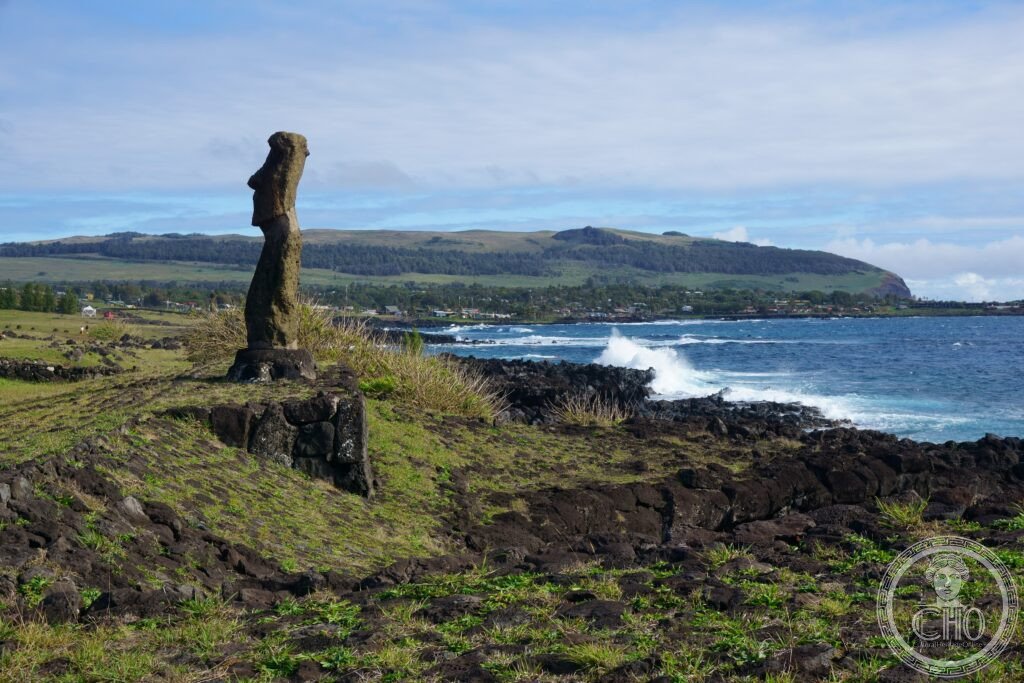
On a remote volcanic island in the South Pacific, the Rapa Nui people carved and moved over a thousand monolithic figures, the moai, from a single quarry to platforms around the coast. Ahu Tongariki, the largest of these platforms, and the quarry itself at Rano Raraku remain the clearest record of that undertaking.
At a glance
Easter Island, known to its Polynesian inhabitants as Rapa Nui, is a triangular volcanic island of about 163.6 square kilometres in the South Pacific, built around three extinct volcanic craters: Rano Kau, Rano Raraku and Terevaka. It is one of the most isolated permanently inhabited islands in the world, lying roughly 3,700 kilometres from the Chilean coast and about 2,075 kilometres from Pitcairn Island, its nearest inhabited neighbour.
The island is best known for the moai, the monolithic human figures carved by the Rapa Nui, and for Ahu Tongariki, its largest ceremonial platform, where fifteen moai stand in a row facing inland. Rapa Nui National Park, which covers the island’s archaeological areas, was inscribed as a UNESCO World Heritage Site in 1995.
Key facts
- Moai: between 1,040 and 1,110 known statues; the exact figure is disputed because definitions of what counts as a moai fragment vary.
- Tallest standing moai: “Paro”, at 9.8 metres.
- Largest ever quarried: “El Gigante”, 21.6 metres long, never finished and still lying in the Rano Raraku quarry.
- Ceremonial platforms (ahu): 887 recorded, of which 313 once carried at least one moai.
- Rapa Nui National Park: covers 7,130 hectares.
- Heritage status: UNESCO World Heritage Site, inscribed 1995.
History
Rapa Nui was settled by Polynesian navigators, probably from the Gambier Islands or the Marquesas, at some point between 1000 and 1200 CE, a date that replaced Thor Heyerdahl’s mid-twentieth-century theory of South American origin, since discounted by genetic analysis. Between roughly 1000 and 1600 CE islanders built the ceremonial platforms and carved and moved the moai. Nearly all the statues were cut from the soft consolidated tuff of the Rano Raraku volcano using basalt hand tools; a single moai is thought to have taken twelve to fifteen months to carve.
From around 1600, a period of intertribal conflict known as the Huri Moai saw rival groups topple the standing statues, and by the time the Dutch navigator Jacob Roggeveen became the first European to land on the island, on Easter Sunday, 5 April 1722, every erected moai had already been pulled down. By then the Birdman cult centred on the god Make-Make had replaced the earlier ancestor-focused moai religion; its annual Tangata Manu competition sent swimmers across open water to the islet of Motu Nui to retrieve the season’s first sooty tern egg, with the winning tribe ruling the island for the following year.
The population suffered a further blow from Peruvian slave raids in 1862–63, which killed or enslaved around 37 per cent of islanders, and Chile annexed Easter Island in 1888. Rapa Nui is today a special territory of Chile with a self-governing council.
What you see
At Ahu Tongariki, the largest single platform on the island, fifteen restored moai stand in a line facing inland towards the village, their backs to the sea, following the general pattern in which moai watched over their communities rather than looking out to the ocean. The exception is Ahu Akivi, where seven moai face the water, looking in the direction from which the first Polynesian settlers are thought to have arrived.
A short distance away, the Rano Raraku volcano was the quarry for almost every moai on the island; 397 statues remain there in every stage of completion, from barely begun outlines to finished figures that were never moved. Some moai carry pukao, cylindrical red scoria topknots weighing up to 13 tonnes, added after the statue itself had been raised.
Practical information
- Access: Rapa Nui National Park covers most of the archaeological sites; entry arrangements and any permits are best checked through the park’s own authority before travelling.
- Getting around: distances between sites such as Ahu Tongariki and Rano Raraku are short, but the island’s terrain and roads call for a vehicle or an organised tour.
- Conservation: the moai and platforms are fragile archaeological monuments; visitors are asked to keep to marked paths and not touch the statues.
Getting there
Easter Island lies far out in the South Pacific and can only be reached by air. Timetables, routes and connections should be checked directly with airlines or the island’s own tourism office, as these change over time.
Nearby
- Rano Raraku — the volcanic quarry where almost all the moai were carved, with hundreds of statues still standing where they were abandoned.
- Ahu Akivi — an inland platform whose seven moai are the only ones on the island facing the sea.
- Motu Nui — the small islet off the south-western coast where competitors in the Birdman ritual swam to retrieve the season’s first tern egg.
Sources
- UNESCO
- Jared Diamond, Collapse (2005)
- Carl Lipo and Terry Hunt, The Statues That Walked (2011)
Find it on the map
See this place and what’s around it →📷 Become a Cultural Heritage Online photographer
Share your photos of places: they stay published under your name as the author. The more they're seen, the more you get noticed — and soon a contest will reward the most appreciated photos.
Log in or sign up free to add a photo