
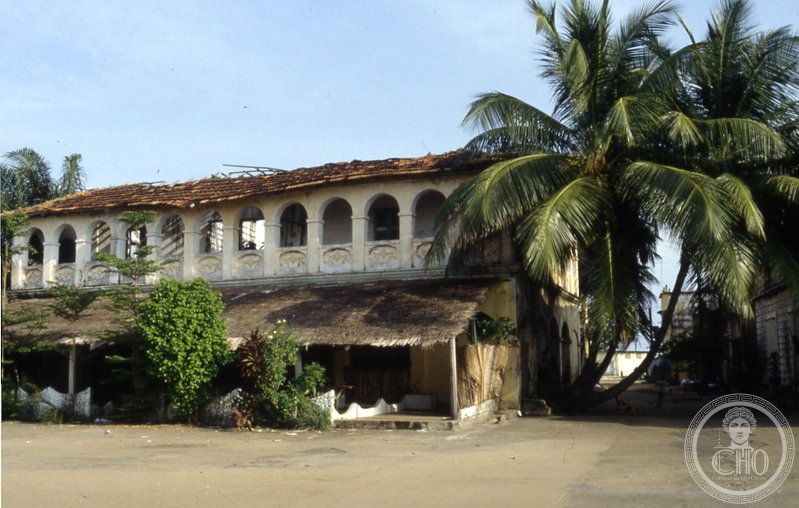
Grand-Bassam was the first capital of French Côte d’Ivoire until a yellow fever epidemic emptied it of its European population within weeks. What remains is the best-preserved French colonial townscape in West Africa, its arcaded verandas standing in deliberate decay beside the older fishing quarter of the Alladian and Nvavlé peoples.
At a glance
Grand-Bassam is built in two distinct parts either side of the Comoé River. The Quartier France occupies a sand barrier peninsula between river and sea, laid out on a grid of wide, shaded streets lined with two-storey arcaded buildings in laterite brick and lime plaster. The ground-floor arcades give shelter from sun and rain, the first-floor verandas catch the sea breeze, and many of the facades are rust-stained and crumbling: the UNESCO inscription treats this decay as authentic evidence of the town’s abandonment rather than a fault to be corrected.
Inland along the river bank lies the Quartier Impérial, the older settlement of the Nvavlé and Alladian fishing communities, with rectangular clay and palm-thatch houses and sacred groves at its edges.
Key facts
- Location: Lagunes District, southeastern Côte d’Ivoire
- Status: UNESCO World Heritage Site, inscribed 2012, reference 1322
- Historical role: first capital of French Côte d’Ivoire, from 1893
- Turning point: a yellow fever epidemic in 1899–1900 killed much of the European population and led the administration to relocate the capital to Bingerville
- Coordinates: 5.2000° N, 3.7333° W
History
The Nvavlé and Alladian peoples, related Lagoon groups whose name means roughly “Master of the Sea”, were established at the mouth of the Comoé long before French contact. A French fort was set up at Grand-Bassam in 1842 under a treaty with the Alladian chief Amon N’dri, initially as a trading post. Full colonial occupation followed in 1893, when Grand-Bassam was named capital of the newly formed territory of Côte d’Ivoire. Colonial rule brought a tax system and the portage system, under which indigenous men were conscripted to carry loads for French expeditions on foot, effectively a form of forced labour. A Catholic mission school opened in the indigenous quarter in 1895, the first school in Côte d’Ivoire.
The town’s colonial boom ended abruptly. Stagnant lagoon water behind the coastal barrier made ideal breeding ground for the mosquito that carries yellow fever, and Europeans without immunity were especially vulnerable. In 1899 an epidemic swept through the European population, killing a large proportion of it within weeks; contemporary accounts describe the hospital overwhelmed and the streets emptied of colonists. The administrator Fernand Forest moved the capital to Bingerville, on higher and better-drained ground, and the new capital was established there in 1900. Grand-Bassam never regained its colonial standing.
What you see
The Musée National du Costume occupies the former residence of the colonial-era merchant Peyrissac and holds a collection of traditional costumes and textiles drawn from across Côte d’Ivoire’s ethnic groups. Along the main street of the Quartier France runs a strip of galleries and artisan workshops selling wax prints, bronze figurines, masks and jewellery, ranging from tourist trinkets to genuinely traditional pieces.
South of the colonial quarter, the beach has become a favoured weekend destination for Abidjan’s middle class, lined with beach bars and seafood restaurants. Currents make the central stretch unsuitable for swimming, but the calmer waters further east, at Plage de Bassam or Plage de l’Est, are more forgiving.
Practical information
- Accommodation: the Taverne Bassam, the oldest hotel in the colonial quarter, offers simple rooms in a colonial building with an Ivorian restaurant; the Hôtel des Pêcheurs sits on the beach and is popular with weekend visitors from Abidjan
- Safety: the beach area was the site of a terrorist attack in March 2016; the area has since been secure, but travellers should check current advisories before visiting
- Currency and services: facilities cluster around the Quartier France and the main beach strip; confirm current details with local tourist information before travelling
Getting there
Grand-Bassam lies southeast of Abidjan, reached by road via Bingerville or by a lagoon boat crossing from Abidjan’s lagoon port, a pleasant alternative to the drive. Abidjan itself is served by Félix Houphouët-Boigny International Airport, with connections to several European and African cities; check airlines directly for current routes and schedules.
Nearby
- Abidjan — Côte d’Ivoire’s economic capital, with the Plateau business district, Aldo Spirito’s tilted Saint-Paul Cathedral of 1985, the Musée des Civilisations de Côte d’Ivoire in Cocody, and the urban rainforest of Banco National Park within the city limits
- Assinie — a beach resort area on a lagoon-and-ocean peninsula, developed since the 1960s and known for its lagoon and mangrove boat trips
Sources
- Wikipedia, Grand-Bassam
- Wikipedia, History of Côte d’Ivoire
- Wikipedia, Alladian
- UNESCO, Historic Town of Grand-Bassam
Find it on the map
See this place and what’s around it →📷 Become a Cultural Heritage Online photographer
Share your photos of places: they stay published under your name as the author. The more they're seen, the more you get noticed — and soon a contest will reward the most appreciated photos.
Log in or sign up free to add a photo