
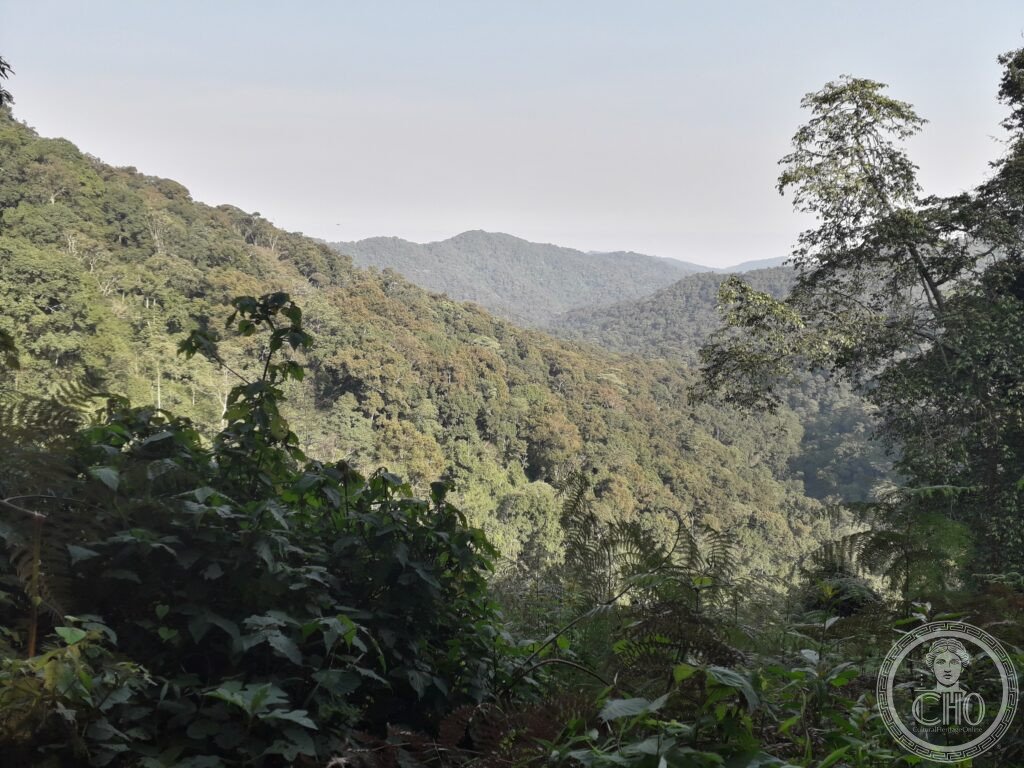
In the steep, ancient forests of the Albertine Rift, Bwindi shelters more than half the world’s remaining mountain gorillas. Trekking to reach a habituated family, through dense undergrowth that gives the forest its name, remains one of the few ways to encounter wild great apes at close range.
At a glance
Bwindi Impenetrable National Park lies in southwestern Uganda, straddling Kanungu and Kabale Districts on the edge of the Albertine Rift. It covers around 33,100 hectares of steeply mountainous montane forest and is one of the oldest forests in Africa, having remained continuously wooded since before the last Ice Age, when it served as a refuge for forest species while much of equatorial Africa dried out.
The park holds more than half the world’s mountain gorilla population, distributed among roughly fifty habituated family groups. It was inscribed as a UNESCO World Heritage Site in 1994.
Key facts
- Location: Kanungu and Kabale Districts, southwestern Uganda, on the edge of the Albertine Rift
- Area: approximately 33,100 hectares
- Key species: mountain gorilla, Gorilla beringei beringei
- Gorilla population: around 459 individuals in Bwindi, more than half the world total of roughly 1,063 (2018 census)
- Forest age: continuously forested for around 25,000 years, one of Africa’s oldest forests
- Designation: UNESCO World Heritage Site, inscribed 1994
History
Bwindi’s forest cover has persisted since before the last Ice Age, when it acted as one of the refugia that preserved equatorial forest species during a period of continent-wide drying. This long ecological continuity is thought to underlie the exceptional diversity found there today.
The forest was also the home of the Batwa, a hunter-gatherer people of the Albertine Rift who had lived there for thousands of years, relying on it for food, medicine and spiritual practice. When the area was gazetted as a National Park in 1991, the Batwa were evicted without consultation or land compensation and lost legal access to their traditional forest knowledge. Around 4,000 Batwa remain in the wider region, and their displacement is frequently cited as an example of conservation-induced displacement in Africa. More recent measures channel a share of gorilla permit revenue to surrounding communities, some Batwa now work as park guides, and a Batwa-guided cultural tourism activity has been established as a source of income.
What you see
The forest is dense and steeply mountainous, its undergrowth thick with ferns, nettles and vines, and its tree trunks heavy with epiphytic moss. The main draw is the mountain gorilla: a habituated family group might show an adult silverback at rest, juveniles and females nearby, and the animals largely indifferent to visitors once accustomed to their presence.
Beyond the gorillas, Bwindi supports around 350 bird species, including 23 found only in the Albertine Rift highlands, among them the African green broadbill, Shelley’s crimsonwing and Grauer’s rush warbler. Other primates include red-tailed monkeys, black-and-white colobus, blue monkeys and L’Hoest’s monkey, along with eastern chimpanzees that are occasionally heard but not habituated for viewing. Forest elephants move through the undergrowth mainly at night, leaving trails that form some of the main paths through the forest, and leopard and African golden cat are also present.
Practical information
- Gorilla permits: issued for a specific family group and date; book well in advance through the Uganda Wildlife Authority or a licensed tour operator, and check current fees on the official channel
- The trek: duration varies depending on where the gorillas nested, typically several hours through steep, wet forest; a strict time limit applies to the viewing itself, with a minimum distance kept from the animals and no flash photography
- Fitness: reasonable physical fitness is needed given the terrain, which rises from around 1,160 metres to 2,607 metres
- Accommodation: lodges range from community-run budget bandas near the main entrance to upscale forest lodges; bookings should be paired with a confirmed gorilla permit
Getting there
Entebbe International Airport, near Kampala, is Uganda’s main international gateway. From Kampala, Bwindi is reached by road via Mbarara and Kabale, a long overland journey that is slower in the wet season, or by a much shorter charter flight to Kihihi airstrip.
Nearby
- Queen Elizabeth National Park — around 80 km north; boat safaris on the Kazinga Channel, the tree-climbing lions of Ishasha and a cluster of crater lakes
- Mgahinga Gorilla National Park — around 40 km south; a smaller gorilla park with one habituated family, plus habituated golden monkeys and the hikeable Virunga volcanoes
Sources
- Wikipedia, Bwindi Impenetrable Forest
- Wikipedia, Mountain gorilla
- Wikipedia, Batwa
- UNESCO, Bwindi Impenetrable National Park, WHS reference 682
Find it on the map
See this place and what’s around it →📷 Become a Cultural Heritage Online photographer
Share your photos of places: they stay published under your name as the author. The more they're seen, the more you get noticed — and soon a contest will reward the most appreciated photos.
Log in or sign up free to add a photo