
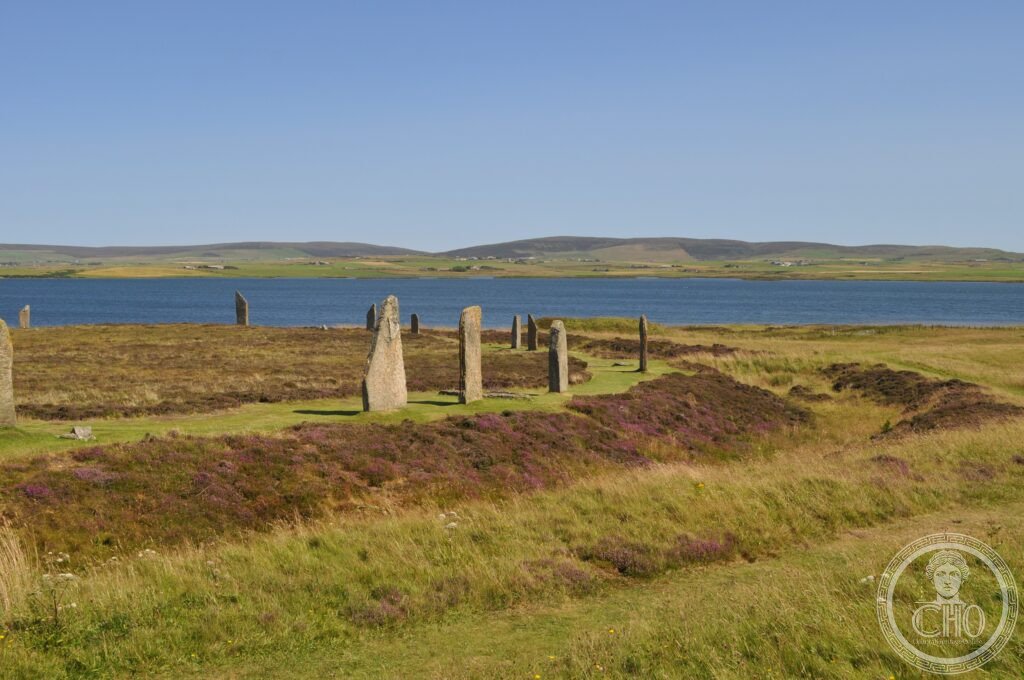
On the Mainland of Orkney, four Neolithic monuments raised over six centuries form one of the most complete ceremonial landscapes surviving from prehistoric Europe. The Ring of Brodgar’s stone circle, Maeshowe’s solstice-aligned tomb, the Standing Stones of Stenness and the buried village of Skara Brae together record the funerary and communal life of the people whose pottery style spread across Britain and may have shaped the culture that built Stonehenge.
At a glance
Heart of Neolithic Orkney is the collective name for four prehistoric monuments on the Mainland of Orkney, inscribed as a UNESCO World Heritage Site in 1999. They were built across roughly six centuries, between about 3100 and 2500 BCE: the chambered cairn of Maeshowe, the Standing Stones of Stenness, the Ring of Brodgar, and the settlement of Skara Brae. A fifth element, the Ness of Brodgar, lies between the stone circles and has been under excavation since 2003, adding steadily to what is known about the whole landscape.
The monuments sit close together on a narrow neck of land between the lochs of Harray and Stenness, a setting that appears to have been chosen deliberately by their builders.
Key facts
- Components: Maeshowe chambered cairn, Standing Stones of Stenness, Ring of Brodgar, Skara Brae settlement, plus the Ness of Brodgar excavation site
- Date range: approximately 3100–2500 BCE
- Maeshowe: a burial mound around 35 metres across and 7 metres high, with an entrance passage about 11 metres long aligned on the midwinter sunset
- Ring of Brodgar: a stone circle 104 metres in diameter, with 27 of an original 60 stones surviving, set within a ditch cut into bedrock
- Standing Stones of Stenness: the oldest of the group, with four surviving stones, the tallest 5.7 metres high
- Skara Brae: eight interconnected stone houses at the Bay of Skaill, preserved under sand for around 4,500 years
History
The people who built these monuments are known to archaeologists as the Grooved Ware people, named after a distinctive style of round-bottomed pottery with incised geometric decoration. This pottery style spread from Orkney across Britain during the third millennium BCE, and Orkney is thought by some to have been its point of origin, which would make it a starting point for the culture that later built Stonehenge. The building sequence moved from funerary architecture towards ceremonial architecture: Maeshowe and the Standing Stones of Stenness were raised first, around 3100 BCE, with the Ring of Brodgar following later.
Maeshowe has a second, much later chapter. In the twelfth century, a group of Norsemen, probably crusaders or pilgrims travelling towards Jerusalem, broke into the mound to shelter from a storm and carved more than thirty runic inscriptions into its walls, the largest such collection found anywhere. The carvings include boasts, a claim that treasure had already been removed from the mound, and images of a lion, a serpent and a walrus.
What you see
At the Ness of Brodgar, ongoing excavation led by archaeologist Nick Card has uncovered Structure 10, the largest known Neolithic building in northern Europe, measuring 25 by 20 metres with walls at least 0.7 metres thick. It is thought to have been a communal hall capable of holding over a hundred people, possibly used for feasting during midwinter ceremonies that culminated at Maeshowe. Excavators have also found tens of thousands of animal bones on the site, mostly cattle, including a single deposit of around 400 bones from one feast, suggesting that people gathered here from a wide area of Scotland and beyond.
At Skara Brae, visitors look down into houses that retain their original stone furniture: box beds either side of a central hearth, a stone dresser opposite the entrance, and recessed storage cells in the walls. The houses are linked by low, roofed passages, and their layout is thought to reproduce in stone what would otherwise have been the standard timber Neolithic dwelling elsewhere in Europe, a form that has not survived anywhere else.
Practical information
- Ring of Brodgar and Stenness: managed by Historic Environment Scotland and freely accessible; no ticket needed
- Maeshowe: visited only with a guided tour, which must be booked in advance through the Maeshowe Visitor Centre at Stenness; the passage is entered on hands and knees
- Skara Brae: has its own visitor centre, with admission also covering the adjacent Skaill House; check current arrangements before visiting
- Distances from Kirkwall: the Ring of Brodgar and Stenness lie about 16 km west of the town, Skara Brae about 28 km west on the coast at Skaill Bay
Getting there
Orkney is reached by air through Kirkwall Airport, with flights from several Scottish and, seasonally, Norwegian airports, or by ferry with NorthLink Ferries from Scrabster near Thurso to Stromness, a crossing through the Pentland Firth. From Kirkwall, the stone circles and Skara Brae are reached by car or by tour bus.
Nearby
- Kirkwall — about 16 km east, Orkney’s capital, home to St Magnus Cathedral, begun in 1137, and the Orkney Museum in the old Bishop’s Palace
- St Magnus Cathedral, Kirkwall — a Romanesque cathedral built of red and yellow Orkney sandstone, containing the tomb of St Magnus
- Italian Chapel, Lamb Holm — about 14 km east of Kirkwall, built by Italian prisoners of war in 1943–44 from two Nissen huts and scrap metal
Sources
- Historic Environment Scotland
- UNESCO
Find it on the map
See this place and what’s around it →📷 Become a Cultural Heritage Online photographer
Share your photos of places: they stay published under your name as the author. The more they're seen, the more you get noticed — and soon a contest will reward the most appreciated photos.
Log in or sign up free to add a photoIs this page about you?
This page is read by travellers and heritage enthusiasts who find it on Google. Tell us how you are connected to this place and we will take it from there.