
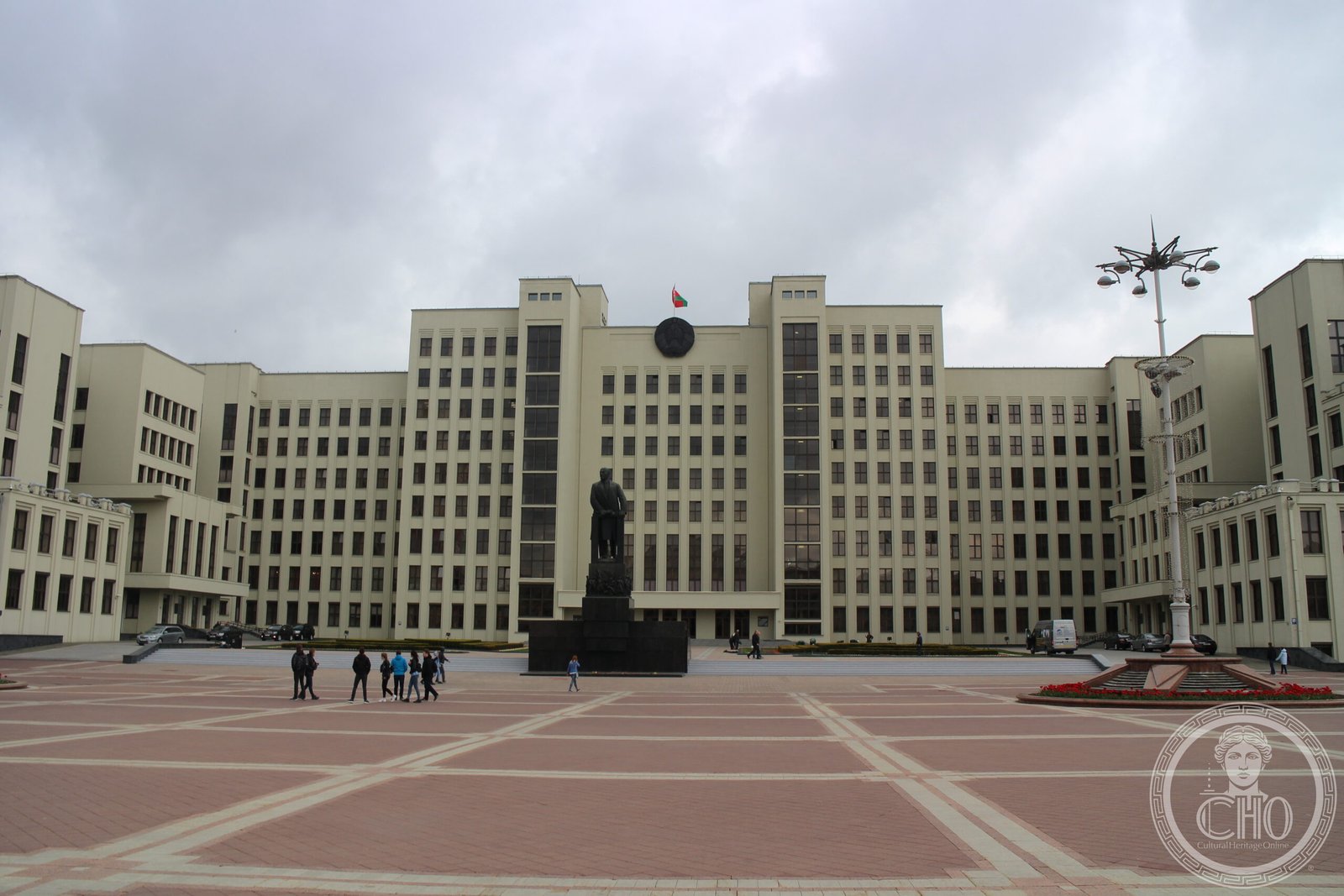
The Government House in Minsk is a landmark of Soviet Constructivism — a bold modernist movement that emerged in parallel with Western Art Déco — designed by architect Iosif Langbard and completed in 1934. Dominating Independence Square at the heart of the Belarusian capital, it is the seat of the National Assembly of Belarus and one of the few major pre-war buildings in Minsk to survive World War II intact.
At a glance
- Type
- Government building
- Period
- 1930–1934
- Style
- Soviet Constructivism
- Location
- Independence Square, Minsk, Belarus
- Coordinates
- 53.8961° N, 27.5448° E
- Architect(s)
- Iosif Langbard
Overview
Standing on Independence Square in central Minsk, the Government House is the largest public building erected in the Belarusian Soviet Socialist Republic before World War II. It currently houses the National Assembly of Belarus — the country’s parliament — comprising both the Council of the Republic and the House of Representatives. A towering Vladimir Lenin statue stands before its main façade, making the ensemble one of the most recognisable civic spaces in the former Soviet Union. The building’s survival through wartime devastation that levelled much of Minsk gives it exceptional historical weight.
History
The design was selected through an architectural competition won by Iosif Langbard in 1929, and construction proceeded from 1930 to 1934. During the Nazi occupation of Minsk (1941–1944) the building served as Gestapo headquarters — a grim chapter that deepened its symbolic resonance for Belarusians after liberation. The Lenin statue that originally stood in front was melted down by occupying forces; it was restored after 1945 using an original casting that had been preserved in Leningrad. On 20 July 1994, the hall hosted the first presidential inauguration of Alexander Lukashenko, cementing the building’s role as the ceremonial centre of the Belarusian state.
Architecture & Design
Langbard designed the Government House in the Soviet Constructivist idiom — a movement that flourished in the USSR from the early 1920s through the mid-1930s. Where Western Art Déco favoured decorative ornament, stepped ziggurat silhouettes, and luxurious materials, Soviet Constructivism privileged function, geometric clarity, and the honest expression of structure. The Minsk building features a monumental rectilinear block massing, large rhythmic window bays, and austere stone cladding stripped of applied decoration. Its staircase is flanked by busts of Karl Marx and Friedrich Engels, the only ideological embellishment on an otherwise sober façade. The result is a building that communicates state authority through mass and proportion rather than surface richness.
Cultural significance
The Government House is a rare intact survivor of Soviet Constructivist civic architecture in Eastern Europe and a defining image of Minsk’s pre-war urban identity. Its survival amid the near-total destruction of the city during World War II — when an estimated 80 percent of Minsk’s buildings were razed — makes it an anchor of collective memory and an irreplaceable document of early Soviet architectural ambition. It remains the ceremonial and legislative heart of the Belarusian republic, lending continuity across radically different political eras.
Visiting today
The Government House is an active legislative building and is not open to the general public for interior visits. The exterior and Independence Square, however, are freely accessible and form a popular civic promenade. The Lenin statue and the broad square create a photogenic ensemble that attracts visitors exploring central Minsk. Guided city walking tours regularly include a stop here to explain Minsk’s Soviet-era urban planning.
Getting there
The building sits on Independence Square (Ploshcha Nezalezhnosti) in central Minsk. The nearest metro station is Ploshcha Lenina on Line 1 (red), a one-minute walk. Numerous city bus and trolleybus routes stop along Independence Avenue (Praspiekt Nezalezhnosti), which runs directly past the square.
Sources & resources
Find it on the map
See this place and what’s around it →Record researched and written by Luigi De Marchi for Cultural Heritage Online, 2026.
📷 Become a Cultural Heritage Online photographer
Share your photos of places: they stay published under your name as the author. The more they're seen, the more you get noticed — and soon a contest will reward the most appreciated photos.
Log in or sign up free to add a photoIs this page about you?
This page is read by travellers and heritage enthusiasts who find it on Google. Tell us how you are connected to this place and we will take it from there.