

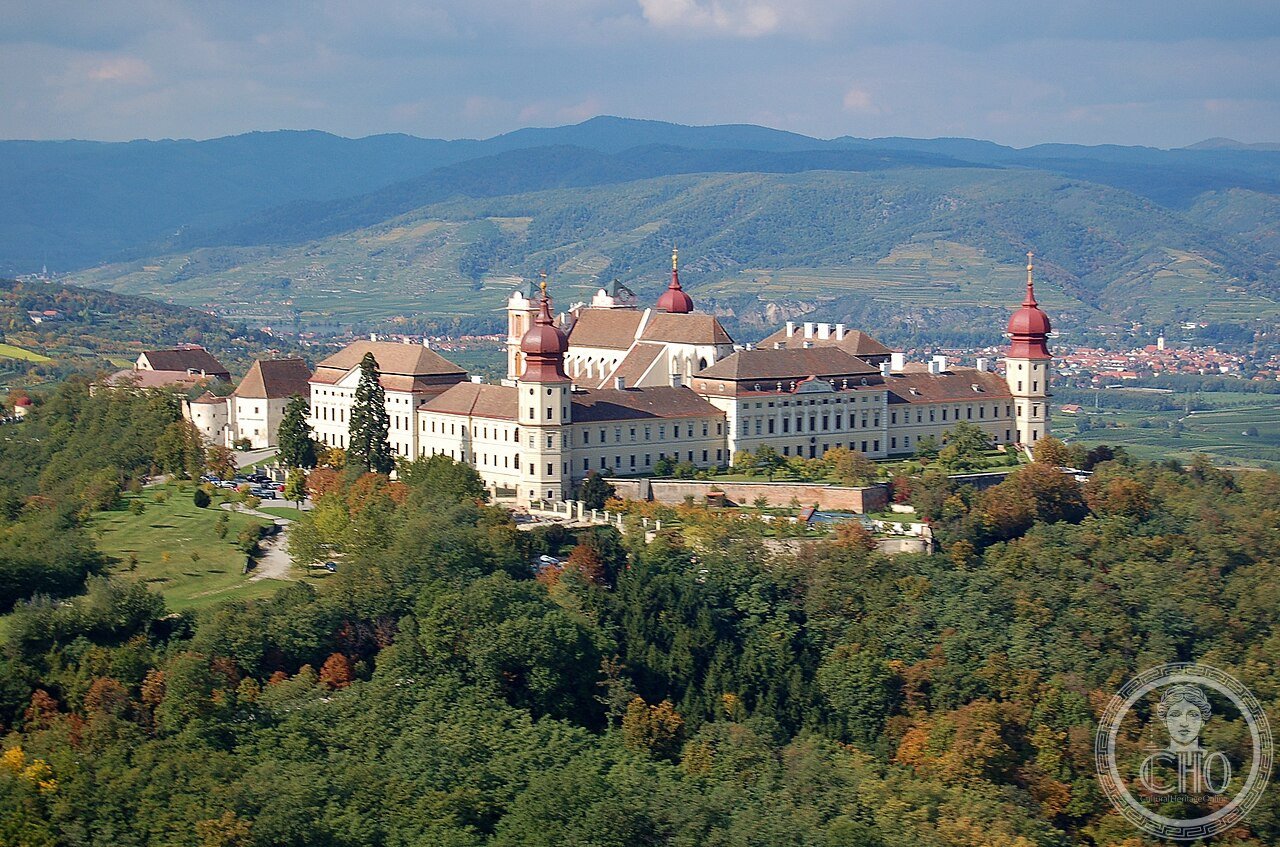
Between 1556 and 1564 Göttweig Abbey was left without an abbot, and by 1564 not a single monk lived there any more. It survived that crisis and a fire in 1580, but it was a second fire, in 1718, that offered the occasion for its definitive rebirth: Abbot Gottfried Bessel commissioned from the architect Johann Lucas von Hildebrandt a rebuilding inspired by the Spanish Escorial, which gave the abbey the largest Baroque staircase in Austria.
About Göttweig Abbey
Göttweig Abbey was founded in 1083 by Bishop Altmann of Passau; its foundation charter, dated 9 September 1083, still survives. Originally established as a house of canons regular, the community was placed under the Rule of Saint Benedict in 1094 by Abbot Hartmann, brought in from St. Blaise’s Abbey. The monastery’s fortunes declined sharply by the 16th century: between 1556 and 1564 it had no abbot at all, and by 1564 not a single monk remained in residence. It survived this near-extinction and a subsequent fire in 1580, rebuilt under Michael Herrlich from Melk Abbey, only to be struck by a second, far more consequential fire in 1718. Under Abbot Gottfried Bessel (1714-1749), the monastery was rebuilt on a grander scale entirely, to designs by the architect Johann Lucas von Hildebrandt explicitly inspired by the Spanish royal monastery of the Escorial. The rebuilt abbey’s Imperial Staircase is the largest Baroque staircase in Austria, its ceiling fresco — painted by Paul Troger in 1739, depicting Holy Roman Emperor Charles VI as Apollo — considered a masterpiece of Austrian Baroque art. The abbey’s library today holds some 150,000 books and manuscripts, alongside significant collections of religious engravings, coins, antiquities, musical manuscripts, and natural history specimens, nearly all of which survived the Second World War and its aftermath intact. Since 1625 a member of the Austrian Congregation within the Benedictine Confederation, the abbey today houses around thirty monks and sits within the UNESCO World Heritage Wachau Cultural Landscape, its vineyards home to the highest apricot orchard in the Wachau valley.
Key facts
- Foundation: 1083, by Bishop Altmann of Passau; charter dated 9 September 1083 still preserved
- 1094: community adopts the Rule of Saint Benedict under Abbot Hartmann
- 1556-1564: abbey without an abbot; by 1564, not a single monk remained
- 1580 and 1718: two major fires; the second prompts a complete Baroque rebuilding
- 1714-1749: reconstruction under Abbot Gottfried Bessel, architect Johann Lucas von Hildebrandt, inspired by the Escorial
- 1739: Paul Troger paints the Imperial Staircase ceiling fresco, depicting Charles VI as Apollo
- Library: approximately 150,000 books and manuscripts
- Today: around 30 monks; part of the UNESCO World Heritage Wachau Cultural Landscape
History
Göttweig’s near-total collapse by 1564 — a monastery literally without a single resident monk — makes its subsequent survival and eventual Baroque transformation into one of Austria’s grandest religious buildings a particularly dramatic case of monastic institutional recovery, one that took a full century and a half and two devastating fires to complete. Abbot Gottfried Bessel’s explicit choice of the Spanish Escorial as an architectural model for the 1718 reconstruction reflects the ambitions of Austrian Baroque prince-abbots of the period to rival the grandest royal and ecclesiastical building projects of Habsburg Europe, even though the full scale of Hildebrandt’s original design was never entirely completed.
The near-complete survival of Göttweig’s library and collections through the Second World War, in an era when many comparable Central European monastic archives suffered catastrophic losses, gives the abbey’s 150,000-volume collection an unusually intact continuity stretching back centuries, making it a genuinely significant surviving resource for the study of Austrian monastic, religious, and cultural history.
What you see
The abbey’s Imperial Staircase (Kaiserstiege), the largest Baroque staircase in Austria, is crowned by Paul Troger’s 1739 ceiling fresco depicting Emperor Charles VI as Apollo, widely regarded as a high point of Austrian Baroque decorative painting. The abbey library preserves its 150,000-volume collection within richly decorated Baroque interiors. Set high above the Danube within the Wachau valley, the monastery complex commands sweeping views over the surrounding vineyard landscape, itself protected as part of the UNESCO World Heritage Wachau Cultural Landscape.
Practical information
- Opening hours: generally open seasonally to visitors; check current hours before visiting; admission fee applies
- Address: Stift Göttweig 1, 3511 Furth bei Göttweig, Austria
Getting there
Göttweig Abbey is reachable by car from Krems an der Donau (approximately 15 minutes) in Lower Austria, overlooking the Danube in the Wachau valley. GPS: 48.3665° N, 15.6124° E.
Nearby
- Krems an der Donau — approximately 15 minutes away; historic Wachau valley town
- Wachau Cultural Landscape — the UNESCO-listed Danube valley of vineyards and terraces surrounding the abbey
- Melk Abbey — another major Baroque Benedictine abbey, further along the Danube
Sources
- Wikipedia — “Göttweig Abbey” (en.wikipedia.org)
- Stift Göttweig — official site (stiftgoettweig.at)
- Encyclopedia.com — “Göttweig, Abbey of” (encyclopedia.com)
Find it on the map
See this place and what’s around it →📷 Become a Cultural Heritage Online photographer
Share your photos of places: they stay published under your name as the author. The more they're seen, the more you get noticed — and soon a contest will reward the most appreciated photos.
Log in or sign up free to add a photo