

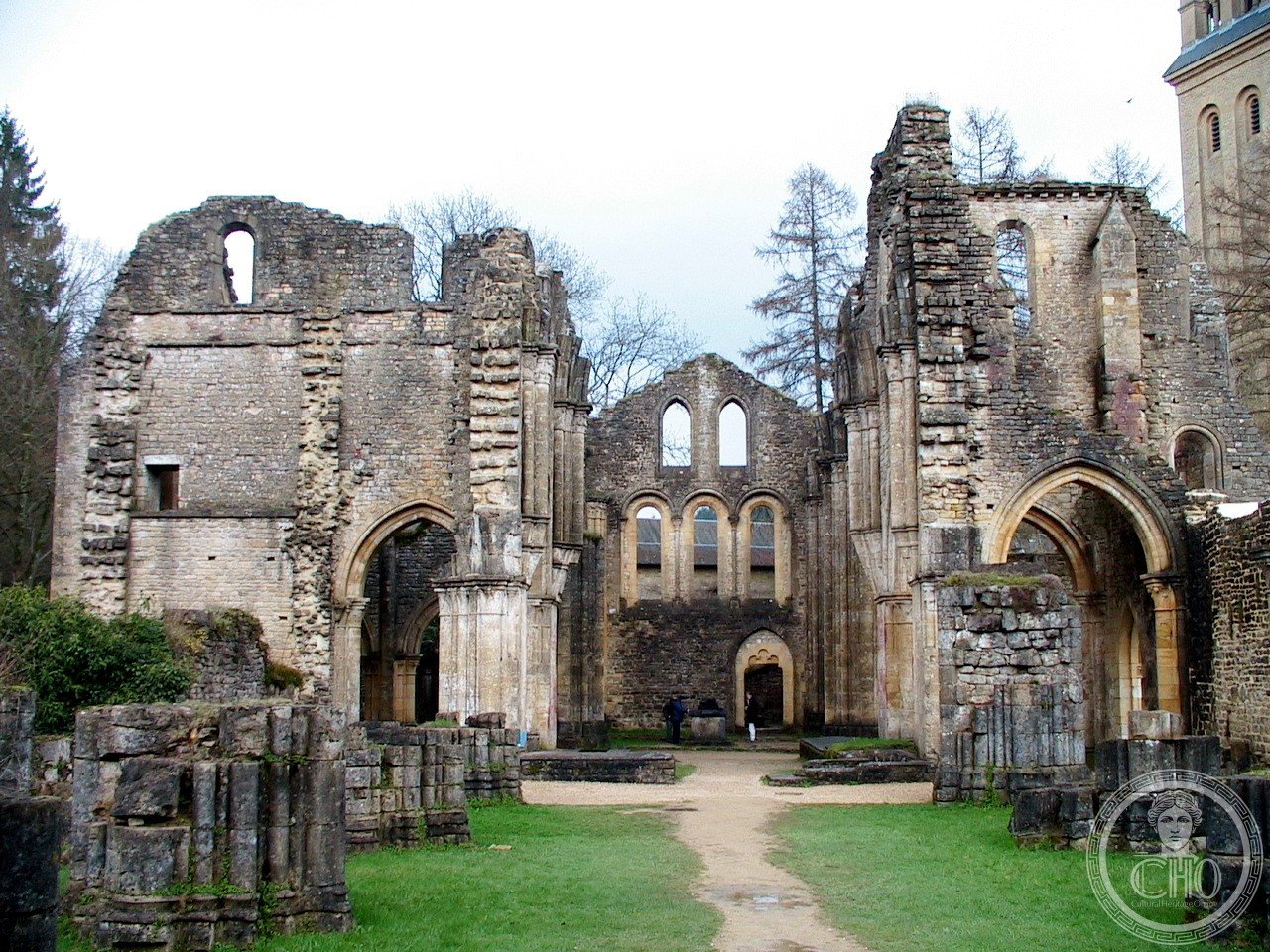
According to legend, the widowed Matilda of Tuscany lost her wedding ring in a spring and prayed to have it back; a trout rose from the water with the ring in its mouth. “This really is a Valley of Gold”, Matilda exclaimed, giving the abbey its name and paying for its foundation. Destroyed during the French Revolution, Orval was rebuilt in the twentieth century with the proceeds of a Trappist beer revived precisely to fund the work.
About Orval Abbey
Around 1070, a group of Benedictine monks from Calabria settled at the site in the Gaume region of present-day Belgium, invited by Arnold I, Count of Chiny, and Conrad I, Count of Luxembourg, and began building a church and monastery — but the community departed again after roughly forty years. In 1132, a group of Cistercian monks from Trois-Fontaines Abbey in Champagne arrived, and the two traditions merged into a single Cistercian community under its first abbot, Constantin. The abbey’s founding legend attributes its name and coat of arms to the widowed Countess Mathilde, who is said to have lost her wedding ring in a spring at the site; when she prayed for its return, a trout surfaced with the ring in its mouth, prompting her to declare the place a “Val d’Or” (Golden Valley) and to fund the new monastery in gratitude. The abbey’s medieval history was repeatedly interrupted by disaster: fire destroyed the monastery around 1252, requiring roughly a century of rebuilding, and in 1637, during the Thirty Years’ War, French mercenaries pillaged and burned the abbey. Its most complete destruction came in 1793, when French revolutionary forces burned the abbey to the ground in retaliation for the hospitality it had extended to Austrian troops, forcibly dispersing the community; the ruins stood abandoned for nearly a century. The Harenne family acquired the ruins in 1887 and donated them to the Cistercian order in 1926, when the Trappist monk Marie-Albert van der Cruyssen began directing the construction of an entirely new monastery on the site; Orval regained the formal rank of abbey in 1936, and the new abbey church was consecrated on 8 September 1948. To help fund this lengthy reconstruction, the monks revived the medieval tradition of brewing beer at the abbey in 1931, producing what has since become one of the world’s best-known Trappist beers.
Key facts
- c. 1070: Calabrian Benedictine monks first settle the site; depart after roughly 40 years
- 1132: Cistercian refoundation by monks from Trois-Fontaines Abbey, under first abbot Constantin
- Founding legend: Countess Mathilde’s lost ring, returned by a trout, giving the abbey its name and coat of arms
- 1252: monastery destroyed by fire, rebuilding takes about a century
- 1637: pillaged and burned by French mercenaries during the Thirty Years’ War
- 1793: completely destroyed by French revolutionary forces; community dispersed
- 1887-1948: ruins acquired by the Harenne family (1887), donated to the Cistercians (1926); new monastery built, abbey rank regained 1936, new church consecrated 8 September 1948
- 1931: beer brewing revived to fund the reconstruction; still produced today as one of the world’s leading Trappist beers
History
Orval’s repeated cycle of destruction and rebuilding — fire in 1252, pillaging in 1637, and complete devastation in 1793 — makes it a particularly stark example of how thoroughly the French Revolution’s anticlerical campaigns could erase institutions that had already survived centuries of earlier medieval and early modern violence, leaving the site as ruins for nearly a hundred years before any attempt at restoration began. The 20th-century refoundation’s reliance on beer production specifically to fund reconstruction represents an unusually direct and commercially self-sustaining model of monastic economic revival, one that has made Orval’s Trappist beer as internationally recognisable as the abbey’s own medieval legend of the countess and the ring.
The persistence of the Mathilde-and-trout founding legend across nearly nine centuries, surviving the abbey’s total physical destruction and long abandonment, illustrates how a monastery’s foundational narrative can outlast the institution’s actual buildings by generations, providing the symbolic continuity — reflected still today in the abbey’s coat of arms — that helped justify and inspire its full 20th-century reconstruction on the original site.
What you see
The evocative ruins of the medieval abbey church, destroyed in 1793, remain open to visitors alongside the working monastery, preserving substantial sections of the Gothic and Romanesque structure including remnants of its rose window and cloister arcades. The entirely new abbey church, built between 1926 and 1948 and consecrated in 1948, stands as a functioning modern monastic building adjacent to the historic ruins, together forming a striking juxtaposition of medieval remains and 20th-century monastic architecture.
Practical information
- Opening hours: the ruins and visitor facilities are generally open daily with seasonal variation; check current hours before visiting; admission fee applies to the ruins
- Address: Abbaye Notre-Dame d’Orval, Orval 1, 6823 Villers-devant-Orval, Belgium
Getting there
Orval is reachable by car from Florenville (approximately 10 minutes) or Arlon (approximately 45 minutes), in the province of Luxembourg, Wallonia. GPS: 49.6409° N, 5.3500° E.
Nearby
- Florenville — approximately 10 minutes away; historic town overlooking the Semois river valley
- Gaume region — the surrounding wooded landscape of southern Belgian Luxembourg
- Château de Chassepierre — a nearby historic village and heritage site
Sources
- Wikipedia — “Orval Abbey” (en.wikipedia.org)
- ChurchPOP — “When a Trout Returned a Wedding Ring: The Legend That Built an Abbey in Belgium” (churchpop.com)
- RITRIT — “Orval Abbey” (ritrit.com)
Find it on the map
See this place and what’s around it →📷 Become a Cultural Heritage Online photographer
Share your photos of places: they stay published under your name as the author. The more they're seen, the more you get noticed — and soon a contest will reward the most appreciated photos.
Log in or sign up free to add a photo