
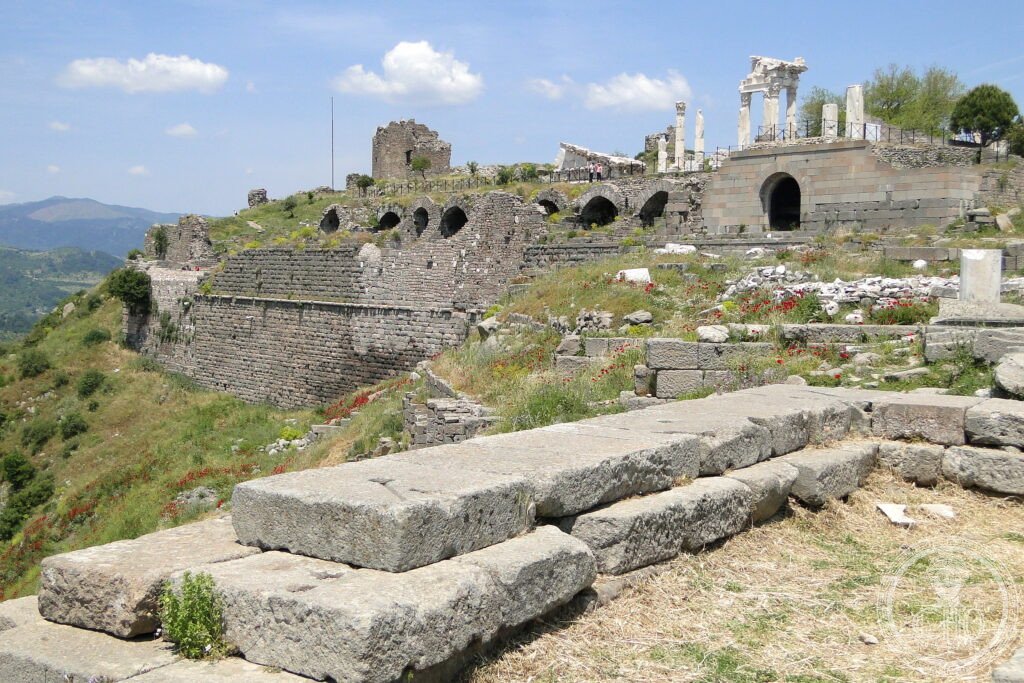
Once the Hellenistic capital of the Attalid kings, Pergamon rivalled Alexandria as a centre of learning and gave the world parchment. Its acropolis holds one of the steepest theatres of antiquity, the remains of a vast library, and the platform of the Altar of Zeus, whose sculpted frieze now stands reconstructed in Berlin.
At a glance
Pergamon rises above the modern town of Bergama in Izmir Province, its acropolis crowned by the reconstructed columns of the Temple of Trajan. Below the summit lies the steeply raked theatre of the Hellenistic period, and further down the hill the foundations of the great library once said to hold two hundred thousand scrolls, second in the ancient world only to Alexandria.
The site is inscribed on the UNESCO World Heritage List, recognised in 2014 for its Hellenistic acropolis, its Asclepion healing sanctuary, and the layered remains of the later Roman city.
Key facts
- Location: Bergama, Izmir Province, Turkey (39.1316° N, 27.1842° E)
- Founded as capital: Attalid Kingdom, roughly 282–133 BCE
- Theatre: Hellenistic, 2nd century BCE, with a steep cavea; the stage building was temporary and removed each winter to preserve the view
- Altar of Zeus: built under Eumenes II, 2nd century BCE, with a 113-metre frieze depicting the battle of the gods and giants; now reconstructed in the Pergamon Museum in Berlin
- Notable native: Galen, physician born in Pergamon in 129 CE, later court physician in Rome
- World Heritage status: inscribed by UNESCO in 2014
History
Pergamon’s fortunes began when Philetaerus, entrusted with a substantial royal treasury, broke from his overlord Lysimachus and set the city on an independent course in the early third century BCE. His successors, Eumenes I and Attalus I, consolidated the kingdom; Attalus I took the title of king after defeating the Galatians at the Caicus River in 241 BCE. Under Eumenes II, from 197 to 159 BCE, Pergamon reached its height, with the city’s library, the Altar of Zeus, and a broader cultural programme built up in explicit rivalry with Ptolemaic Alexandria.
The dynasty ended with Attalus III, who died in 133 BCE without a male heir and bequeathed the entire kingdom, its treasury, army, and territory, to the Roman People. The Senate accepted the gift and formed the Roman province of Asia around it. Pergamon remained a prominent city of Asia Minor under Rome, receiving one of the earliest temples to the imperial cult under Augustus and later the honorific title of temple warden, granted twice by Hadrian. Galen, the physician, was born here in 129 CE and trained at the city’s Asclepion before moving to Rome.
After the Roman period Pergamon passed into Byzantine hands, suffered from Arab raids from the seventh century, and came under Ottoman rule from the early fourteenth century. The site declined into the modern Turkish town of Bergama during the twentieth century, before its ancient remains were recognised by UNESCO in 2014.
What you see
The acropolis is dominated by the Temple of Trajan, a Roman-period structure with eight by six Corinthian columns, partially re-erected by the German Archaeological Institute and considered among the best-preserved Roman temples in Turkey. Below it lies the steeply banked theatre, and further down the hillside the foundations of the Attalid library, including the reading room associated with Eumenes II, along with the remains of a sanctuary to Athena, patron goddess of the city. Only the base of the Altar of Zeus survives in situ; its sculpted frieze was removed to Berlin in the nineteenth century.
About four kilometres west of the main hill lies the Asclepion, a healing sanctuary rebuilt in its present form during the Roman period. Visitors approach along the remains of the Via Tecta, a colonnaded Roman street, passing through a tunnel entrance into a complex of treatment rooms, water therapy pools, an incubation hall, and a marble fountain, along with a theatre, a council house, and a round temple to Zeus Telesphoros at its centre.
The modern town of Bergama sits below the hill and holds the Bergama Archaeological Museum and a separate Asklepion Museum, both displaying finds from the site.
Practical information
- Site management: the ancient city and the Asclepion are managed as part of Turkey’s protected archaeological areas; current opening arrangements and ticketing should be checked with the official heritage authority before visiting.
- Museums: the Bergama Archaeological Museum and the Asklepion Museum hold finds from the site and are worth combining with a visit to the ruins.
- On site: the acropolis and the Asclepion are separate areas connected by road; comfortable footwear is advisable given the steep terrain around the theatre.
Getting there
Pergamon lies above the town of Bergama in Izmir Province, on the western coast of Turkey. The acropolis and the Asclepion are reached from the modern town, with the two areas linked by road rather than forming a single walking circuit.
Nearby
- Bergama town — at the foot of the acropolis, with the Bergama Archaeological Museum
- Asclepion — around four kilometres west of the main acropolis, a Roman-period healing sanctuary with its own theatre and temple
- Asklepion Museum — in Bergama, dedicated to finds from the healing sanctuary
Sources
- UNESCO World Heritage List
- German Archaeological Institute
Find it on the map
See this place and what’s around it →📷 Become a Cultural Heritage Online photographer
Share your photos of places: they stay published under your name as the author. The more they're seen, the more you get noticed — and soon a contest will reward the most appreciated photos.
Log in or sign up free to add a photo