
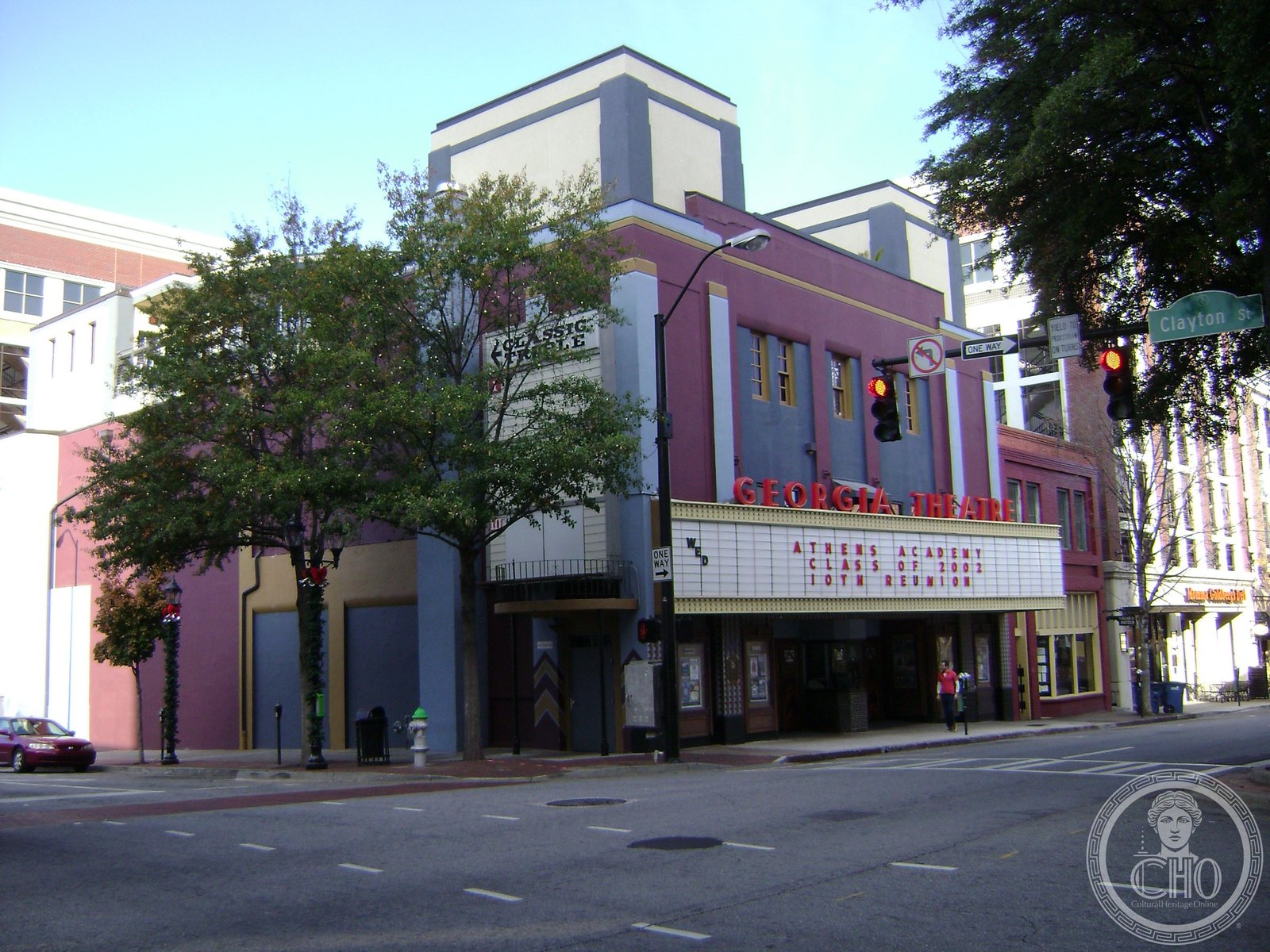
The Georgia Theatre on North Lumpkin Street has defined Athens’s cultural identity for nearly a century — an Art Moderne commercial facade that has framed live performances from R.E.M. to the world’s most sought-after touring acts.
At a glance
The Georgia Theatre stands on North Lumpkin Street in Athens, Georgia, at the intersection of the University of Georgia campus district and the independently-owned music venues that have made Athens one of the most culturally significant small cities in American rock history. The building’s 1930s Streamline Moderne commercial facade — preserved through a major fire in 2009 that gutted the interior — has become the visual emblem of a city that has generated artists, audiences, and record labels out of all proportion to its population. The restored theater continues to present live music and events in an intimate setting that reflects its origins as a neighborhood gathering place.
Key facts
- Address: 215 N Lumpkin Street, Athens, GA 30601
- Built: c. 1935 (structure); interior restored after 2009 fire
- Style: Streamline Moderne commercial architecture
- Current use: Live music venue and event hall
- County: Clarke County, Georgia
- Coordinates: 33.9603° N, -83.3776° W (Google Maps)
History
Athens, Georgia grew up as a university town around the University of Georgia — the oldest state-chartered university in the United States, founded in 1785. The commercial strip along North Lumpkin Street, immediately north of the main campus, developed steadily through the early 20th century as the city’s principal entertainment and retail district. The construction of the Georgia Theatre in the mid-1930s represented the arrival of a full-service movie palace at this campus-adjacent address, bringing the Streamline Moderne design language that had become standard for American entertainment architecture during the New Deal era to one of the South’s most vibrant college towns.
The theater’s significance grew enormously in the early 1980s, when Athens became the epicenter of an alternative rock movement centered on the University of Georgia music scene. R.E.M., the B-52s, Pylon, and dozens of other bands performed at the Georgia Theatre during formative periods of their careers. The venue’s intimate capacity and its proximity to the university made it an essential proving ground for new music, and its booking history reads as a catalog of alternative rock’s first generation.
A fire in June 2009 destroyed the theater’s interior, but the exterior facade — the defining visual element of the building’s contribution to the Lumpkin Street streetscape — survived intact. A restoration effort preserved the original Streamline Moderne exterior while rebuilding the interior to modern performance specifications, and the Georgia Theatre reopened in 2011.
What you see
The Georgia Theatre presents a characteristic mid-1930s Streamline Moderne commercial facade to Lumpkin Street: a smooth masonry composition with horizontal banding, a vertical theater sign, and the clean geometric ornament that distinguishes late Art Deco commercial buildings from the more elaborately decorated Zigzag Moderne of the late 1920s. The restored marquee projects over the sidewalk at the building’s entrance, continuing a streetscape relationship that has not changed in outline since the theater opened.
The post-2011 interior preserves the capacity and intimacy of the original hall while integrating modern stage, sound, and lighting systems appropriate for contemporary live performance. A rooftop bar with views across the Athens skyline was added during the restoration, offering a second venue space that has become one of the most popular outdoor gathering spots in downtown Athens.
Practical information
- Programming: Live music (rock, indie, folk, country), comedy, private events. Check the Georgia Theatre website for current listings.
- Tickets: Available online; many shows sell out in advance. Purchase early for popular touring acts.
- Age policy: Varies by event; check individual show pages.
- Rooftop venue: The rooftop bar is open on event nights and select non-event evenings; check the website for hours.
- Parking: Parking decks on Hull Street and Washington Street; metered street parking throughout downtown Athens.
Getting there
Hartsfield-Jackson Atlanta International Airport (ATL) is the practical gateway for most visitors, approximately 65 miles west of Athens via Interstate 20 east. Athens Ben Epps Airport (AHN), a general aviation facility, is 3 miles east of downtown and serves charter and private traffic. By road, US-78 east from Atlanta connects directly to downtown Athens; the drive takes approximately 75–90 minutes depending on Atlanta traffic. Greyhound serves Athens with connections to Atlanta; there is no Amtrak service to Athens.
Nearby
- University of Georgia Historic Campus — the main quad, Chapel, Arch, and Broad Street gates of the oldest state university in the US, a five-minute walk south of the Georgia Theatre.
- Georgia Museum of Art — the state’s official art museum, on the East Campus of UGA, with strong holdings in American art including regional Southern works.
- Morton Theatre (1910) — a half-block away on Washington Street, the Morton is one of the oldest surviving theaters built and operated by African Americans in the South, now a performing arts center.
- 40 Watt Club — the other pole of Athens’s live music culture, a block east on W Washington Street, where the 1980s Athens music scene was incubated alongside the Georgia Theatre.
Sources
- Georgia Theatre — official venue history and rebuild documentation.
- Classic City News / Athens Banner-Herald — restoration coverage, 2009–2011.
- University of Georgia — Athens Historic District designation records.
- Wikimedia Commons — Georgia Theater, Athens.JPG, CC BY-SA 3.0 (Michael Rivera).
Find it on the map
See this place and what’s around it →Record researched and written by Luigi De Marchi for Cultural Heritage Online, 2026.
📷 Become a Cultural Heritage Online photographer
Share your photos of places: they stay published under your name as the author. The more they're seen, the more you get noticed — and soon a contest will reward the most appreciated photos.
Log in or sign up free to add a photoIs this page about you?
This page is read by travellers and heritage enthusiasts who find it on Google. Tell us how you are connected to this place and we will take it from there.