

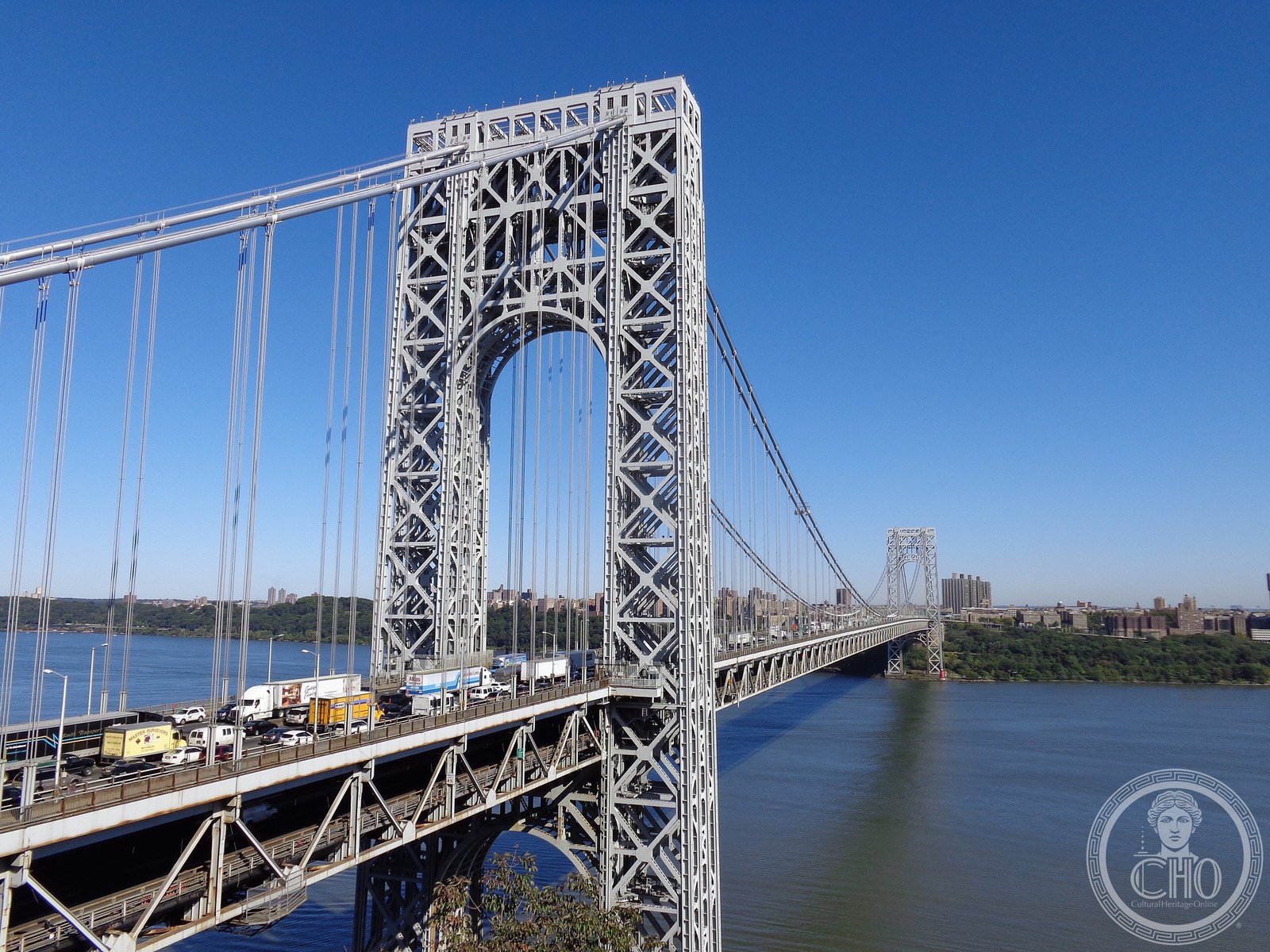
The bridge whose towers were designed to be clad in granite — until Depression-era budgets cancelled the stonework and left bare lattice steel that architects and engineers came to regard as more beautiful than any ornamental facing could have been.
At a glance
The George Washington Bridge spans the Hudson River between Fort Lee, New Jersey and Washington Heights in upper Manhattan. Completed in October 1931 under the Port Authority of New York and New Jersey, it was the world’s longest suspension bridge at its opening. The twin steel towers — rising over 600 feet above the river — became defining monuments of the Art Deco engineering era. Chief engineer Othmar Ammann designed them to support architect Cass Gilbert’s elaborate masonry cladding, but the scheme was abandoned when Depression costs mounted. The exposed steel frame that emerged from the Hudson struck observers as a revelation: Le Corbusier, visiting New York, later wrote admiringly of the towers’ unadorned structural honesty.
Key facts
- Opened: October 1931
- Chief engineer: Othmar Ammann
- Tower architect: Cass Gilbert (designer of the Woolworth Building, 1913)
- Operator: Port Authority of New York and New Jersey
- Span record: World’s longest suspension bridge at opening; surpassed by the Golden Gate Bridge in 1937
- Decks: Upper deck opened 1931; lower deck added in the early 1960s
- Named for: George Washington, who crossed the Hudson near this site during the retreat of November 1776
History
The Port Authority of New York and New Jersey, established in 1921, secured the commission for a Hudson River crossing at the Palisades and appointed Othmar Ammann — a Swiss-born engineer with growing authority over regional infrastructure — as chief engineer. Cass Gilbert, whose Woolworth Building had defined the commercial tower for a generation, was engaged as consulting architect for the towers and approaches.
Gilbert developed plans for monumental Gothic masonry piers to sheathe each steel tower in granite, turning the industrial structure into something cathedral-like above the river. As the Depression deepened through the late 1920s and early 1930s, budgets collapsed along with financing. Construction continued without the stonework, and the bare lattice-steel frame that rose from the Hudson surprised nearly everyone who saw it. The unintentional aesthetic — industrial steel exposed at enormous scale — influenced a generation of structural engineers and architects who began to question whether masonry ornament had ever been necessary at all.
The lower deck, which Ammann had built into the original structural design as a future option, was completed in the early 1960s, roughly doubling traffic capacity. Today the bridge carries more daily vehicle crossings than any other in the Western Hemisphere.
What you see
From the overlook at Fort Lee Historic Park, the full geometry reads as pure structure: two four-legged towers of open lattice steel carry the main suspension cables across the Hudson, the roadway hanging between them in a long parabolic curve. The towers stand well above 600 feet; the approach cables anchor into massive concrete blocks set into the Palisades on the New Jersey side and the bedrock of Washington Heights on the Manhattan side. Below the east tower, directly on the Manhattan shore, the red cast-iron cylinder of the Jeffrey’s Hook Lighthouse — the Little Red Lighthouse — sits above the waterline, dwarfed by the grey steel overhead. A well-known 1942 children’s book made the contrast between the small lighthouse and the immense bridge famous across the English-speaking world.
The approach structures on both shores retain their original Art Deco character: masonry toll buildings and anchor houses from 1931 carry the restrained classical massing and geometric ornament that Cass Gilbert applied to every element within his reach, even when the towers themselves were stripped bare.
Practical information
- Pedestrian and bicycle path on the upper deck open daily (seasonal hours; check the Port Authority website)
- Allow 45–60 minutes for a round-trip walk; approach ramps on the New Jersey side add considerable distance
- Best photographic viewpoints: Fort Lee Historic Park (west), Riverside Drive near 178th Street (east)
- The Little Red Lighthouse is accessible by trail from Fort Washington Park on the Manhattan shoreline
- Eastbound (Manhattan-bound) vehicle toll applies; pedestrians and cyclists cross free of charge
Getting there
From midtown Manhattan, the A train northbound reaches 175th Street in approximately 35 minutes; the pedestrian bridge entrance is a short uphill walk at 178th Street and Fort Washington Avenue. From New Jersey, Fort Lee Historic Park — the most widely photographed viewpoint — is accessible by car from Route 9W or by Trans-Bridge Lines coach service from the Port Authority Bus Terminal. Cyclists share the pedestrian path on the south side of the upper deck.
Nearby
- Fort Lee Historic Park — site of the November 1776 battle; interpretive exhibits on Washington’s retreat across New Jersey
- The Little Red Lighthouse (Jeffrey’s Hook Lighthouse, rebuilt 1921) — beneath the east tower on the Manhattan shore; celebrated in a classic 1942 children’s book
- Palisades Interstate Park — cliff-top walking along the Hudson, stretching north from Fort Lee into New York State
- The Cloisters — Metropolitan Museum of Art branch for medieval art, Fort Tryon Park, Manhattan, a short walk north along Riverside Drive
Sources
- Port Authority of New York and New Jersey, George Washington Bridge official history and engineering records
- Jameson Doig, Empire on the Hudson (Columbia University Press, 2001)
- Darl Rastorfer, Six Bridges: The Legacy of Othmar H. Ammann (Yale University Press, 2000)
- National Register of Historic Places listing (1981); ASCE Historic Civil Engineering Landmark
- New York Landmarks Preservation Commission, bridge approach structures documentation
Find it on the map
See this place and what’s around it →Record researched and written by Luigi De Marchi for Cultural Heritage Online, 2026.
📷 Become a Cultural Heritage Online photographer
Share your photos of places: they stay published under your name as the author. The more they're seen, the more you get noticed — and soon a contest will reward the most appreciated photos.
Log in or sign up free to add a photoIs this page about you?
This page is read by travellers and heritage enthusiasts who find it on Google. Tell us how you are connected to this place and we will take it from there.