

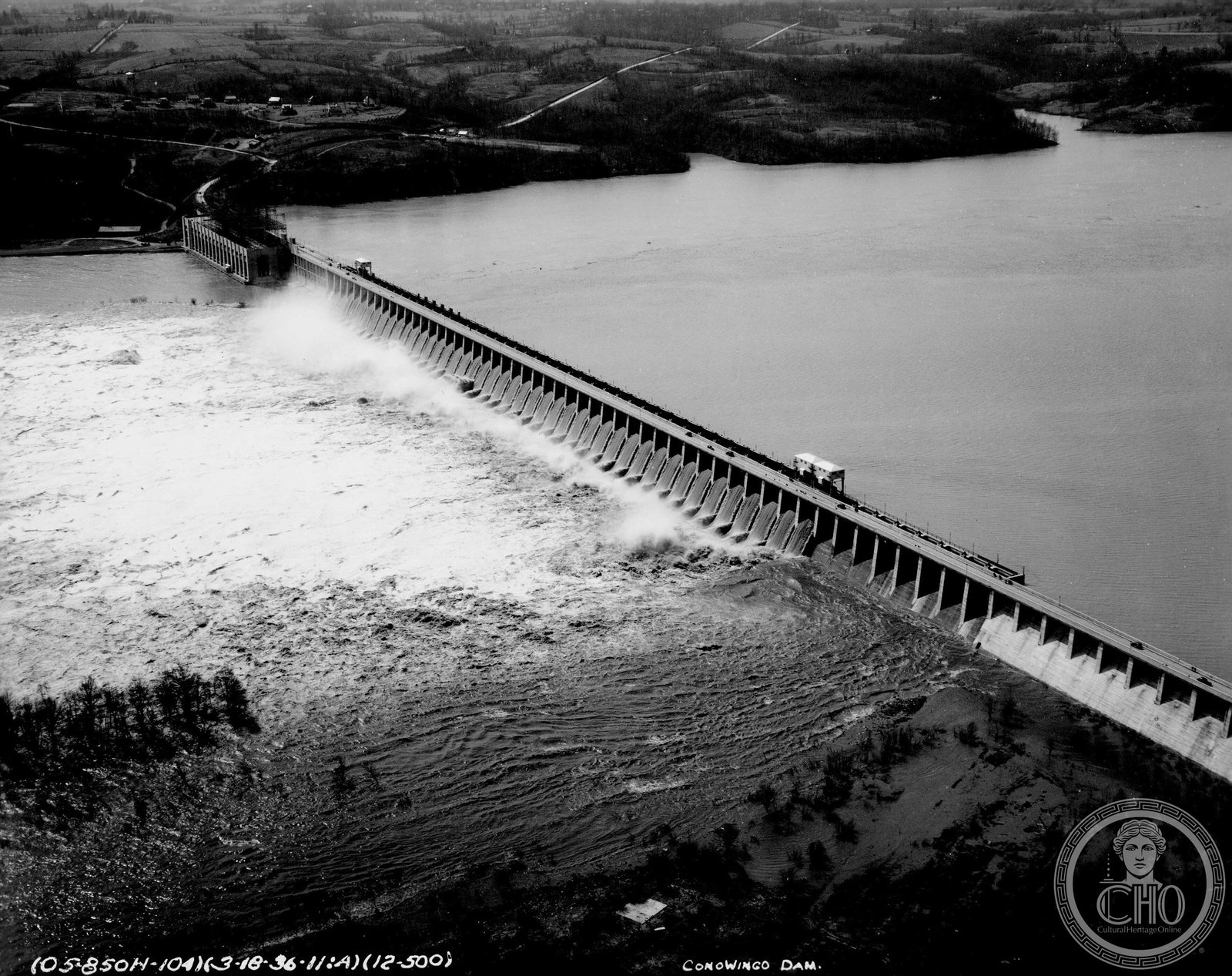
Built in just over two years by Philadelphia Electric Company, Conowingo Dam transformed the lower Susquehanna into one of the most powerful run-of-river hydroelectric stations in the eastern United States — its Art Deco powerhouse a long, composed colonnade of concrete beside the broad river.
At a glance
Conowingo Dam spans the Susquehanna River in Cecil and Harford Counties, Maryland, approximately ten miles above where the river empties into the Chesapeake Bay. Completed in 1928 for the Philadelphia Electric Company, the dam is a run-of-river structure — it generates electricity from the natural flow of the river rather than from a large impounded reservoir — and remains one of the largest such facilities on the eastern seaboard. The powerhouse, a long, low structure of smooth concrete detailed with Art Deco geometry, stretches along the Maryland bank and is visible from the surrounding countryside.
Key facts
- Location: Susquehanna River, Cecil and Harford Counties, Maryland
- Construction: 1926–1928
- Owner: Philadelphia Electric Company (now Exelon)
- Type: Run-of-river hydroelectric dam
- Powerhouse: Art Deco design; one of the largest run-of-river plants on the East Coast at opening
- Ecological role: Significant sediment trap in the Chesapeake Bay watershed; winter bald eagle congregation site
- Status: National Register of Historic Places; active generating facility
History
Philadelphia Electric Company had been studying the hydroelectric potential of the lower Susquehanna since the early twentieth century, when the rapid growth of the Delaware Valley industrial region was straining the capacity of coal-fired generation. Conowingo offered a rare combination: a narrow rocky gorge suitable for a dam foundation, a large catchment basin extending hundreds of miles into Pennsylvania and New York, and proximity to the major load centres of Baltimore and Philadelphia.
Construction proceeded from 1926 with a workforce drawn from across the mid-Atlantic states. The speed of construction — just over two years from groundbreaking to first generation — was made possible by favourable geology and the relatively modest height of the structure compared to the great Bureau of Reclamation dams being built in the West. When the dam went into service in 1928, it was one of the largest hydroelectric facilities on the eastern seaboard, and the power it produced became part of the regional grid that underpinned the growth of Philadelphia and Baltimore through the mid-twentieth century.
The dam’s most celebrated modern role is ecological: each winter, concentrations of bald eagles gather below the spillway to feed on fish disoriented by the turbulent water, drawing thousands of birders to the Conowingo area. The dam also plays a complicated role in the health of the Chesapeake Bay, trapping sediment from the upper watershed — an accumulation that, when released during major flood events, can carry nutrients and toxins into the bay.
What you see
The powerhouse stretches along the Maryland shore in a composition that demonstrates what Art Deco meant to a private utility company of the 1920s: the building must project stability, modernity, and permanence simultaneously. The exterior is faced in smooth concrete with slightly projecting window bays set within shallow pilaster frames, the whole repeated in a precise rhythm across the several hundred feet of the building’s length. The geometric mouldings at the cornice are understated rather than exuberant, expressing competence rather than extravagance.
From the Route 1 bridge upstream or from the Fisherman’s Park below the dam on the Pennsylvania side, the full scale of the structure becomes apparent: the low dam crest across the full width of the Susquehanna, the powerhouse building running parallel to it along one bank, and the broad spillway bays in between through which the river pours in curtains of white water. In winter, telescopes trained on the trees and rocks below the spillway reveal a congress of bald eagles — sometimes dozens at a time — waiting with their characteristic patience for the current to bring their next meal.
Practical information
- Viewing: Fisherman’s Park (Pennsylvania side) and the Route 1 bridge offer free public views of the dam and powerhouse
- Eagle watching: Best in January and February; weekends in winter attract organised birding groups; no admission charge for viewing areas
- Facility access: The dam and powerhouse are active industrial facilities; interior access is not generally available to the public
- Drive time: Approximately 1 hour from Baltimore; 1.5 hours from Philadelphia
Getting there
Conowingo Dam is on US Route 1 in Harford County, Maryland, approximately 10 miles north of Havre de Grace and 35 miles northeast of Baltimore. From I-95 northbound, take the exit for MD 155 toward Havre de Grace, then follow Route 155 west to US 1 and north to Conowingo. The nearest major airports are Baltimore Washington International (BWI), approximately 45 miles south, and Philadelphia International (PHL), approximately 65 miles northeast. There is no public transit to the dam.
Nearby
- Havre de Grace Decoy Museum — celebrates the region’s tradition of waterfowl hunting and decoy carving
- Susquehanna State Park — along the river south of Conowingo; hiking, heritage sites
- Ladew Topiary Gardens — Monkton, Maryland; nationally significant topiary garden estate
Sources
- National Register of Historic Places — nomination, Conowingo Hydroelectric Plant
- Exelon Corporation — Conowingo Dam history and relicensing
- USGS — Susquehanna River basin sediment studies
- Wikipedia — Conowingo Dam (cross-checked against NRHP and Exelon sources)
Find it on the map
See this place and what’s around it →Record researched and written by Luigi De Marchi for Cultural Heritage Online, 2026.
📷 Become a Cultural Heritage Online photographer
Share your photos of places: they stay published under your name as the author. The more they're seen, the more you get noticed — and soon a contest will reward the most appreciated photos.
Log in or sign up free to add a photoIs this page about you?
This page is read by travellers and heritage enthusiasts who find it on Google. Tell us how you are connected to this place and we will take it from there.