
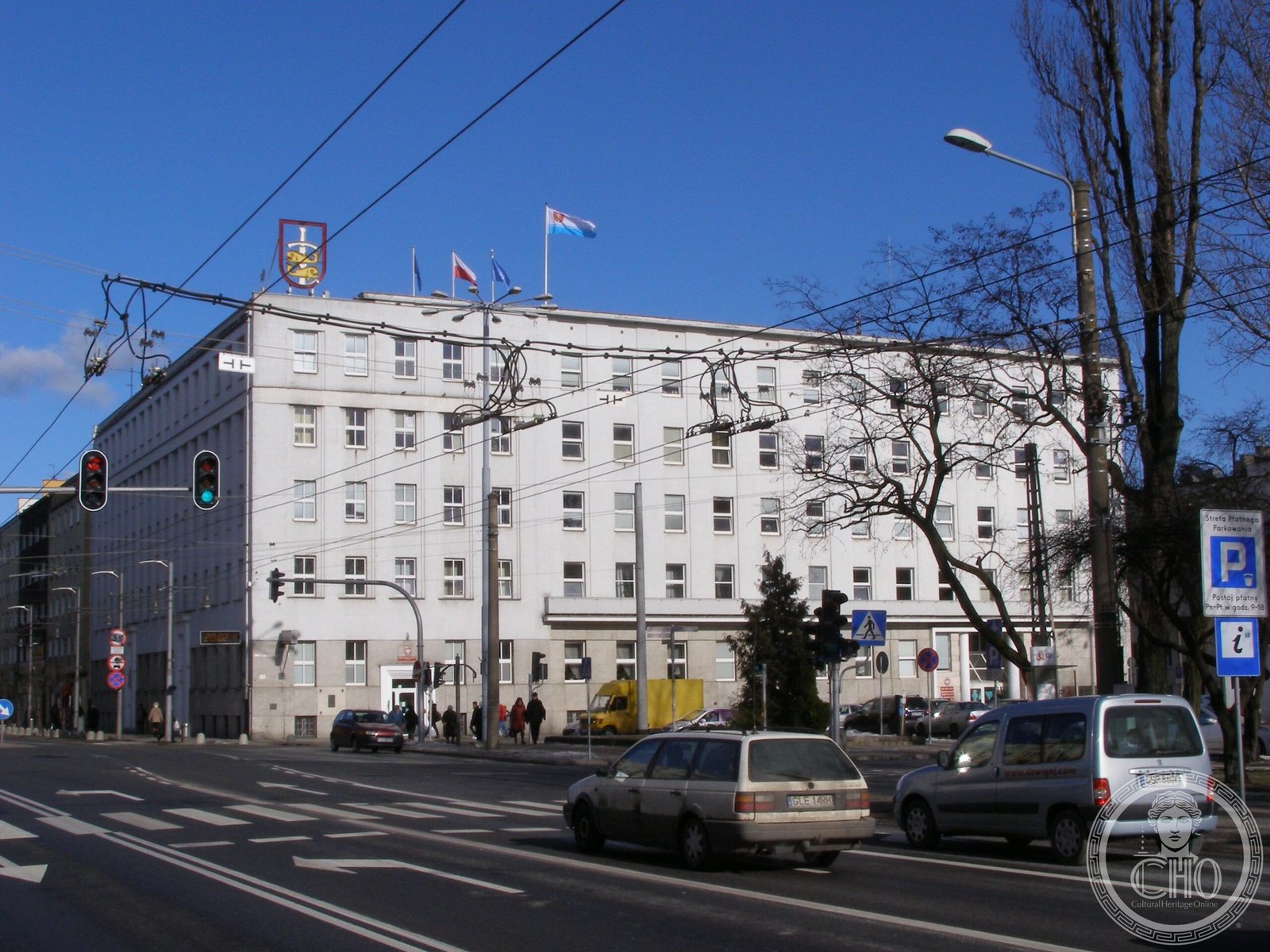
Gdynia City Hall stands as the civic crown of one of Europe’s most remarkable interwar experiments in urban planning. Built between 1930 and 1936 to designs by architects Jan Müller and Bogdan Damse, it anchors the monumental axis of a port city conjured almost from nothing after Poland regained independence in 1918. The building embodies the Polish Functionalist spirit — rational geometry softened by restrained ornament, the vertical accent of a modest tower asserting municipal authority over a busy seascape. Gdynia had been little more than a fishing village when the Treaty of Versailles granted Poland access to the Baltic; within two decades it had grown into a city of 120,000, its downtown a cohesive showcase of interwar modernism recognised today as a historical monument of Poland and a candidate for UNESCO World Heritage status. The City Hall, with its seagull sculptures and clean limestone elevations, remains the beating administrative heart of this improbable maritime capital, receiving visitors in halls that have changed little since the day they first opened.
At a glance
- Type
- Municipal government building
- Period
- 1930–1936
- Style
- Polish Modernism / Functionalism
- Location
- Świętojańska Street, Gdynia, Poland
- Coordinates
- 54.5189° N, 18.5305° E
- Architect(s)
- Jan Müller & Bogdan Damse
Overview
Gdynia City Hall is the principal public building of Poland’s purpose-built interwar port city. Completed in 1936, it occupies a commanding position along the city’s ceremonial axis and serves as the administrative seat of Gdynia’s municipal government. Its clean Functionalist lines, paired with restrained classical references and locally distinctive seagull sculptures, make it a landmark of the Polish Modernist movement and a focal point of the historic downtown district now under consideration for UNESCO inscription.
History
Poland’s access to the Baltic Sea, secured through the Treaty of Versailles in 1919, created an urgent need for a major national port. The small fishing settlement of Gdynia was chosen, and an extraordinary programme of urban construction commenced in the early 1920s. The 1926 master plan by Adam Kuncewicz and Roman Feliński imposed a rational grid on the growing city, with a broad civic axis connecting inland Plac Kościuszki to the southern pier. Construction of the City Hall began in 1930 under architects Jan Müller and Bogdan Damse, who had trained in the European Functionalist tradition influenced by Erich Mendelssohn. The building was inaugurated in 1936, just three years before the Second World War would reduce much of the newly built city to rubble. Gdynia’s centre, however, survived relatively intact and was designated a historical monument of Poland in 2015.
Architecture & Design
The City Hall presents a symmetrical facade in pale limestone, its central block rising into a rectilinear tower that provides orientation across the city grid. The massing is Functionalist in its rejection of applied historical ornament, yet the composition retains an axial solemnity appropriate to civic architecture. Seagull sculptures — a recurring motif throughout Gdynia’s public buildings, evoking the city’s maritime identity — animate the principal elevation. Horizontal window bands and flush wall planes reflect the influence of German and French modernism current in European architectural schools of the late 1920s. Interior spaces feature well-preserved terrazzo floors and restrained wood panelling characteristic of the period. The building sits within what survives as one of the most coherent ensembles of interwar Functionalist civic and commercial architecture anywhere in Europe.
Cultural significance
Gdynia City Hall is inseparable from the story of modern Poland’s self-invention as a maritime nation. The building represents the ambition and optimism of the Second Polish Republic — a state that built a functioning port metropolis in under two decades and equipped it with architecture of European quality. The wider historic downtown, of which the City Hall is the centrepiece, has been proposed for UNESCO World Heritage status, with comparisons drawn to the White City of Tel Aviv and Asmara for the rarity and coherence of its interwar Modernist fabric. The seagull motif embedded in the building’s ornamental programme has become a symbol of Gdynia identity.
Visiting today
The building remains an active municipal government seat, and public access is limited to the ground-floor hall and any civic events open to residents. Visitors exploring Gdynia’s Modernist heritage typically combine a walk along Świętojańska Street with the nearby Kamienica Żeromskiego and the Southern Pier. The Gdynia City Museum (Muzeum Miasta Gdyni) offers an excellent introduction to the city’s interwar history before exploring on foot.
Getting there
Gdynia is served by the SKM commuter rail from Gdańsk and Sopot; alight at Gdynia Główna station, a 10-minute walk from the City Hall via ul. 10 Lutego. Direct PKP Intercity trains connect Warsaw Centralna to Gdynia Główna in approximately 2 hours 45 minutes. By car, the A1 motorway links the Tri-City with southern Poland. Gdańsk Lech Wałęsa Airport is 35 km from Gdynia, reachable by bus or taxi.
Sources & resources
Find it on the map
See this place and what’s around it →Record researched and written by Luigi De Marchi for Cultural Heritage Online, 2026.
📷 Become a Cultural Heritage Online photographer
Share your photos of places: they stay published under your name as the author. The more they're seen, the more you get noticed — and soon a contest will reward the most appreciated photos.
Log in or sign up free to add a photoIs this page about you?
This page is read by travellers and heritage enthusiasts who find it on Google. Tell us how you are connected to this place and we will take it from there.