
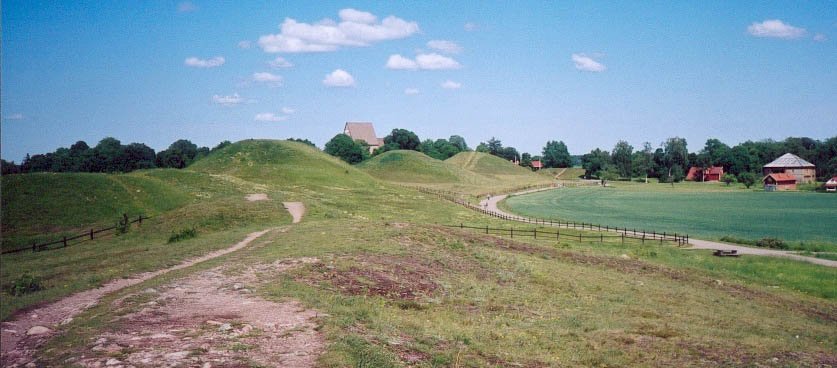
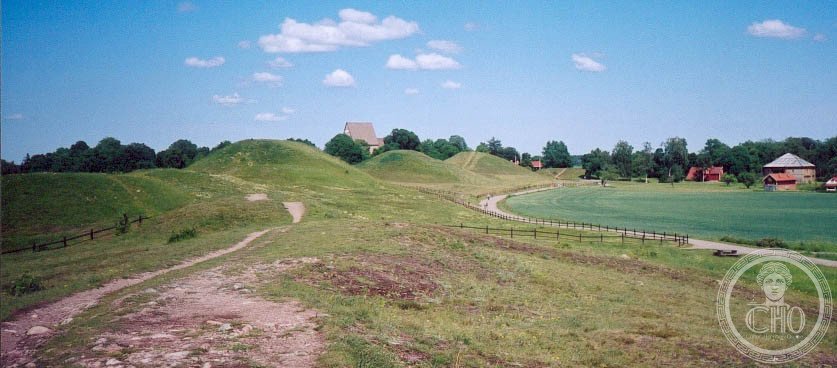
Five kilometres north of modern Uppsala, three colossal burial mounds mark the graves of the Svear royal dynasty and stand above the site of the most important pagan temple in northern Europe — a place where gold-clad gods received nine-yearly sacrifices of nine males of every species, including humans.
At a glance
Gamla Uppsala (Old Uppsala) is a low ridge above the Swedish plain bearing three great earth mounds — the King’s Mounds (Kungshögarna) — dated to the 5th and 6th centuries AD, when this was the ceremonial and religious capital of the Svear kingdom from which Sweden takes its name. The site combines royal burial archaeology of extraordinary richness with the location of Scandinavia’s most celebrated pre-Christian temple, described by the German chronicler Adam of Bremen around 1070 AD as covered in gold and the scene of a nine-yearly sacrifice festival. A 12th-century Romanesque church now stands on or near the temple site.
Key facts
- Period: Migration Period through Viking Age, c. 500–1100 AD
- The three great mounds: Eastern, Western, and Northern Mounds — each 60–70 m in diameter and 9–10 m tall
- Excavations: Eastern Mound 1846; Western Mound 1874; both contained cremation burials of royal quality
- Adam of Bremen’s temple: described c. 1070 AD as gold-covered, holding statues of Odin, Thor, and Freyr; nine-day festival every nine years with nine sacrifices of every species including humans
- Church foundation: large Viking-age post-holes found beneath the 12th-century church floor suggest the timber temple preceded it on the same spot
- Wider complex: approximately 250 additional burial mounds surround the three great ones, most unexcavated
- UNESCO status: on Sweden’s national tentative list for World Heritage inscription
History
The three Kungshögarna are believed to contain the remains of three Svear kings of the Yngling dynasty — the royal lineage whose names survive in the Old Norse poem Ynglingatal, the Icelandic saga Ynglinga saga by Snorri Sturluson, and possibly in the Old English epic poem Beowulf. The Western Mound, excavated in 1874, yielded the cremated remains of a man of approximately 50 years old, accompanied by a sword, a decorated comb, fine clothing, gaming pieces, and the bones of sacrificed animals — a pyre so intensely hot that glass had vitrified and gold had melted together. Byzantine sources of the same period describe royal Scandinavian funerary practices in terms that match this assemblage precisely.
The pagan religious centre at Gamla Uppsala reached its peak between roughly 400 and 1000 AD. Adam of Bremen’s description of the temple, written around 1070 based on oral testimony from people who had attended the festival, is the most detailed account of Norse paganism from any written source: a large building decorated with gold, containing gold-plated statues of Odin (with arms), Thor (with a sceptre), and Freyr (in a state of ithyphallic arousal), beside which a sacred grove held the bodies of sacrificed men and animals hanging from the trees. Every nine years the Dísablót festival drew attendees from all over Sweden; absence from the sacrifice was punishable by exile and confiscation of property. When Christianity arrived in Sweden in the 11th century, the Uppsala temple was one of the last pagan sanctuaries to be dismantled, reportedly destroyed by the Christian king Inge the Elder around 1090 AD.
A Romanesque stone church was built at Gamla Uppsala in the early 12th century, replacing a wooden church that had itself replaced the temple. Post-holes found beneath the stone church floor during excavations in the 1920s are consistent with a large timber structure of Viking-age date. The church contains runestones reused as building material and a carved Romanesque interior depicting scenes from Norse mythology, including what has been identified as a representation of the battle of Ragnarök.
What you see today
The three great mounds dominate the low landscape, visible for kilometres across the flat Uppsala plain. The Eastern Mound is the most accessible, with a path to the summit. Between the mounds and the church, a fourth smaller mound — identified by tradition as the Blót Mound — marks the alleged site of the sacrificial rituals. The 12th-century church of Gamla Uppsala retains its original Romanesque tower and nave, with painted medieval interior scenes. Several Viking-age runestones, reused as building material during the church’s construction, have been relocated and are visible beside the building.
The broader landscape of Gamla Uppsala is threaded with lesser mounds — the remnants of an elite cemetery that spread across the ridge over several centuries. A small museum on the site presents finds from the excavations of the great mounds and reconstructions of the burial assemblages, including replicas of the gold and textile fragments from the Eastern Mound and the sword and gaming pieces from the Western Mound.
Practical information
- Address: Gamla Uppsalavägen, 750 02 Uppsala, Sweden
- Opening: The mounds and grounds are always open (free). The museum has seasonal hours; check the Uppsala Museum website before visiting.
- Admission: Mounds and church exterior — free. Museum and church interior — small fee.
- Best time to visit: May–September for clear conditions; the midsummer sunrise alignment is best observed from the ship’s centre on 21–22 June.
- Facilities: Museum café and shop on site; accessible parking nearby.
Getting there
Gamla Uppsala is 5 km north of Uppsala city centre. From Uppsala Central Station, take bus line 2 (direction Gamla Uppsala) — journey approximately 15 minutes. By car, follow road 290 north from Uppsala; the site is signed. From Stockholm, Uppsala is 70 minutes by SJ regional train; Gamla Uppsala is then a bus or taxi ride from Uppsala station.
Nearby
- Uppsala Cathedral — Scandinavia’s largest medieval cathedral (1435), 5 km south; contains the tombs of Swedish kings including Gustav Vasa
- Uppsala University — founded 1477, oldest university in Scandinavia; the Gustavianum museum holds Viking and medieval collections
- Vendel churchyard — 40 km north; contains boat graves of the Vendel culture contemporaneous with the Gamla Uppsala mounds
- Valsgärde burial site — near Gamla Uppsala; additional Vendel-period boat graves excavated from the 1920s onward
Sources
- Adam of Bremen, Gesta Hammaburgensis Ecclesiae Pontificum, c. 1070 (Book IV, Scholia 26–28): primary description of the Uppsala temple
- Snorri Sturluson, Ynglinga saga, c. 1230: legendary genealogy of the Svear kings buried at Gamla Uppsala
- Anders Kaliff & Olof Sundqvist, Odens öga — myten, ritualen och den religiösa platsen (2004): scholarly analysis of the cult centre
- Uppsala University Museum (Upplandsmuseet): excavation records and finds catalogues from the 19th-century mound openings
- Swedish National Heritage Board (Riksantikvarieämbetet): official site documentation and tentative UNESCO nomination file
Find it on the map
See this place and what’s around it →📷 Become a Cultural Heritage Online photographer
Share your photos of places: they stay published under your name as the author. The more they're seen, the more you get noticed — and soon a contest will reward the most appreciated photos.
Log in or sign up free to add a photo