
The largest megalithic complex in Southeast Asia — and, if the most extraordinary claims are confirmed, possibly the oldest constructed monument on Earth.
At a glance
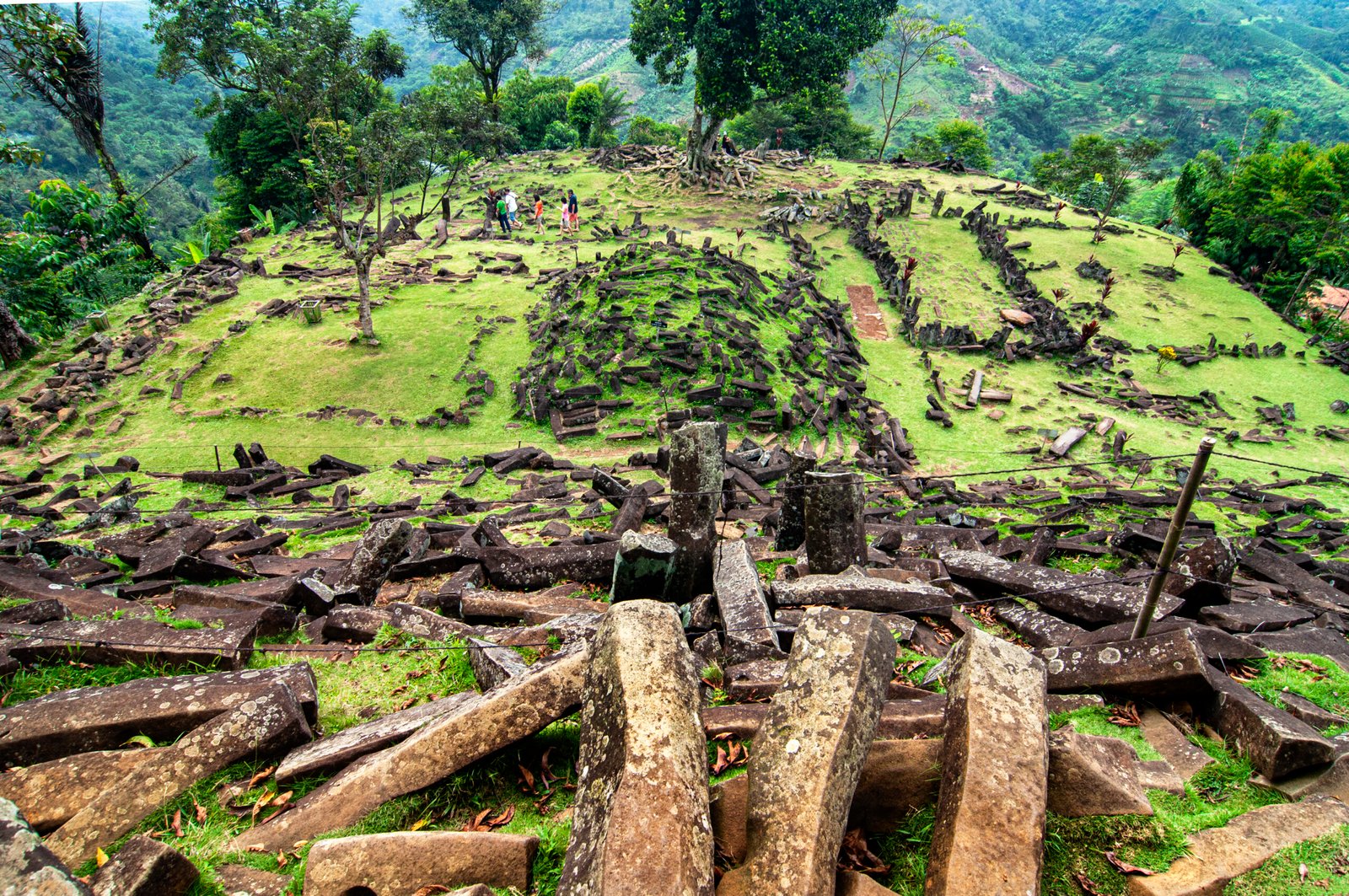
On a hill 885 metres above sea level in West Java’s Cianjur Regency, approximately 120 kilometres southeast of Jakarta, Gunung Padang — “Mountain of Enlightenment” in Sundanese — is five terraced platforms of andesite columnar stone blocks arranged across a hilltop, connected by stone stairways, with at least one orientation toward the sunrise. Approximately 2,900 stone blocks, natural prismatic prisms, form the terraces. Known from a Dutch colonial survey of 1891, the site was previously dated to the West Javanese late Neolithic. In 2011–2023, a research team claimed to identify buried construction layers beneath the visible surface, dating them to as early as 25,000 BC — claims that triggered intense scientific controversy that remains unresolved as of 2026.
Key facts
- Location: Cianjur Regency, West Java, Indonesia (~120 km SE of Jakarta)
- GPS: 6.9936° S, 107.0564° E
- Surface date: c. 2500–500 BC (West Javanese late Neolithic/Bronze Age; broadly accepted)
- Contested claims: Buried layers dated by Natawidjaja team to 5,000 BC, 12,000 BC, and 25,000 BC (under scientific dispute; journal expression of concern issued 2024)
- Size: Five terraced platforms; ~2,900 andesite stone blocks; largest megalithic complex in SE Asia
- Known since: Dutch colonial survey 1891; listed as national heritage site
History
Gunung Padang has been known to local Sundanese communities since antiquity and to Western scholarship since a Dutch topographical survey of 1891 that described it as “a remarkable terraced hill with dressed stones.” For most of the twentieth century, the site was interpreted as a hilltop terraced complex of the West Javanese late Neolithic or early Bronze Age period — a class of sacred hilltop sites found throughout the Indonesian archipelago, dated approximately 2,500–500 BC. This interpretation placed Gunung Padang in the same cultural horizon as the Torajan megaliths of Sulawesi and the stone monuments of Nias Island.
In 2011, geologist Danny Hilman Natawidjaja and a multidisciplinary research team began extensive drilling, ground-penetrating radar, electrical resistivity tomography, and seismic surveys of the hill itself. By 2023, they published findings in the peer-reviewed journal Archaeological Prospection claiming to identify multiple buried construction phases beneath the visible surface: Layer 2 (approx. 5,000 BC), Layer 3 (approx. 12,000 BC), and Layer 4 (approx. 25,000 BC). If confirmed, Layer 4 would predate all known human architecture by at least 15,000 years. The claims were immediately disputed by numerous independent archaeologists and geologists, who argued that the “buried layers” were natural geological formations and that the radiocarbon dating measured ambient soil carbon rather than human activity. The journal issued a formal expression of concern in 2024; the debate continues.
What you see
Visitors approach via a path through terraced agricultural fields and then a stone stairway leading to the five terraced platforms of the hilltop complex. The stones are natural andesite prisms — the columnar jointing of volcanic rock produces hexagonal and pentagonal columns, the same phenomenon seen at Nan Madol — arranged horizontally across the terraces rather than set vertically as monoliths. The uppermost terrace commands panoramic views across the volcanic Sundanese landscape, with Mount Gede visible to the southwest on clear days. The stone arrangements on each terrace include what appear to be walls, platforms, and pathways, though the original function of the structures is not established.
The site is maintained as an Indonesian national heritage site and has a small visitor centre at the base with displays about the site’s history and the ongoing excavation controversy. The controversy itself is part of the site’s contemporary significance: Gunung Padang has become one of the most contested sites in current world archaeology, with the “lost civilisation” hypothesis promoted by popular writers generating global attention that substantially exceeds the scientific consensus on what has actually been demonstrated.
Practical information
- Hours: Daily ~8:00–17:00; check locally as hours vary
- Admission: Small entrance fee; parking available at the base
- Access: Paved road to car park; stone stairway (~350 steps) to the hilltop terraces; allow 2 hours
- Guides: Local guides available at the entrance; recommended for context on the excavation controversy
- Nearest accommodation: Cianjur town (25 km); Bandung (2 hours SE) for full-service options
Getting there
From Jakarta: approximately 120 km southeast via toll road toward Sukabumi/Cianjur (2.5–3 hours depending on traffic). From Bandung: approximately 60 km northwest (1.5 hours) through mountainous West Java. No regular direct public transport to the site; hiring a car or joining a day tour from Jakarta or Bandung is the standard approach. The nearest town with regular intercity bus connections is Cianjur (approx. 25 km north of the site).
Nearby
- Cipanas highland resort area — 20 km north, cool mountain resort town below the Gede-Pangrango volcano; traditional Sundanese gardens and the Presidential Summer Palace (Istana Cipanas)
- Mount Gede-Pangrango National Park — 25 km north, twin-volcano national park with highland trails and rare Javan edelweiss
- Bandung — 60 km southeast, West Java’s major city; Art Deco colonial architecture, volcanic crater lakes, strong cafe culture
Sources
- Natawidjaja, D.H. et al. (2023). “Geo-archaeological prospecting of Gunung Padang buried prehistoric pyramid.” Archaeological Prospection. (Expression of concern issued 2024.)
- Miksic, J.N. & Goh, G.Y. (2017). Ancient Southeast Asia. Routledge.
- van der Hoop, A.N.J. (1932). Megalithic Remains in South-Sumatra. W.J. Thieme.
- Flint, J. (2024). “The Gunung Padang Controversy.” Archaeology Magazine.
- Wikipedia: Gunung Padang megalithic site
Find it on the map
See this place and what’s around it →📷 Become a Cultural Heritage Online photographer
Share your photos of places: they stay published under your name as the author. The more they're seen, the more you get noticed — and soon a contest will reward the most appreciated photos.
Log in or sign up free to add a photo