
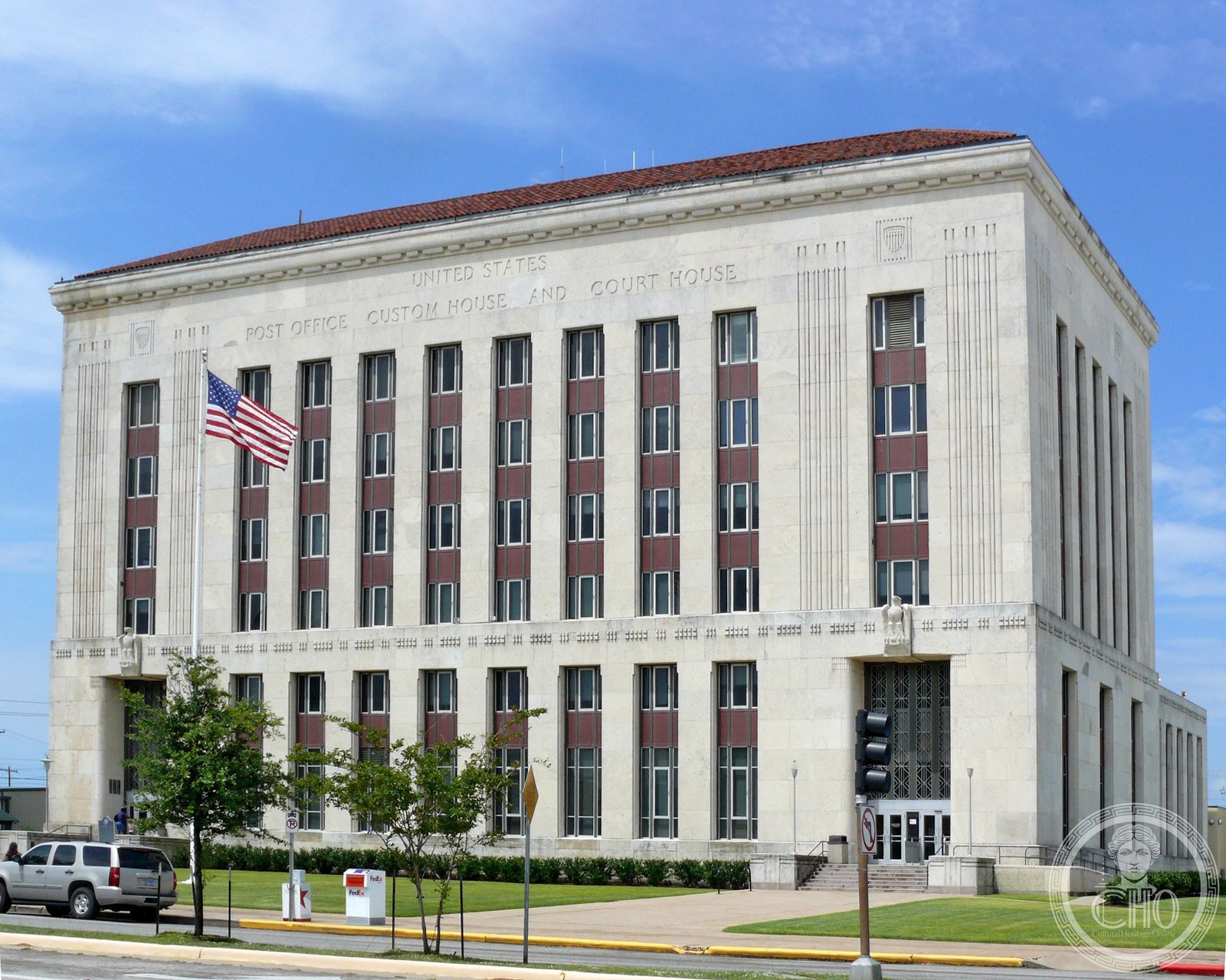
Built from fossiliferous limestone quarried near the Gulf Coast, this eight-story 1937 federal building is the most distinctive Art Deco structure in a city better known for its Victorian streetscapes.
At a glance
The Galveston Federal Building stands eight stories on a granite base at the corner of 25th and Rosenberg streets, clad in porous fossiliferous limestone whose surface, on close inspection, contains marine shell fragments — a material that ties the building literally to the Gulf Coast geology beneath it. Designed by Alfred C. Finn and completed in 1937, it replaced a Romanesque building from the 1890s as the seat of federal authority in Galveston. The Art Deco style is, as the General Services Administration noted, “uncommon, and therefore distinctive, in Galveston” — a city whose architectural identity was otherwise shaped by Victorian and Edwardian commercial building.
Key facts
- Built: 1937, on the site of an 1890s Romanesque building
- Style: Art Deco
- Height: 8 stories (including basement), on granite base
- Architect: Alfred C. Finn
- Builder: Algernon Blair Construction Co.
- Cladding: Porous fossiliferous limestone — regionally quarried, pushed by local Congressman Joseph J. Mansfield
- Address: 601 25th St. (Rosenberg St.), Galveston, Texas
- National Register of Historic Places: April 25, 2001 (ref. 01000438)
History
Galveston’s first post office was built in 1836, when the city was the commercial gateway to the Texas Republic. A Customs House and Courthouse followed in the late 1850s, and by the 1890s the growth of Galveston as a major port city — at its peak the busiest cotton-exporting port in the United States — demanded a larger building. The Romanesque structure built in the early 1890s was itself inadequate within forty years, and was demolished in 1930 to make way for the current federal building.
The choice of fossiliferous limestone as the cladding material was not an obvious one: the original plans called for brick. Local Congressman Joseph J. Mansfield and Customs Collector Fred Papst lobbied the Treasury Department for limestone, arguing it was a grander and more fitting material for a federal building. The limestone used is typical of the Texas Gulf Coast — porous, shell-rich, and with a color that shifts between buff and warm gray depending on the light.
The building was constructed during an era of unprecedented federal construction activity following the passage of the Public Buildings Act of 1926. Alfred C. Finn was one of Texas’s leading architects of the period, also responsible for the Gulf Building in Houston (1929). Construction was completed in 1937 and the building was added to the National Register of Historic Places in 2001.
What you see
The east elevation — the main facade — is the building’s most prominent composition. Three pavilions are defined by abstracted pilasters rising across the full height of the building, with the upper five floors resting on a two-story piano nobile capped by an ornamental string course. Carved eagles perch above the main entry doors at the north and south, a federal iconographic convention rendered in Art Deco geometries. The variation in height between the east and west sections — a common feature of Art Deco composition — gives the building a massing that reads differently from different approach angles on 25th Street.
The first-floor Main Lobby retains its original Art Deco light fixtures and ornamental ceiling reliefs. The exterior limestone, on close inspection, reveals the marine shell fossils embedded in the stone — a tactile connection between the building’s material and the geological history of the island on which it stands.
Practical information
- Access: Active federal post office and courthouse; lobby accessible during business hours
- Interior: Main lobby Art Deco fixtures visible; courthouse floors restricted
- Exterior: Full facade visible from 25th Street (Rosenberg St.)
- Best time: Morning light falls on the east facade; afternoon for the north and south entries with carved eagles
- Time needed: 20–30 minutes for exterior circuit and lobby
Getting there
The building stands at 601 25th Street (also called Rosenberg Street) in Galveston’s historic downtown. Galveston Island is reached from the mainland via I-45 South, approximately 50 miles southeast of Houston. The Galveston Island Trolley stops near the historic Strand District, roughly eight blocks north on 25th Street. Jack Brooks Regional Airport serves smaller regional traffic; Houston airports are the nearest major hubs.
Nearby
- The Strand Historic District — Victorian and commercial architecture along the former “Wall Street of the Southwest”
- Galveston Railroad Museum — in the restored 1913 Santa Fe depot, eight blocks north
- Bishop’s Palace (1886) — Galveston’s most photographed Victorian mansion, five blocks south
- Moody Mansion (1895) — Galveston’s grandest private residence, two blocks south
Sources
- Wikipedia: Galveston United States Post Office and Courthouse
- General Services Administration Historic Buildings database — Building ID 468
- National Register of Historic Places — refnum 01000438 (listed April 25, 2001)
- United States District & Bankruptcy Court for the Southern District of Texas — history of the district
Find it on the map
See this place and what’s around it →Record researched and written by Luigi De Marchi for Cultural Heritage Online, 2026.
📷 Become a Cultural Heritage Online photographer
Share your photos of places: they stay published under your name as the author. The more they're seen, the more you get noticed — and soon a contest will reward the most appreciated photos.
Log in or sign up free to add a photoIs this page about you?
This page is read by travellers and heritage enthusiasts who find it on Google. Tell us how you are connected to this place and we will take it from there.