
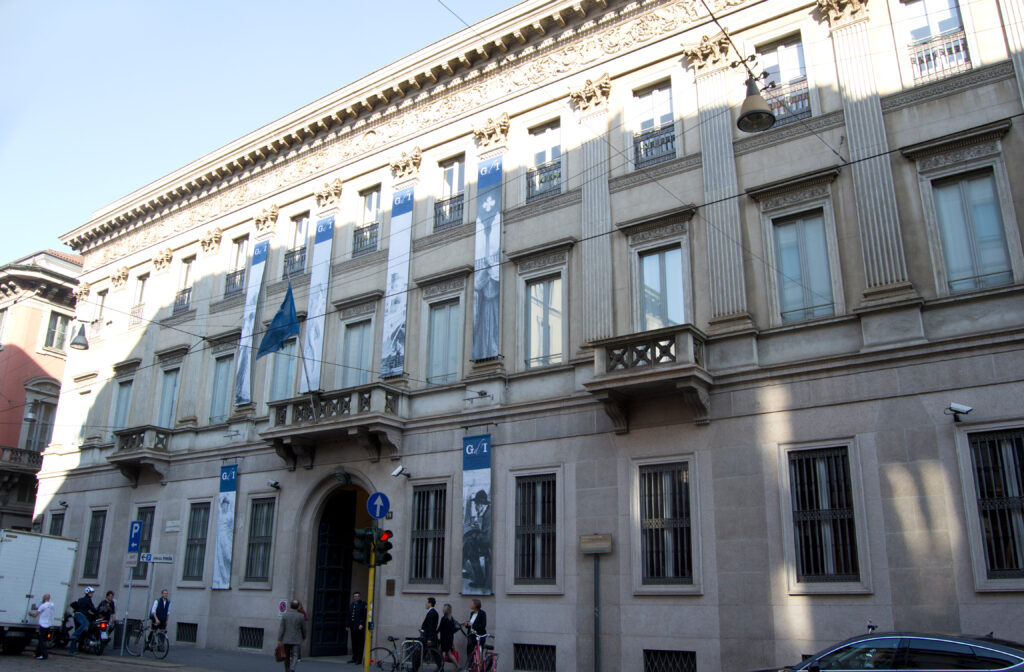

The Gallerie d’Italia in Piazza Scala, Milan, occupy three connected palaces on the block facing La Scala opera house: Palazzo Anguissola Antona Traversi and Palazzo Brentani on Via Manzoni, and the former headquarters of the Banca Commerciale Italiana on the piazza. Managed by the Intesa Sanpaolo banking group, the complex houses one of the finest collections of nineteenth-century Italian painting assembled in a single venue, alongside rotating exhibitions of photography, contemporary art, and design, making it the cultural flagship of one of Europe’s largest financial institutions.
At a glance
- Type
- Art museum; cultural foundation of Intesa Sanpaolo
- Period
- Palaces built 18th–19th century; museum opened 2011
- Style
- Neoclassical and Romantic palace architecture
- Location
- Piazza della Scala 6, Milan, Italy
- Coordinates
- 45.4666° N, 9.1894° E
Overview
The Gallerie d’Italia at Piazza Scala are part of a network of museum venues established by Intesa Sanpaolo across Italy, with further branches in Naples (Palazzo Zevallos Stigliano) and Vicenza. The Milan venue is the largest and most visited of the three, hosting both the permanent 19th-century Italian art collection and major temporary exhibitions that draw international audiences. The galleries are housed in interconnected palaces whose ornate rooms provide a fitting setting for the Romantic and Realist canvases that form the core of the permanent display.
History
The three palaces on Piazza Scala were built and occupied by Milanese noble and merchant families during the eighteenth and nineteenth centuries, accumulating art collections that reflected the tastes of the Risorgimento era. The Brentani family in particular assembled a significant collection of 19th-century Italian works. Intesa Sanpaolo acquired the buildings and their contents over successive decades, merging them into a single museum complex that opened to the public in 2011 following extensive restoration. The project brought back into public view hundreds of works that had been in private or banking-foundation storage for generations.
What you see
The permanent collection spans Italian painting and sculpture from the late eighteenth to the early twentieth century, with particular strength in Lombard Romanticism, the Scapigliatura movement, and Divisionism — the Italian variant of Pointillism practised by artists including Giovanni Segantini and Gaetano Previati. The palace interiors retain elaborate frescoed ceilings, parquet floors, and neoclassical mouldings, creating a period setting that enriches the viewing experience. A dedicated underground section hosts rotating temporary exhibitions with state-of-the-art display technology.
Cultural significance
The Gallerie d’Italia represent a significant model of corporate cultural patronage in Italy, making a major private collection freely or affordably accessible to the public in the heart of Milan’s cultural district. The concentration of 19th-century Italian art — a period often overshadowed internationally by French Impressionism — provides an essential counterpoint to the standard narratives of European art history and offers visitors a distinctively Italian perspective on Romantic and modern painting.
Practical information
- Address
- Piazza della Scala 6, 20121 Milan, Italy
- Opening hours
- Tuesday–Sunday 09:30–19:30; closed Monday (check official website for current hours)
- Admission
- Admission charged for temporary exhibitions; check gallerieditalia.com for current prices and free-entry days
- Website
- gallerieditalia.com
Getting there
The nearest metro station is Duomo (lines M1 and M3) or Cordusio (line M1), each approximately five to eight minutes’ walk from Piazza della Scala. Tram lines 1, 2, and others run along Via Manzoni and Via Dante nearby. The museum is a short walk from the Duomo, La Scala, and Brera, making it easy to combine with other visits in the city centre.
Sources & resources
See the place
Find it on the map
See this place and what’s around it →Events here — now on & upcoming
- Arnaldo Pomodoro. Una vita29 May 2026 — 18 Oct 2026See the event →
Historical events at this place (3)
📷 Become a Cultural Heritage Online photographer
Share your photos of places: they stay published under your name as the author. The more they're seen, the more you get noticed — and soon a contest will reward the most appreciated photos.
Log in or sign up free to add a photoIs this page about you?
This page is read by travellers and heritage enthusiasts who find it on Google. Tell us how you are connected to this place and we will take it from there.