
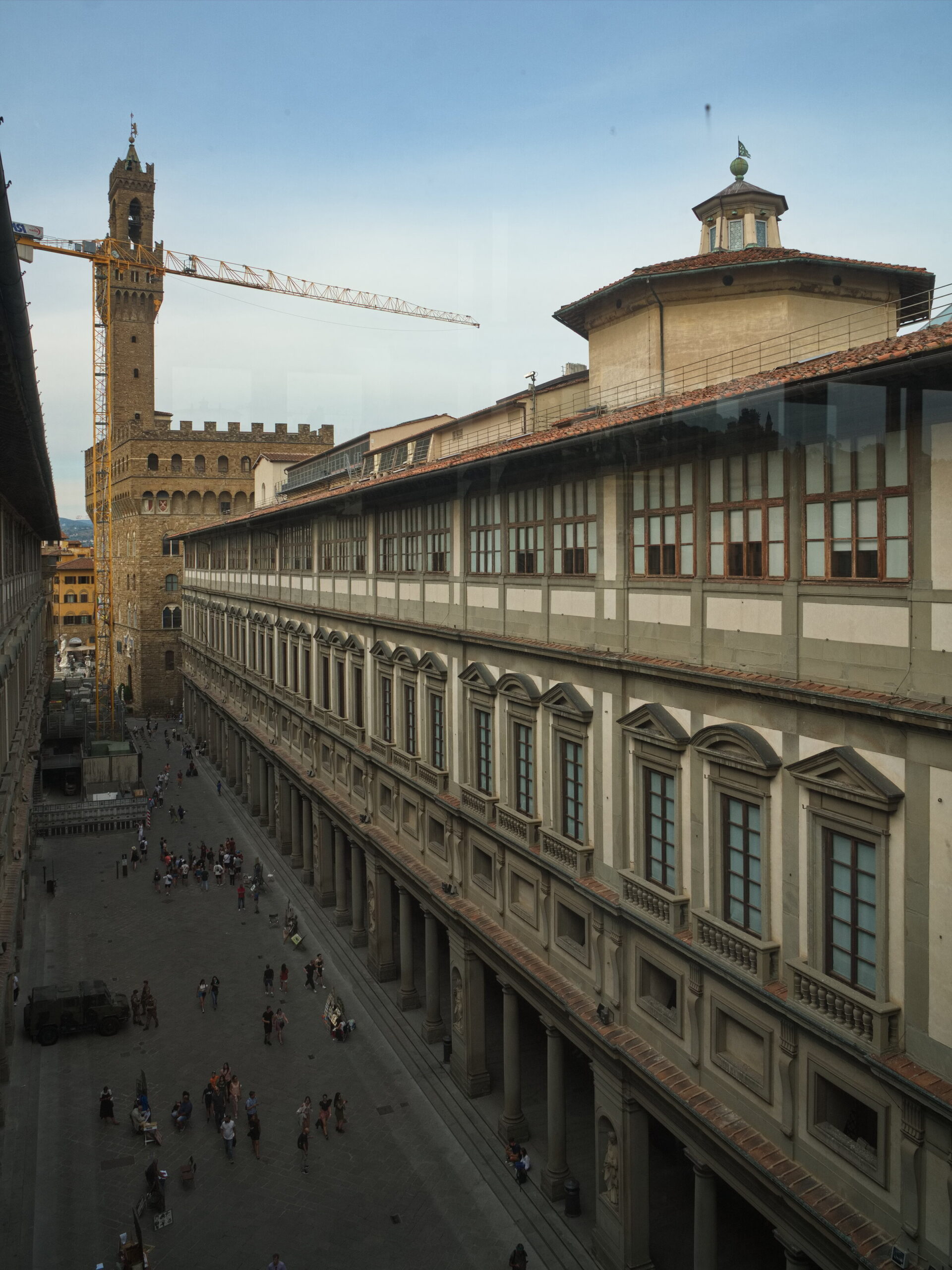
The Uffizi is a U-shaped Renaissance palace on the Arno in Florence, commissioned in 1560 by Cosimo I de’ Medici from Giorgio Vasari to house the magistracies of the Tuscan grand-ducal state and completed in 1581 by Bernardo Buontalenti and Alfonso Parigi the Elder after Vasari’s death in 1574. From 1581 the top floor began to host the Medici family art collection, bound to Florence in perpetuity by the 1737 Patto di Famiglia of Anna Maria Luisa de’ Medici and opened to the public in 1769 under Grand Duke Pietro Leopoldo. Today the Gallerie degli Uffizi hold one of the world’s most important collections of Italian Renaissance painting — Botticelli, Leonardo, Raphael, Michelangelo, Titian, Caravaggio. The building stands within the Historic Centre of Florence, a UNESCO World Heritage Site since 1982.
- Address
- Piazzale degli Uffizi 6, 50122 Firenze FI
- Period
- 1560–1581 (Vasari and Buontalenti); public museum since 1769
- Architect
- Giorgio Vasari (1560–1574); completed by Bernardo Buontalenti and Alfonso Parigi the Elder
- Patron
- Cosimo I de' Medici
- Function
- Originally administrative offices of the Medici state; from 1581 partially used to display the family art collection on the top floor
- Current use
- State museum, part of the Gallerie degli Uffizi with Palazzo Pitti and the Boboli Gardens: the three sites together recorded about 5.3 million visitors in 2024
- Heritage
- Within the Historic Centre of Florence, UNESCO World Heritage Site since 1982
- Coordinates
- 43.7677° N, 11.2553° E
- Notes
- Connected to Palazzo Vecchio and Palazzo Pitti via the Vasari Corridor (1565); Medici collection bequeathed to Florence forever by the 1737 'Patto di Famiglia' of Anna Maria Luisa de' Medici
Gallery
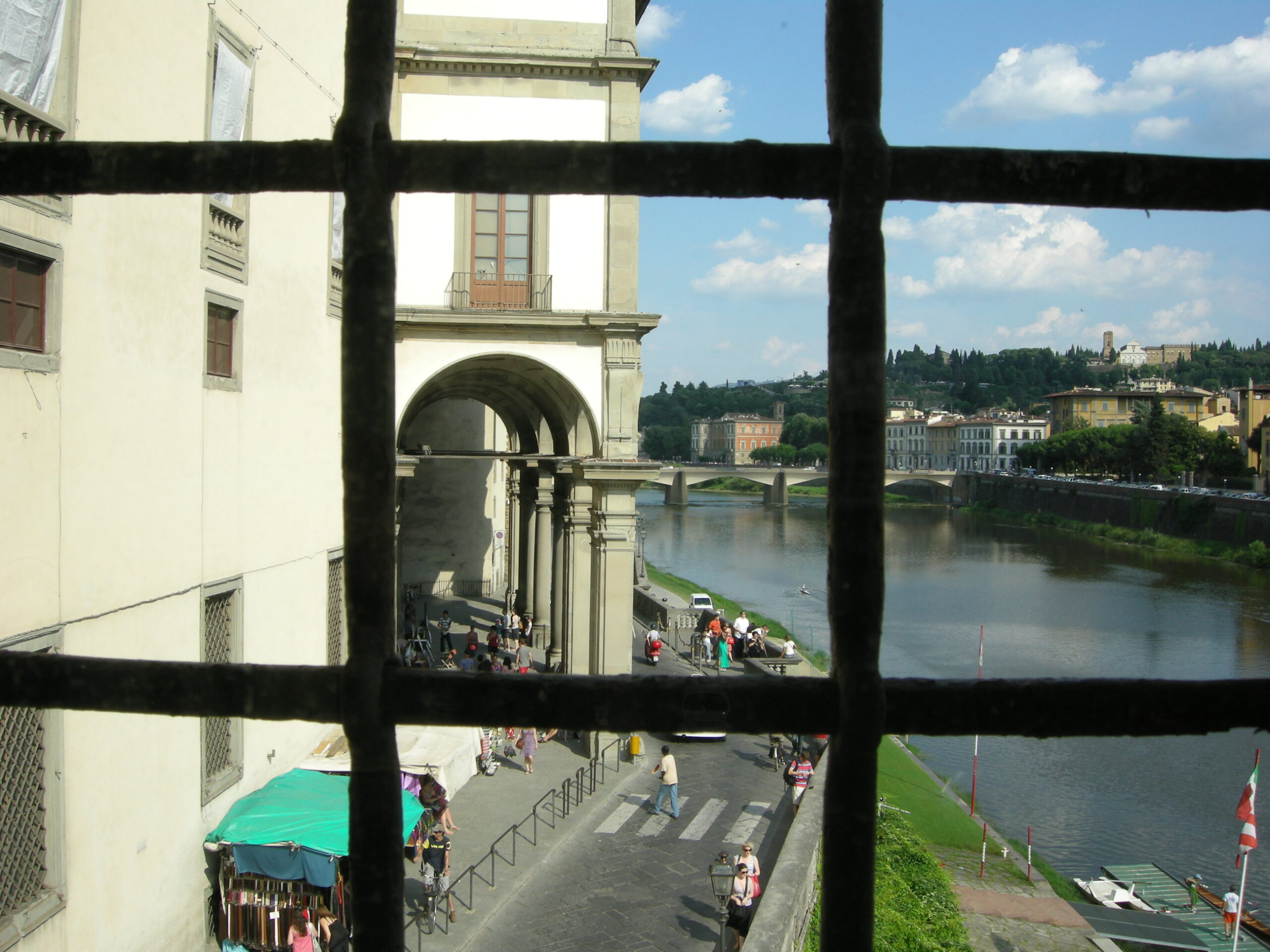
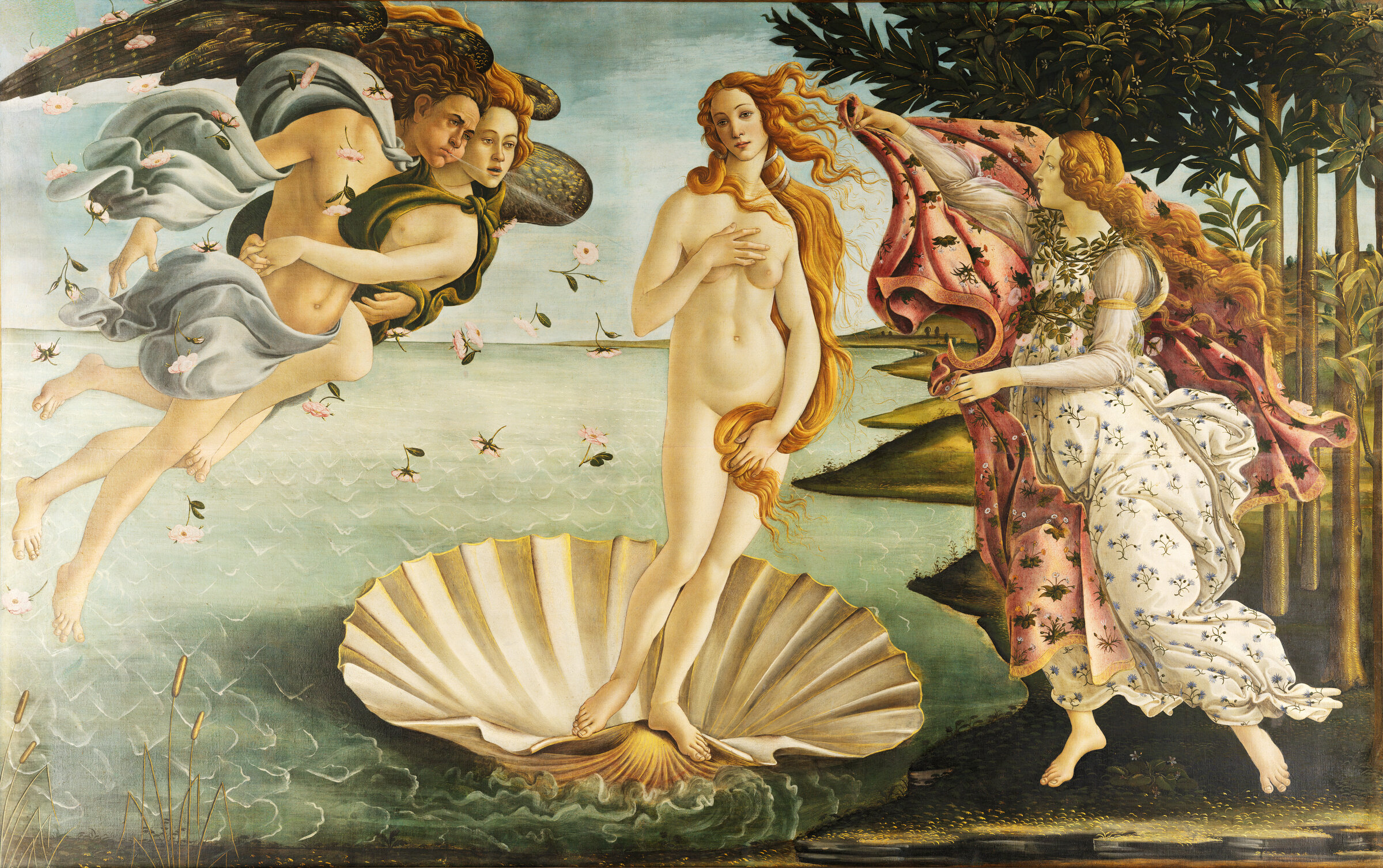
Two further views: the elevated Vasari Corridor over the Arno, and Botticelli’s Birth of Venus from the Botticelli rooms.
Visit on the map
Piazzale degli Uffizi 6 · 43.7677° N, 11.2553° E
Download for your navigator
A single waypoint, ready for GPS apps, navigators, and contacts.
In 1560 Cosimo I de’ Medici commissioned Giorgio Vasari to design a U-shaped palace on the narrow strip of land between Palazzo Vecchio and the Arno. The brief was administrative, not artistic: to gather under one roof the thirteen principal magistracies of the Tuscan grand-ducal state — the uffici from which the building took its name. Vasari conceived a long double portico in pietra serena and intonaco, with a continuous loggia framing a piazzale that opens like a stage between the city’s civic centre and the river. He died in 1574 with the work unfinished; Bernardo Buontalenti and Alfonso Parigi the Elder carried it to completion in 1581. In 1565, in parallel, Vasari built the elevated corridor that still bears his name, an aerial passageway over Ponte Vecchio linking Palazzo Vecchio through the Uffizi to the new Medici residence at Palazzo Pitti, allowing the grand duke to move between offices and palace without descending into the street.
From 1581 Francesco I began to install the family’s growing art collection on the top floor, in a sequence of rooms culminating in the octagonal Tribuna designed by Buontalenti. Over the next two centuries the Medici assembled one of the most important collections of Italian Renaissance painting and antique sculpture in Europe. When the dynasty extinguished, the last Medici heir, Anna Maria Luisa, signed in 1737 the Patto di Famiglia, the family pact that bound the entire collection to the city of Florence in perpetuity — forbidding its dispersal, sale or removal. In 1769 the Galleria was officially opened to the public by Grand Duke Pietro Leopoldo of Lorraine, decades before the Louvre. The collection visitors still walk through today includes Botticelli’s Birth of Venus and Primavera, Leonardo’s Annunciation and Adoration of the Magi, Raphael’s Madonna del Cardellino, Titian’s Venus of Urbino, Caravaggio’s Bacchus and Medusa, and Michelangelo’s Tondo Doni.
Two modern dates left their mark on the building. In November 1966 the flood of the Arno reached the lower floors and the storerooms. On the night of 27 May 1993 a Mafia car bomb exploded in Via dei Georgofili, beside the west wing: five people were killed, and part of the building, the first stretch of the Vasari Corridor and several works were damaged. Outside, the courtyard is lined with nineteenth-century statues of illustrious Tuscans, among them Dante, Giotto, Machiavelli, Galileo, Leonardo and Michelangelo. From the loggia above the river, looking back, the tower of Palazzo Vecchio stands framed between the two wings: the view Vasari built the piazzale around.
The long Nuovi Uffizi project has roughly doubled the museum’s exhibition space, opening new monographic rooms — among them the renovated Botticelli and Caravaggio halls — and reorganising the visitor route under successive directors Eike Schmidt and Simone Verde. The Gallerie degli Uffizi today is a single institutional cluster that includes Palazzo Pitti and the Boboli Gardens on the opposite bank of the Arno, sold as an integrated ticket. With about 5.3 million visitors across its three sites in 2024, second among Italy’s state museums after the Colosseum, it is one of the most visited art institutions in the world and a working laboratory of conservation, digital cataloguing and loan policy for the entire Italian Renaissance corpus.
Plan your visit
- Booking: timed entry is booked on the museum’s official site, with a reservation fee on top of admission. In summer, queues of a couple of hours are ordinary without it.
- When to go: at opening or late in the afternoon; the Botticelli rooms are the crowded point in the middle of the day. The museum is closed on Mondays.
- Vasari Corridor: reopened in December 2024 after eight years of closure, with its own ticket and limited numbers. Check availability well ahead.
- Nearby: Palazzo Vecchio adjoins the building; Ponte Vecchio is two minutes away, with the corridor running above its shops; Palazzo Pitti and the Boboli Gardens are across the river, at the far end of the corridor. Santa Maria Novella station is about fifteen minutes on foot.
Resources & References
Editorial picks across Wikipedia, photo archives, and the official portal.
All photographs Wikimedia Commons (CC-BY / CC-BY-SA / Public Domain) unless otherwise stated. Editorial text Cultural Heritage Online, OASIS Tech LLC USA.
Find it on the map
See this place and what’s around it →Historical events at this place (6)
📷 Become a Cultural Heritage Online photographer
Share your photos of places: they stay published under your name as the author. The more they're seen, the more you get noticed — and soon a contest will reward the most appreciated photos.
Log in or sign up free to add a photoIs this page about you?
This page is read by travellers and heritage enthusiasts who find it on Google. Tell us how you are connected to this place and we will take it from there.