
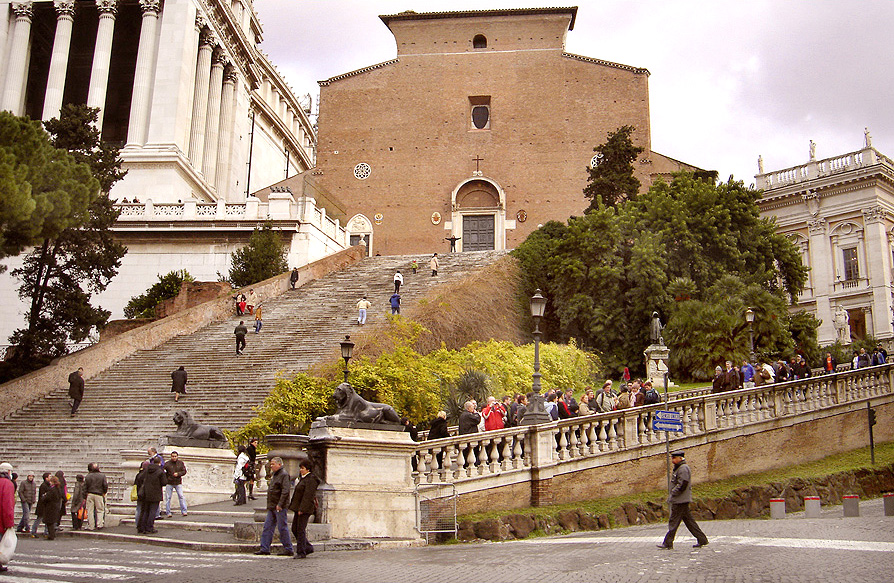
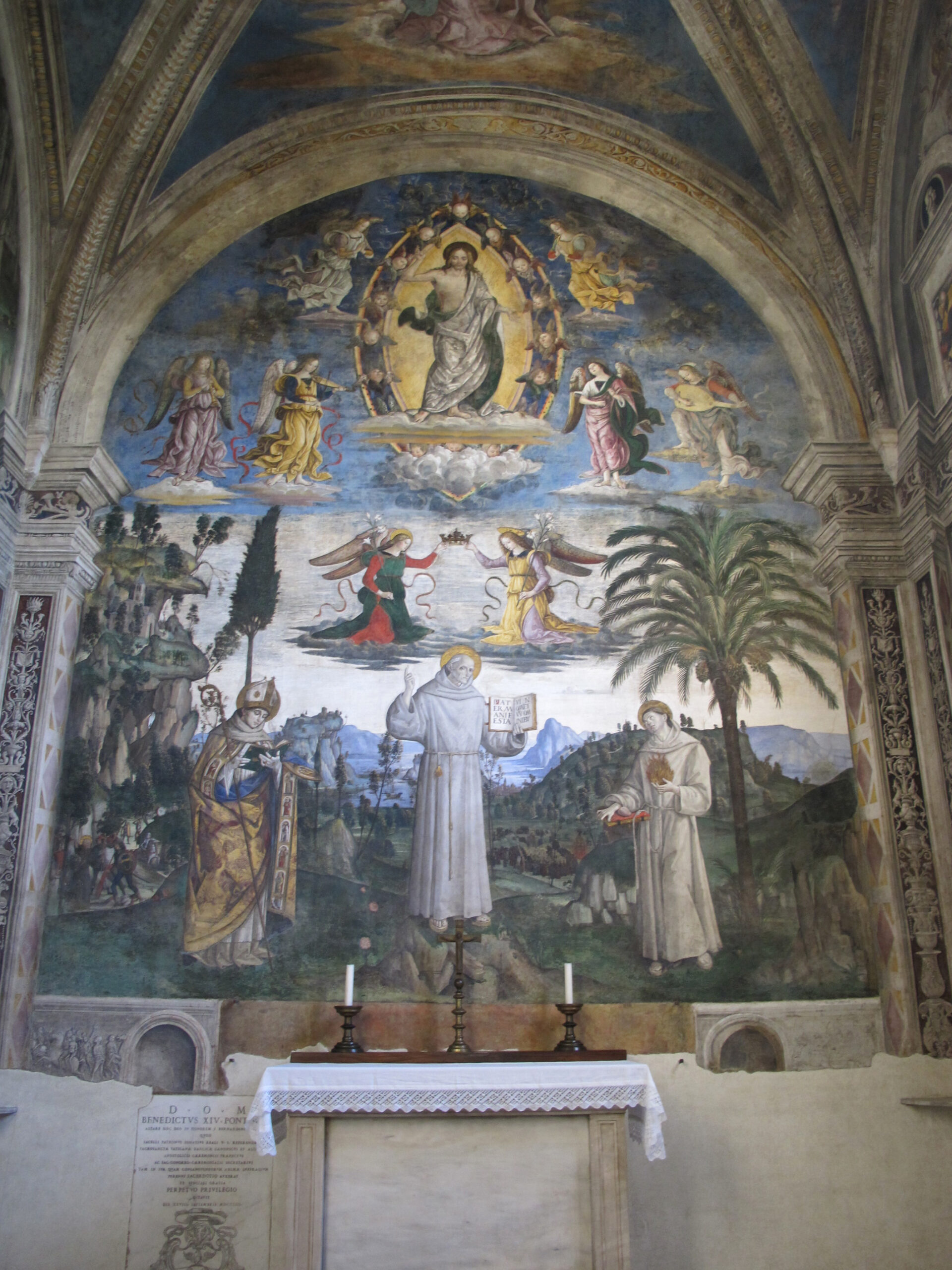
Santa Maria in Ara Coeli is a medieval basilica that crowns the northern summit of the Capitoline Hill, reached by a steep flight of 124 marble steps commissioned by the Roman people in 1348. Inside, visitors find the venerated Santo Bambino — a 15th-century olive-wood figure traditionally said to be carved from a tree in the Garden of Gethsemane — and the Bufalini Chapel, whose walls are covered with Pinturicchio’s fresco cycle on the life of Saint Bernardino of Siena, painted in 1486.
- Address
- Scala dell'Arce Capitolina 12, 00186 Roma RM
- Period
- 6th-century Greek monastic church; rebuilt in present Romanesque-Gothic form from the 13th century by the Franciscan Order; Cordonata staircase 1348
- Architect
- Anonymous Franciscan masters (13th century); Cordonata attributed to Lorenzo di Simone Andreotti (1348)
- Function
- Conventual basilica of the Franciscan Order; titular church of the Cardinal-Priest of Santa Maria in Aracoeli
- Current use
- Active basilica; managed by the Franciscan friars; ceremonial church of the Senate and Roman People (Senatus Populusque Romanus tradition)
- Coordinates
- 41.8939° N, 12.4830° E
- Notes
- Cordonata of 124 marble steps commissioned by the Roman people in 1348 to thank Mary for the end of the Black Death; Pinturicchio fresco cycle of the life of Saint Bernardino in the Bufalini Chapel (1486); coffered gilded ceiling commemorating the Battle of Lepanto (1571); the celebrated Santo Bambino, a 15th-century olive-wood figure said to be carved from Gethsemane wood, was stolen on 1 February 1994 and replaced with a copy
Gallery
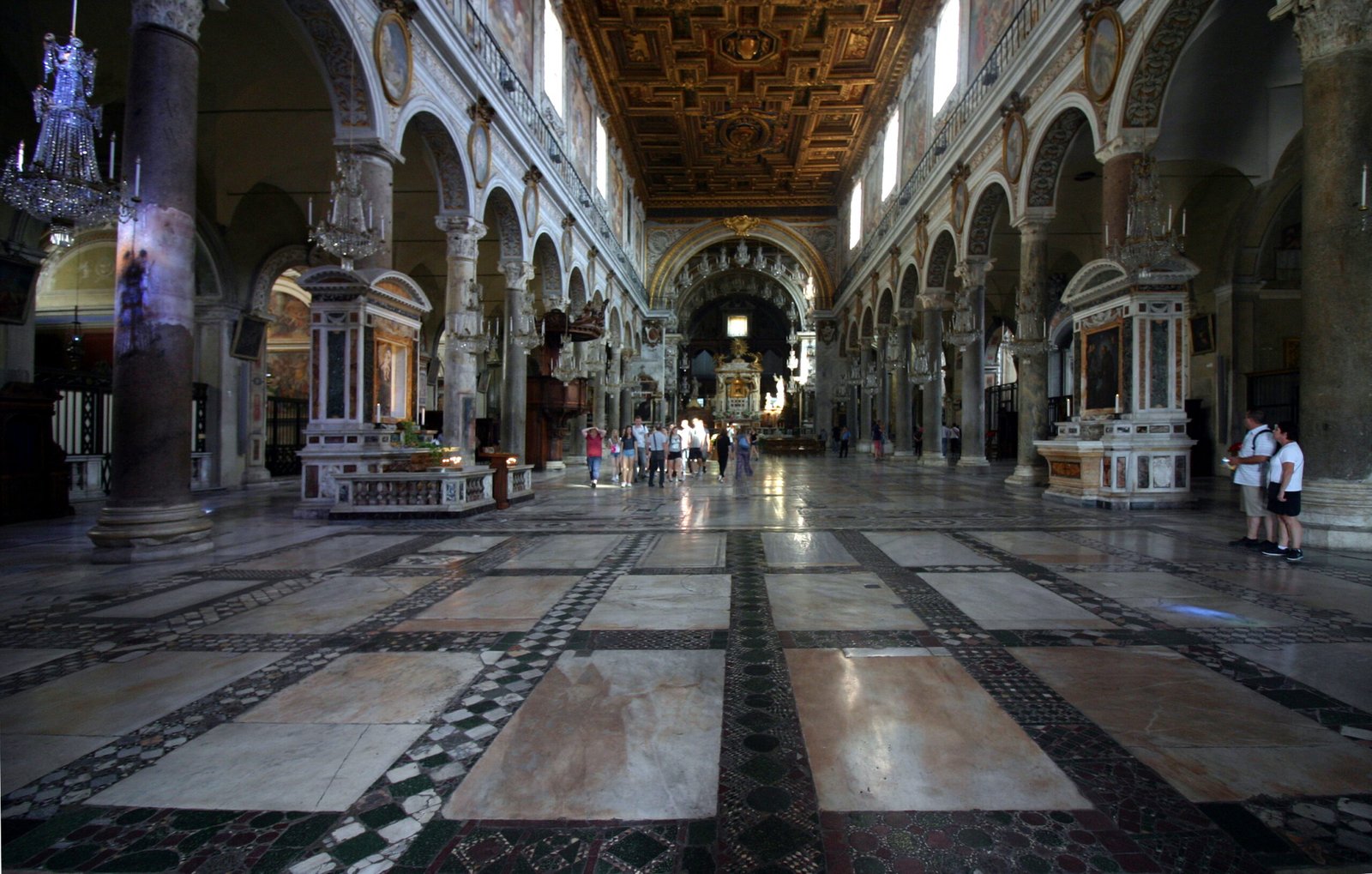
Two further views: the Roman-spolia nave under its Lepanto ceiling, and Pinturicchio’s Renaissance fresco cycle in the Bufalini Chapel.
Visit on the map
Scala dell’Arce Capitolina 12 · 41.8939° N, 12.4830° E
Download for your navigator
A single waypoint, ready for GPS apps, navigators, and contacts.
The site has been a place of Christian worship since at least the 6th century, when a Byzantine-rite abbey is documented on the northern summit of the Capitoline Hill in 574. Passed to papal control by the 9th century and then to the Benedictines, the church was transferred in 1249–1250 to the Franciscan Order, which rebuilt it into the Romanesque-Gothic basilica visible today. In 1348 the Roman people commissioned the Cordonata — a monumental flight of 124 marble steps designed by Lorenzo di Simone Andreotti and traditionally said to be an ex-voto for the end of the Black Death. The staircase was inaugurated by the tribune Cola di Rienzo, who used the basilica as a stage for the civic and religious life of the late-medieval city.
The interior is divided into a nave and two aisles by twenty-two antique columns, each spoliated from a different Roman monument, and paved with a Cosmatesque floor. Halfway down the right aisle, the Bufalini Chapel preserves Pinturicchio’s fresco cycle of 1486 on the life of Saint Bernardino of Siena — one of the earliest fully Renaissance fresco programmes in Rome and a key work for understanding the Umbrian master before his Borgia Apartments. Above, the coffered gilded ceiling, completed around 1575, was commissioned by the Roman Senate and the Conventual Franciscans to commemorate the victory of the Holy League over the Ottoman fleet at the Battle of Lepanto on 7 October 1571. In a chapel off the left transept stood the Santo Bambino, a 15th-century figure of the Christ Child carved from olive wood reputed to have come from the Garden of Gethsemane, taken in procession to the bedsides of the sick.
On the night of 1 February 1994 the original Santo Bambino was stolen from the basilica and has never been recovered; the figure now venerated in the dedicated chapel is a faithful copy, again carved from olive wood from Gethsemane. The basilica remains an active Conventual Franciscan church and the titular seat of a Cardinal-Priest, but it also retains its civic role as the designated church of the city government of Rome under the ancient title Senatus Populusque Romanus — the Senate and People of Rome — used for solemn celebrations involving the Capitoline authorities. Access is free; the climb up the Cordonata, from Piazza d’Aracoeli, is part of the experience the church has offered the city since the fourteenth century.
Resources & References
Editorial picks across Wikipedia, photo archives, and the official portal.
All photographs Wikimedia Commons (CC-BY / CC-BY-SA / Public Domain) unless otherwise stated. Editorial text Cultural Heritage Online, OASIS Tech LLC USA.
Find it on the map
See this place and what’s around it →Historical events at this place (1)
📷 Become a Cultural Heritage Online photographer
Share your photos of places: they stay published under your name as the author. The more they're seen, the more you get noticed — and soon a contest will reward the most appreciated photos.
Log in or sign up free to add a photoIs this page about you?
This page is read by travellers and heritage enthusiasts who find it on Google. Tell us how you are connected to this place and we will take it from there.