
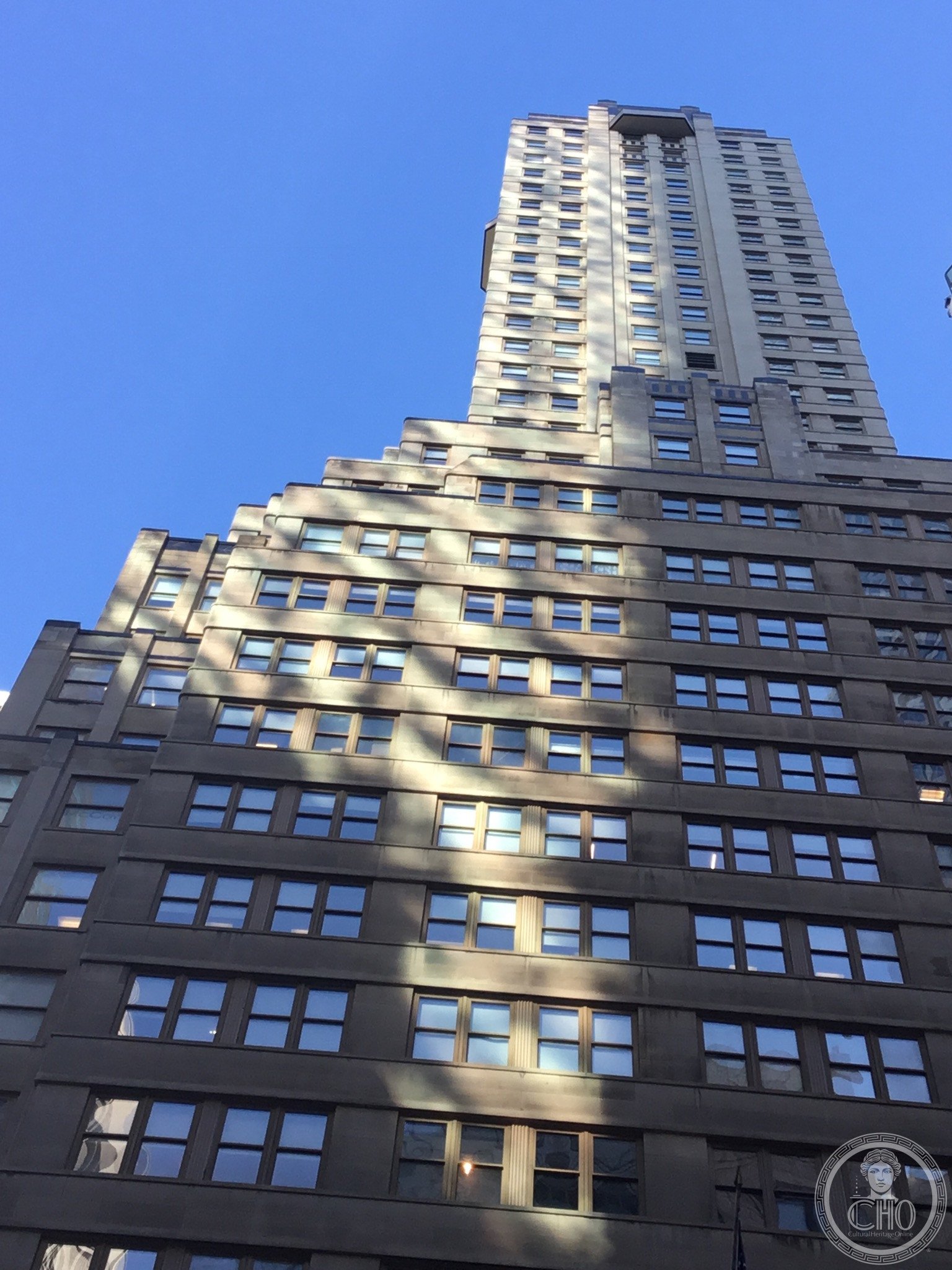
At the corner of 57th Street and Madison Avenue, the Fuller Building stands apart from its midtown neighbors through a striking black-and-white facade and an entrance flanked by figural sculptures — one of New York’s most elegant Art Deco office towers.
At a glance
The Fuller Building at 41 East 57th Street was completed in 1929 for the Fuller Construction Company, the general contractor responsible for many of New York’s most important early skyscrapers. Designed by Walker & Gillette, the 40-story tower is distinguished by its dramatic two-tone exterior — the base clad in black granite, the upper floors in white stone — and by the sculptural program at the entrance, executed by Elie Nadelman. It is a New York City Landmark and one of the finest examples of restrained Art Deco commercial architecture in Manhattan’s midtown.
Key facts
- Address: 41 East 57th Street, Manhattan, NY 10022
- Height: 40 stories
- Completed: 1929
- Architects: Walker & Gillette (A. Stewart Walker and Leon N. Gillette)
- Style: Art Deco
- NYC Landmark: Yes (exterior designation)
- Sculptor: Elie Nadelman (entrance figural sculptures)
- Current use: Mixed commercial (retail and office), including multiple art galleries
History
The Fuller Construction Company was one of the most important builders in American architectural history. Its founder, George Fuller, had pioneered the use of steel-frame construction in the late 19th century; his firm built the Flatiron Building (originally the Fuller Building), the Plaza Hotel, and many of New York’s most important early skyscrapers. By the late 1920s, the company was one of the most successful general contractors in the country, and the 1929 tower at 57th Street was conceived as a prestige headquarters that would reflect that success.
Walker & Gillette designed a building that was sophisticated rather than spectacular — its restraint a deliberate contrast with the more exuberant Art Deco towers rising simultaneously in midtown. The black-and-white color scheme gave the tower an identity that was immediately legible from the street and from across the midtown skyline. Elie Nadelman, one of the leading sculptors of the American Art Deco period, provided two large figural groups flanking the entrance — figural groups representing the building trades.
The building was designated a New York City Landmark for its architectural quality. Since its completion it has attracted art galleries as tenants — a function that suits its location at 57th Street, one of New York’s most important art dealing corridors — and continues in that role today.
What you see
The Fuller Building’s most striking feature is visible from the opposite sidewalk: the sharp contrast between the black polished granite of the lower floors and the white stone of the shaft above. This two-tone approach was unusual in 1929 and remains distinctive today — most Art Deco towers chose a single material palette and modulated it through ornament, while Walker & Gillette used the color shift as the primary compositional gesture. The effect is dramatic and elegant at the same time.
At street level, Nadelman’s sculptures frame the entrance: two over-life-size figures in the rounded, simplified style he developed in the 1920s — Art Deco in feeling, with the human form reduced to smooth geometric volumes. Inside, the lobby continues the architectural quality of the exterior, its proportions and materials appropriate to a building that has always attracted sophisticated commercial tenants.
Practical information
- Lobby and galleries: Accessible during gallery hours (typically Tuesday–Saturday); individual gallery schedules vary
- Exterior: Viewable at all times; the entrance sculptures are at street level on 57th Street
- Photography: Best wide shot from the south side of 57th Street; approach from Madison Avenue for the corner view
- Art galleries: The building hosts several major commercial galleries; check individual gallery listings for current exhibitions
Getting there
The Fuller Building is at 57th Street and Madison Avenue in midtown Manhattan. The N/R/W/Q trains stop at Fifth Avenue/59th Street two blocks north; the 4/5/6 trains stop at 59th Street two blocks north-east. The F/Q stop at 57th Street and Sixth Avenue is four blocks west. John F. Kennedy International Airport (JFK) is about 18 miles south-east.
Nearby
- Seagram Building (1958) — Mies van der Rohe’s masterwork, five blocks south on Park Avenue
- Hearst Tower (2006) — Foster + Partners glass tower rising from a 1928 Art Deco base, four blocks west
- Trump Tower (1983) — postmodern tower at Fifth Avenue and 56th Street; the 1928 Bonwit Teller Building it replaced was a major Art Deco loss
Sources
- Wikipedia, “Fuller Building (Manhattan)” — architects, date, NYC Landmark, Nadelman sculptures
- New York City Landmarks Preservation Commission — exterior designation report
- Elie Nadelman estate and museum records — documentation of the entrance sculptures
- Robert A. M. Stern, Gregory Gilmartin, Thomas Mellins, New York 1930 — Fuller Construction Company history and Walker & Gillette context
Find it on the map
See this place and what’s around it →Record researched and written by Luigi De Marchi for Cultural Heritage Online, 2026.
📷 Become a Cultural Heritage Online photographer
Share your photos of places: they stay published under your name as the author. The more they're seen, the more you get noticed — and soon a contest will reward the most appreciated photos.
Log in or sign up free to add a photoIs this page about you?
This page is read by travellers and heritage enthusiasts who find it on Google. Tell us how you are connected to this place and we will take it from there.