

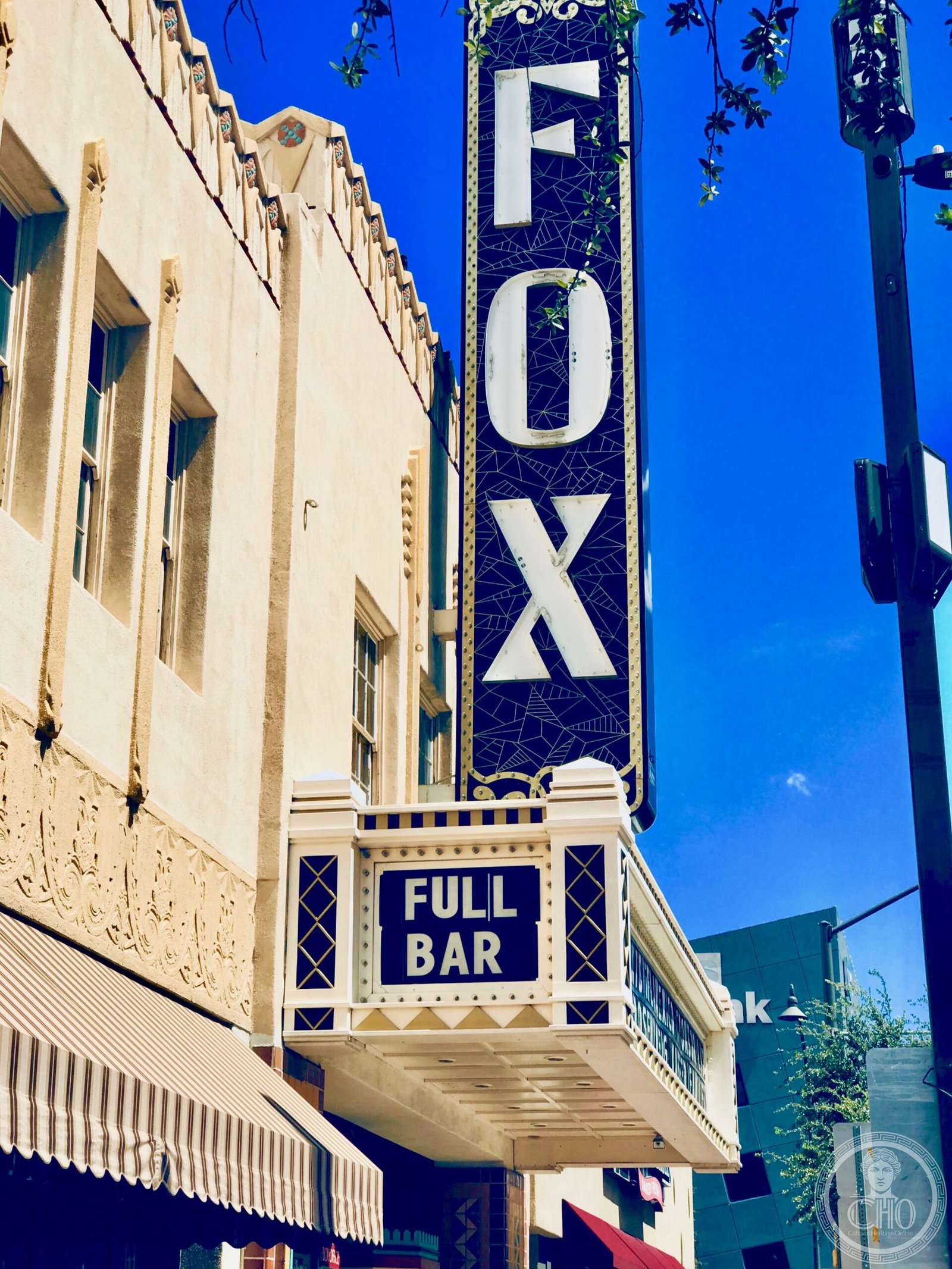
The Fox Tucson Theatre brought Hollywood’s most glamorous architectural language to the Arizona desert in 1930 — a terra cotta Art Deco facade on Congress Street that, after decades of neglect, was restored to full operation and continues to define downtown Tucson’s cultural identity.
At a glance
Opened in 1930 at 17 West Congress Street, the Fox Tucson Theatre was built as part of the Fox West Coast Theatres chain’s expansion across the American Southwest. Its Art Deco facade of cream-coloured terra cotta with ornamental friezes and a bold vertical marquee brought the visual vocabulary of contemporary Los Angeles and New York directly to downtown Tucson. The theatre served audiences for nearly five decades before economic pressure and changing entertainment habits led to its closure. A concerted community campaign and a major restoration, completed in 2005, returned the building to its original configuration and equipped it for twenty-first-century performance. The Fox Tucson was listed on the National Register of Historic Places in 1996 and now operates as one of the premier mid-size concert and performance venues in the American Southwest.
Key facts
- Address: 17 West Congress Street, Tucson, AZ 85701
- Opened: 1930
- Style: Art Deco
- Original operator: Fox West Coast Theatres
- Seating: Approximately 1,200 (post-restoration)
- NRHP: Listed 1996
- Restoration completed: 2005
- Current use: Concert hall and live performance venue
History
Fox West Coast Theatres was one of the largest cinema chains in the western United States during the late 1920s, and its expansion into Tucson reflected both the city’s growth as a regional centre and the chain’s ambition to bring first-run Hollywood films to desert audiences within days of their Los Angeles premieres. The 1930 opening came at the height of the sound era, when cinema palaces were still being built with the ornamental ambition of the silent film period even as the economics of the industry began to shift.
The Fox Tucson served continuous programming through the 1940s and 1950s, benefiting from Tucson’s status as a military and university city. By the 1970s, however, the rise of suburban multiplexes and changes in downtown retail patterns had undermined the theatre’s viability. It closed in 1974 and remained dark for three decades, the building deteriorating but largely intact. A nonprofit preservation organisation, the Fox Tucson Theatre Foundation, was formed in the 1990s and mounted the capital campaign that funded the restoration. The restoration reconstructed original finishes, upgraded technical systems, and reopened the Fox in 2005 to national attention as a model for small-city theatre preservation.
What you see
The Congress Street facade presents a two-storey base of cream-coloured terra cotta with decorative friezes in the Mesoamerican-influenced Art Deco manner that was fashionable in southwestern states during the late 1920s — geometric stepped patterns and stylised motifs that evoke both Aztec ornament and the abstracted floral vocabulary of metropolitan Art Deco without belonging entirely to either tradition. The vertical marquee and blade sign, restored to their original proportions, remain the most visible element of the building from the street and a landmark of the Congress Street corridor.
The interior, substantially restored in 2005, features the original plasterwork ceiling with its geometric coffering, the curved balcony, and the proscenium surround with its layered mouldings and terracotta ornament. The auditorium is raked for clear sightlines and retains the intimate feel of a mid-size venue that the restoration carefully preserved rather than expanding to a larger capacity. The lobby incorporates the original Art Deco ticket booth and terrazzo floor.
Practical information
- Hours: Open for events; lobby accessible on performance days and for guided tours by appointment.
- Tickets: Concerts, films, and events bookable via the Fox Tucson Theatre box office.
- Best time: Attend an evening performance for the full experience of the restored interior with the original theatrical lighting.
- Time needed: Allow the length of a performance for the full experience; 20–30 minutes for exterior and lobby viewing on non-performance days.
Getting there
The Fox Tucson Theatre stands on West Congress Street in the heart of downtown Tucson, one block west of Stone Avenue. The Sun Link streetcar stops immediately in front of the building on Congress Street. Tucson International Airport is approximately 20 minutes south by road. The Hotel Congress (1919), another Tucson landmark, is adjacent to the east, and the Rialto Theatre (1920) is one block east on Broadway.
Nearby
- Hotel Congress (1919) — Historic hotel and entertainment complex immediately adjacent, part of the Congress Street historic district.
- Rialto Theatre (1920) — Another restored downtown venue, one block east on East Congress Street.
- Barrio Viejo — Tucson’s oldest neighbourhood with adobe buildings dating from the Spanish colonial period, three blocks south.
- Arizona State Museum — Collections of Southwestern archaeology and Native American heritage on the University of Arizona campus, one mile northeast.
Sources
- National Register of Historic Places, Fox Tucson Theatre nomination (1996), U.S. National Park Service.
- Fox Tucson Theatre Foundation, restoration documentation and history, foxtucson.com.
- Ben Sternberg, “Cinema Palaces of the American Southwest,” Journal of the Society of Architectural Historians, 2003.
- Wikipedia contributors, “Fox Tucson Theatre,” Wikipedia, The Free Encyclopedia.
Find it on the map
See this place and what’s around it →📷 Become a Cultural Heritage Online photographer
Share your photos of places: they stay published under your name as the author. The more they're seen, the more you get noticed — and soon a contest will reward the most appreciated photos.
Log in or sign up free to add a photoIs this page about you?
This page is read by travellers and heritage enthusiasts who find it on Google. Tell us how you are connected to this place and we will take it from there.