

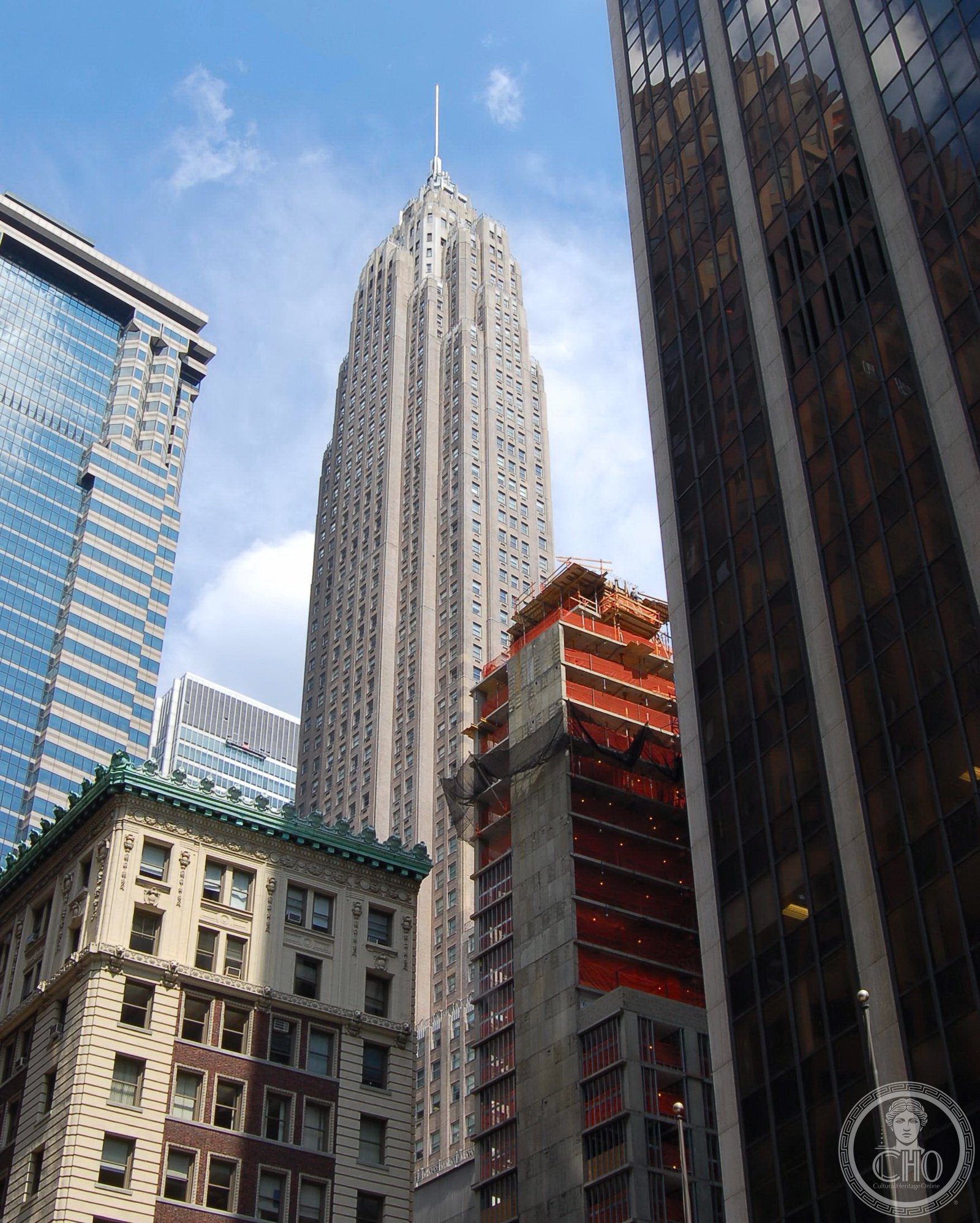
At 952 feet and 66 stories, 70 Pine Street ranks among the tallest Art Deco towers ever built — a tapering limestone spire in Lower Manhattan that rises from the financial district’s canyon streets to a crown visible from Brooklyn, New Jersey, and the Upper Bay.
At a glance
Completed in 1932 as the Cities Service Building — headquarters of Henry Doherty’s Cities Service Company, one of the largest oil and gas companies in the United States — 70 Pine Street entered the world at a moment when its height record had already been surpassed by the Chrysler Building (1930) and the Empire State Building (1931). Its distinction lay not in being tallest but in the quality of its design: a slender tower that rises in progressive setbacks from a limestone base, its shaft tapering to a sharply pointed crown ornamented with Art Deco detail. The lobby, with its coffered bronze ceiling, travertine walls, and original elevator doors, was considered one of the finest commercial interiors of the period. Renamed the American International Building when AIG took occupancy in the 1970s, the tower was converted to luxury residential apartments in 2016 and listed on the National Register of Historic Places. The crown today houses an observation deck converted to a restaurant, offering one of the highest views in downtown New York.
Key facts
- Address: 70 Pine Street, New York, NY 10005
- Completed: 1932
- Height: 952 feet (290 m), 66 stories
- Original name: Cities Service Building
- Later name: American International Building (AIG)
- Current use: Luxury residential apartments (since 2016)
- NRHP: Listed
History
Henry L. Doherty, founder of Cities Service Company, commissioned the tower as the firm’s world headquarters at a time when corporate identity and architectural height were closely linked in the minds of American business. The 1929 stock market crash had already begun when construction started, and the building rose through the early Depression years, opening in 1932. Cities Service — whose stock-ticker symbol was Cities Service and which eventually became CITGO — occupied the building for decades, its logo displayed prominently on the crown lighting that made the spire one of the more distinctive elements of the Lower Manhattan skyline at night.
In the 1970s, American International Group (AIG) acquired the building and it became known as the American International Building, a name it retained until the conversion. The interiors underwent various changes over the corporate decades, but the overall architectural integrity of the facade remained largely intact. The residential conversion by New York developer DTH Capital and Rose Associates resulted in the restoration of the lobby’s historic elements and the creation of market-rate rental apartments across the majority of the floors.
What you see
The tower announces itself from a distance through its crown: above the 59th floor, the building steps down rapidly to the final pointed spire, creating a silhouette that reads as almost Gothic in profile against the sky. The facade is clad in limestone throughout, without the polychrome terracotta that distinguished some contemporaries, giving the building a monochromatic unity that is particularly striking in grey winter light.
At street level, the main entrance on Pine Street opens into the Art Deco lobby, restored as part of the 2016 conversion. Bronze elevator doors framed in geometric ornament, travertine cladding, and the original coffered ceiling give the space a compressed grandeur suited to a building whose primary architectural aspiration is upward. Looking south from the Pine Street facade, the tower’s progressive setbacks read clearly as the eye travels from the base — occupying a nearly full city block — to the needle-like upper floors.
Practical information
- Lobby: The restored historic lobby is visible from the street; access depends on building management policies for residents and guests.
- Crown restaurant: A restaurant occupying the former observation deck at the 66th floor offers panoramic views of Lower Manhattan, the Statue of Liberty, and New York Harbor; reservations recommended.
- Best view of exterior: From the plaza at Maiden Lane and Liberty Street, or from the Brooklyn Bridge pedestrian walkway to the northeast.
- Time needed: 20–30 minutes for exterior viewing; longer if dining at the crown restaurant.
Getting there
70 Pine Street stands in the heart of Lower Manhattan’s Financial District, a short walk from Wall Street. The nearest subway stations are Wall Street (4/5 trains) and Rector Street (1 train), each within two blocks. Fulton Center, a major transit hub serving the A/C/2/3/4/5/J/Z lines, is approximately four blocks north. The Staten Island Ferry terminal at Whitehall Street, offering free views of New York Harbor and the skyline, is six blocks to the south.
Nearby
- 40 Wall Street (1930) — The Bank of Manhattan building, another Art Deco tower competing for the downtown skyline, one block west.
- One Wall Street — Irving Trust Building (1931) — Rare Art Deco tower with a mosaic lobby, two blocks west.
- Trinity Church (1846) — Gothic Revival masterpiece whose historic cemetery once made it the tallest structure in New York, four blocks northwest on Broadway.
- Brooklyn Bridge (1883) — Ten-minute walk east via Fulton Street.
Sources
- National Register of Historic Places, 70 Pine Street nomination, U.S. National Park Service.
- New York City Landmarks Preservation Commission, Manhattan designation reports.
- Carol Willis, Form Follows Finance: Skyscrapers and Skylines in New York and Chicago, Princeton Architectural Press, 1995.
- Wikipedia contributors, “70 Pine Street,” Wikipedia, The Free Encyclopedia.
Find it on the map
See this place and what’s around it →📷 Become a Cultural Heritage Online photographer
Share your photos of places: they stay published under your name as the author. The more they're seen, the more you get noticed — and soon a contest will reward the most appreciated photos.
Log in or sign up free to add a photoIs this page about you?
This page is read by travellers and heritage enthusiasts who find it on Google. Tell us how you are connected to this place and we will take it from there.