

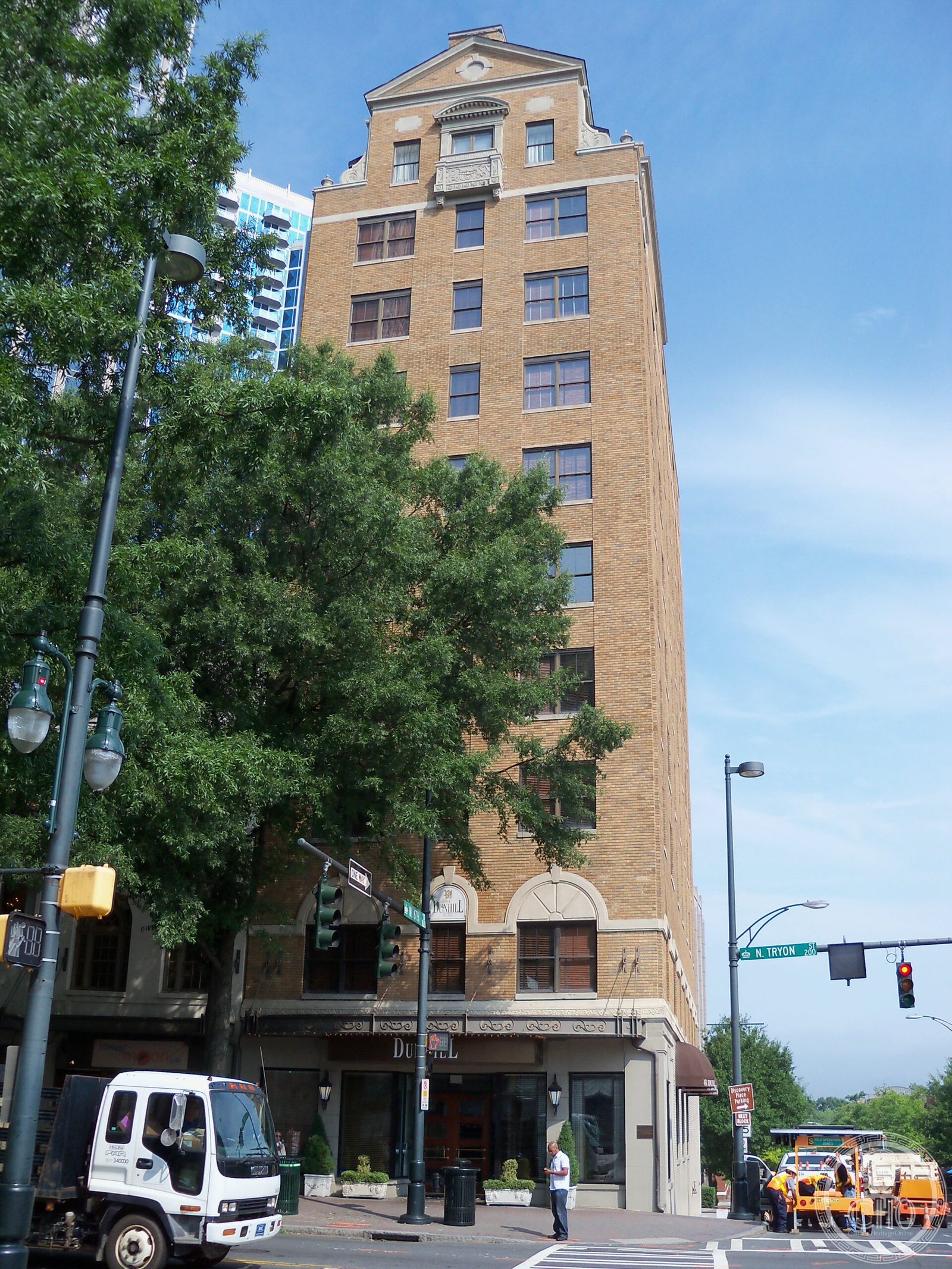
Charlotte’s oldest continually operating hotel — a 10-story Art Deco landmark that has housed presidents, governors, and literary figures on its way from the Jazz Age to the present.
At a glance
The Dunhill Hotel at 237 North Tryon Street opened in 1929 as a premier address for the business and political travelers of a city rapidly expanding on the back of textile wealth and banking growth. Its 10-story Art Deco facade in buff brick with terra-cotta ornament established a presence on Tryon Street that the building has maintained through multiple ownership changes, the Depression, and the transformation of Uptown Charlotte from a mid-century commercial center to a contemporary financial district. Listed on the National Register of Historic Places, the Dunhill remains the oldest hotel in continuous operation in Charlotte and a reference point for the city’s early-twentieth-century ambitions.
Key facts
- Opened: 1929
- Address: 237 North Tryon Street, Charlotte, North Carolina 28202
- Height: 10 stories
- Style: Art Deco
- Historic designation: National Register of Historic Places
- Notable: Charlotte’s oldest continually operating hotel
History
Charlotte’s growth in the 1920s was driven by the consolidation of the Piedmont Carolinas textile industry and the emergence of the city as a regional banking center. A prosperous town without a first-class hotel was a commercial liability, and the Dunhill was conceived specifically to fill that gap: a building that could host the mill owners, merchants, and financiers arriving on the Southern Railway from Atlanta and New York. When it opened in 1929, it was the tallest and most stylish commercial accommodation in Charlotte.
The timing was difficult: the hotel opened the same year as the stock market crash. Like many American hotels of its class, the Dunhill navigated the Depression through reduced rates, reduced staff, and the particular advantage of being the only address of its kind in the city — travelers still came to Charlotte, and they came to the Dunhill. The hotel hosted political figures through the New Deal era, wartime visitors, and the post-war economic expansion that remade the Carolinas.
The building underwent a comprehensive restoration in the late twentieth century that preserved its Art Deco exterior and public rooms while updating the guest accommodations to contemporary boutique-hotel standards. The restoration earned the hotel its NRHP listing and reinforced its identity as Charlotte’s architectural link to the Jazz Age. Today it operates as a small luxury property with a restaurant in the original lobby-level space.
What you see
The Tryon Street facade is a restrained essay in South Atlantic Art Deco — more conservative in ornament than contemporaries in New York or Chicago, reflecting the taste of a city that wanted modernity without flamboyance. The buff-brick surface is articulated by vertical terra-cotta strips that extend from the second floor to the cornice, channeling the eye upward along the building’s narrow frontage. The ground-floor storefronts and canopied entrance have been updated sympathetically, but the upper-floor fenestration and the decorative terra-cotta detailing at the cornice retain their 1929 character.
Inside, the lobby retains its original proportions and ceiling height, with plaster molding and woodwork in the period manner. The hotel’s compact floor plan — a consequence of its urban Tryon Street lot — gives the building a vertical slenderness that reads more like a New York residential hotel than a Southern civic palace, a quality that marks Charlotte’s commercial aspirations in the late 1920s.
Practical information
- Access: Hotel open to guests; restaurant open to the public
- Best time to visit: Weekday mornings for the quietest Tryon Street experience; weekend evenings for the restaurant
- Nearest transit: CATS Blue Line, Trade/Tryon station (two blocks south); Gold Line streetcar
- Time needed: 30 minutes for exterior and lobby; longer if dining
Getting there
237 North Tryon Street is in the heart of Uptown Charlotte, three blocks north of Trade Street and adjacent to the city’s main commercial and financial district. Charlotte Douglas International Airport (CLT) is approximately 20 minutes west by car or 30 minutes on the CATS Airport Connector. Amtrak’s Carolinian and Piedmont routes serve Charlotte’s main station at 1914 North Tryon Street, 10 minutes north by cab or Light Rail.
Nearby
- Levine Museum of the New South — comprehensive history of the post-Civil War Carolinas; two blocks south on Tryon Street
- Harvey B. Gantt Center for African-American Arts + Culture — art and history of Black Charlotte; three blocks west
- Romare Bearden Park — public park honoring Charlotte-born collage artist Romare Bearden; adjacent to Levine Museum
- NASCAR Hall of Fame — motorsport history museum; five-minute walk south on Tryon
Sources
- National Register of Historic Places, nomination file: Dunhill Hotel, Charlotte
- Preservation North Carolina, hotel landmark records
- Charlotte-Mecklenburg Historic Landmarks Commission, survey documentation
- Dan L. Morrill, Historic Charlotte: An Illustrated History of Charlotte and Mecklenburg County
Find it on the map
See this place and what’s around it →📷 Become a Cultural Heritage Online photographer
Share your photos of places: they stay published under your name as the author. The more they're seen, the more you get noticed — and soon a contest will reward the most appreciated photos.
Log in or sign up free to add a photoIs this page about you?
This page is read by travellers and heritage enthusiasts who find it on Google. Tell us how you are connected to this place and we will take it from there.