
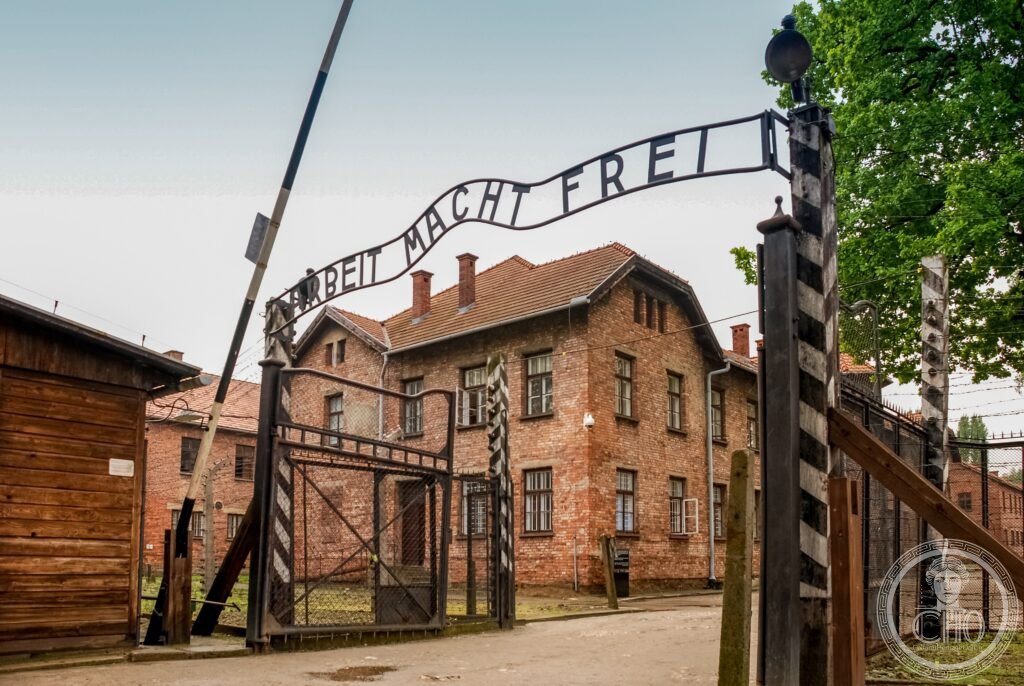
Auschwitz-Birkenau preserves the physical evidence of the largest killing complex the Nazi regime built. Roughly 1.1 million people, most of them Jews, were murdered here between 1940 and 1945. The site is kept largely as it was found at liberation, and it is this material record, buildings, rail line, victims’ belongings, that gives the memorial its weight.
At a glance
Auschwitz-Birkenau comprises two main sites three kilometres apart. Auschwitz I, opened in June 1940 in a former Polish Army barracks, functioned first as a prison for Polish political prisoners and later as the administrative core of the camp complex; it retains 28 brick buildings, among them Block 11 and the entrance gate bearing the inscription “Arbeit macht frei”. Auschwitz II-Birkenau, opened in 1942, was built specifically for mass extermination and held some 300 wooden and brick barracks together with four crematoria and gas chambers.
The United Nations Educational, Scientific and Cultural Organization inscribed the site on the World Heritage List in 1979 under the title “Auschwitz Birkenau: German Nazi Concentration and Extermination Camp (1940–1945)”, a name chosen to make clear who built and operated the camp.
Key facts
- Location: Oświęcim, Małopolska, Poland
- Opened: Auschwitz I in June 1940; Auschwitz II-Birkenau in 1942
- Deaths: approximately 1.1 million people, including around 1 million Jews, 70,000–75,000 Polish political prisoners, 21,000 Roma, 15,000 Soviet prisoners of war and 10,000 others
- Liberation: 27 January 1945, by the Red Army; the date is now marked internationally as Holocaust Remembrance Day
- Heritage status: UNESCO World Heritage Site, inscribed 1979
- Archive: the Auschwitz-Birkenau State Museum holds an extensive documentary archive drawn on as evidence at the Nuremberg Trials
History
Auschwitz I was established in June 1940 on the orders of Reichsführer-SS Heinrich Himmler, in a former Polish Army barracks in the town of Oświęcim, known in German as Auschwitz. It began as a prison for Polish political prisoners and prisoners of war. Mass killing of Jews at the complex escalated from 1942, following the Wannsee Conference of 20 January 1942, which set out the administrative framework for the “Final Solution”.
Birkenau’s rail spur was extended two kilometres directly into the camp in 1944, a change made to speed the deportation and killing of Hungarian Jews: 437,402 people were deported from Hungary in the space of fifty-six days between May and July that year. Inside the crematoria, Jewish prisoners known as the Sonderkommando were forced to work; on 7 October 1944 they staged the only armed uprising to take place within the crematorium complex.
The camp was liberated by the Red Army on 27 January 1945. The Auschwitz-Birkenau State Museum was established on the site, and UNESCO inscribed it as a World Heritage Site in 1979.
What you see
At Auschwitz I, visitors pass through the gate marked “Arbeit macht frei” into the former camp, now the museum’s exhibition ground. Block 11, the punishment block, held basement cells where prisoners were left to die standing, and its courtyard contains the execution wall known as the Black Wall, where an estimated 20,000 people were shot. Zyklon B was first tested as a killing agent in Block 11’s basement, on Soviet prisoners of war, on 3 September 1941. The camp’s only surviving intact gas chamber and crematorium stand within Auschwitz I; the four gas chambers and crematoria at Birkenau were destroyed by the SS before its retreat and survive only as ruins.
Several of the brick exhibition buildings at Auschwitz I display objects taken from victims on arrival: shoes, human hair, spectacles and suitcases labelled with names and addresses, kept as they were found. At Birkenau, the rail line runs directly into the site, past rows of wooden and brick barracks stretching across the camp’s considerable area.
All visits to the memorial are conducted with licensed guides.
Practical information
- Guided visits: entry is with a licensed guide; visits should be arranged through the Auschwitz-Birkenau State Museum’s official channels
- Layout: Auschwitz I and Auschwitz II-Birkenau are separate sites about three kilometres apart, and a visit typically covers both
- Coordinates: 50.0274° N, 19.2023° E
Getting there
The memorial lies in the town of Oświęcim in the Małopolska region of southern Poland. Visitors should consult the Auschwitz-Birkenau State Museum’s official website for current guidance on transport, entry arrangements and guided-tour bookings.
Nearby
- Auschwitz II-Birkenau — about three kilometres from Auschwitz I, the extermination camp built in 1942, reached most often as the second part of the same visit
Sources
- Auschwitz-Birkenau State Museum
- UNESCO
Find it on the map
See this place and what’s around it →📷 Become a Cultural Heritage Online photographer
Share your photos of places: they stay published under your name as the author. The more they're seen, the more you get noticed — and soon a contest will reward the most appreciated photos.
Log in or sign up free to add a photoIs this page about you?
This page is read by travellers and heritage enthusiasts who find it on Google. Tell us how you are connected to this place and we will take it from there.