
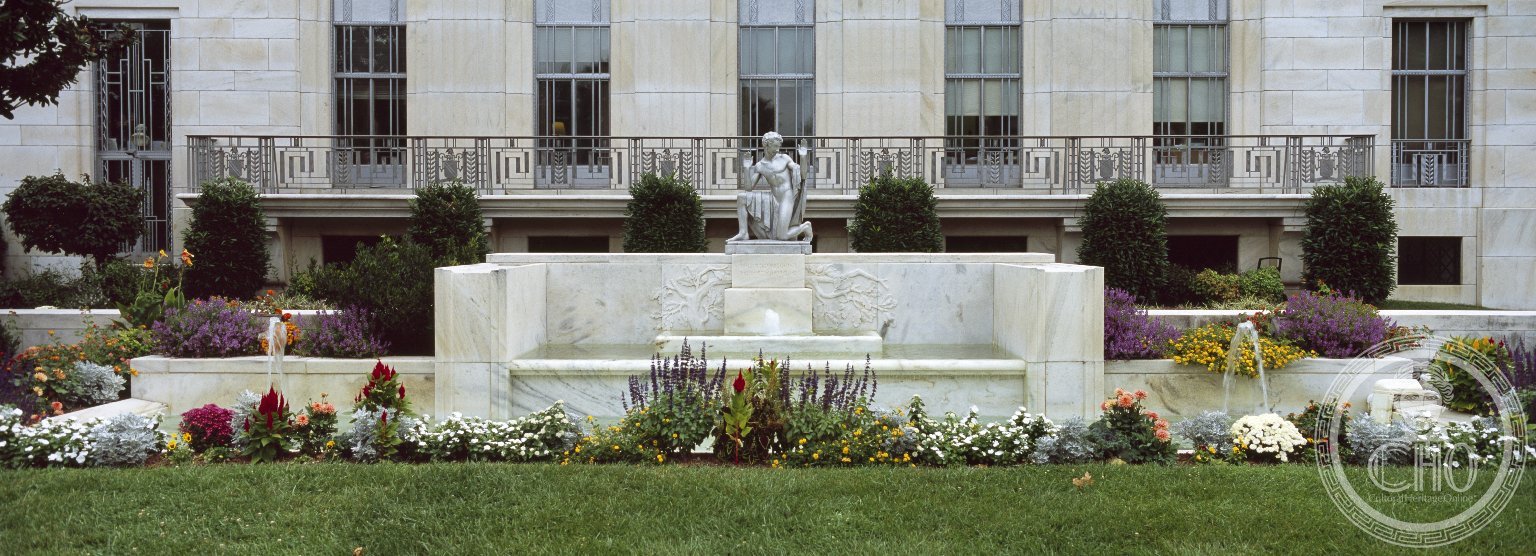
The Folger Shakespeare Library holds the world’s largest collection of printed works by William Shakespeare and stands among the finest repositories of early modern materials anywhere on earth. Completed in 1932 on Capitol Hill to designs by Paul Philippe Cret, the building presents a cool white marble exterior whose stripped Neoclassical severity gives way, at closer inspection, to extraordinary Art Deco detail: nine alabaster bas-relief panels depicting scenes from Shakespeare’s plays line the facade, and cast aluminium grilles of sinuous botanical complexity frame each door and window. Inside, an intimate Elizabethan Theatre recreates a 1600s playing space, while the reading room preserves the oak-panelled quiet of a Tudor hall. Henry Clay Folger and his wife Emily assembled the collection over four decades; their gift to the American people, enshrined in this building, remains one of the great acts of private cultural philanthropy in the nation’s history.
At a glance
- Type
- Research library / cultural institution
- Period
- 1930–1932
- Style
- Art Deco / Stripped Classicism
- Location
- 201 East Capitol Street SE, Washington DC, USA
- Coordinates
- 38.8894° N, 77.0031° W
- Architect(s)
- Paul Philippe Cret; Alexander B. Trowbridge (consultant)
Overview
Established by Standard Oil chairman Henry Clay Folger and opened in 1932, the library holds over 310,000 books and manuscripts including 82 copies of the First Folio — more than any other institution in the world. It functions as an independent research library affiliated with Amherst College, open to scholars worldwide and to the public for exhibitions and performances. The collection spans the entire arc of early modern English culture from 1500 to 1750, making it a foundational resource for Renaissance studies globally.
History
Henry Clay Folger began collecting Shakespeare editions in the 1880s, quietly purchasing rare copies at auction over four decades. By the time he commissioned Cret’s building, his collection was the largest of its kind. The cornerstone was laid in May 1930; the building opened on 23 April 1932 — Shakespeare’s traditional birthday. Folger himself died in 1930 before seeing it complete. His wife Emily supervised the opening and continued to support the institution. A 1959 wing added by Harbeson, Hough, Livingston, and Larson expanded research facilities without disturbing the original fabric. The building was listed on the National Register of Historic Places, cementing its status as a landmark of American cultural life.
Architecture & Design
Cret employed what he called “stripped Classicism” — a modernist reduction of classical language to planar surfaces and precise proportions, enriched by Art Deco ornament rather than historicist mouldings. Nine relief panels by sculptor John Gregory punctuate the white Georgia marble facade, each illustrating a Shakespeare play. Cast aluminium grilles of intricate design fill the window and door openings. Inside, the reading room is panelled in English oak with plaster ceilings recalling Tudor interiors. The Elizabethan Theatre seats approximately 260 and features a painted ceiling quotation; its stage replicates the thrust configuration of Jacobean playhouses. A stained-glass window by Nicola D’Ascenzo depicting the Seven Ages of Man illuminates the great hall.
Cultural significance
The Folger is simultaneously a monument of American philanthropy, a world-class research institution, and a building of genuine architectural distinction. It houses more copies of the Shakespeare First Folio than anywhere else — a fact that gives it global importance for literary scholarship. As a Capitol Hill landmark completed in the depths of the Depression, it also testifies to the belief that cultural institutions deserve permanent, beautiful homes. Cret’s design influenced a generation of American institutional buildings that sought to reconcile classical dignity with modern efficiency.
Visiting today
The library is open Tuesday through Saturday; admission to the public galleries is free. Rotating exhibitions draw on the collection’s Shakespeare materials and early modern holdings. The Elizabethan Theatre hosts concerts, lectures, and theatrical performances throughout the year. The Elizabethan Garden — featuring plants mentioned in Shakespeare’s works — is open during library hours. Scholarly access to the reading room requires registration in advance.
Getting there
The library is at 201 East Capitol Street SE, Washington DC. The nearest Metro station is Capitol South (Blue/Orange/Silver lines), a five-minute walk. Metrobus routes serve East Capitol Street. The library is adjacent to the Library of Congress and a short walk from the Supreme Court Building, making a combined visit convenient. Limited street parking is available on surrounding streets.
Sources & resources
Find it on the map
See this place and what’s around it →Record researched and written by Luigi De Marchi for Cultural Heritage Online, 2026.
📷 Become a Cultural Heritage Online photographer
Share your photos of places: they stay published under your name as the author. The more they're seen, the more you get noticed — and soon a contest will reward the most appreciated photos.
Log in or sign up free to add a photoIs this page about you?
This page is read by travellers and heritage enthusiasts who find it on Google. Tell us how you are connected to this place and we will take it from there.