
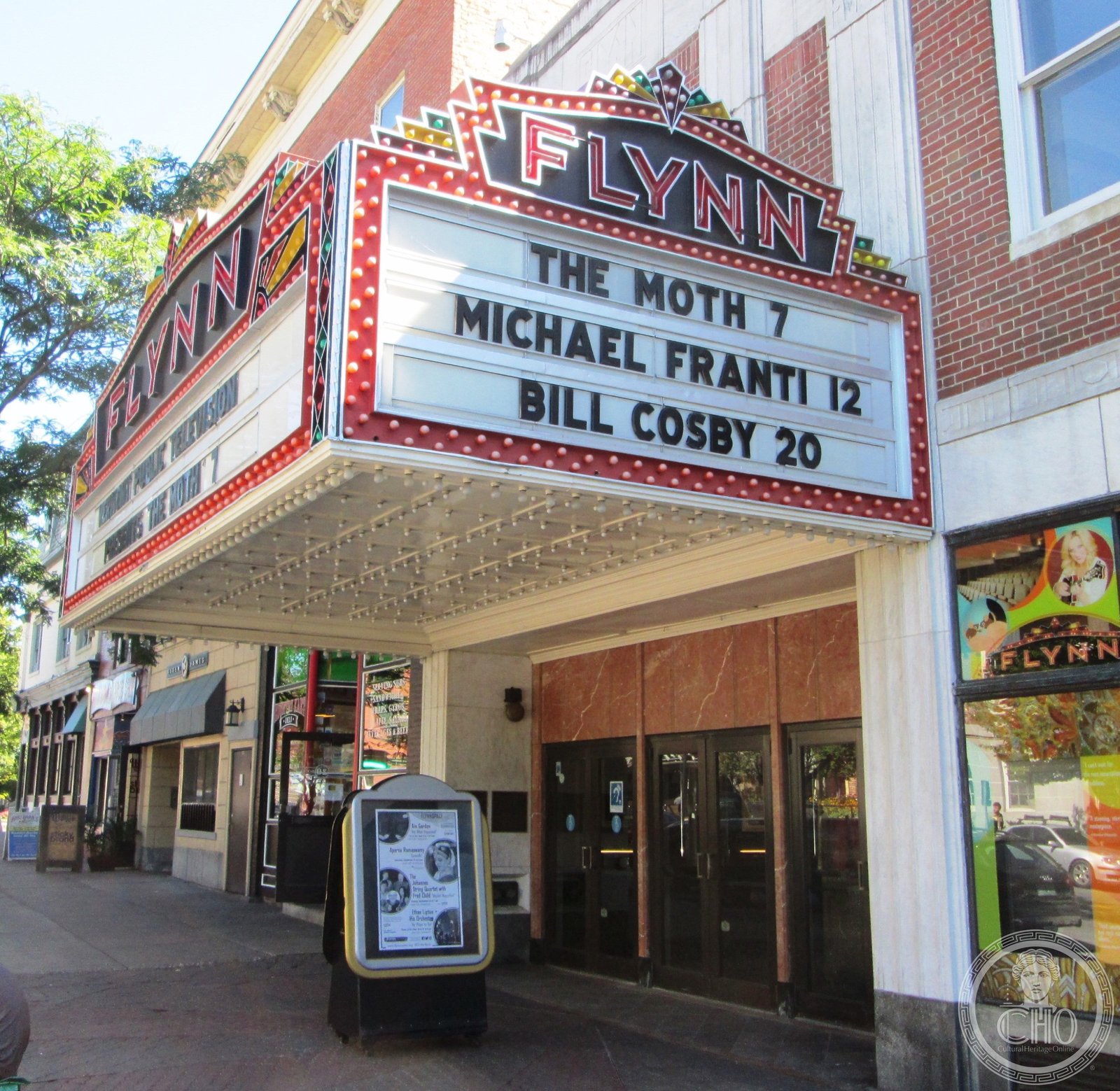
On Main Street in the heart of Burlington, the Flynn Theater has served as Vermont’s premier performing arts venue since it opened in 1930 — an Art Deco movie palace whose streamlined facade and richly decorated interior brought the full vocabulary of 1930s theatrical design to New England’s most culturally active city, and whose transformation into the Flynn Center for the Performing Arts has made it the anchor of a Burlington arts scene that punches far above the weight of any city its size.
At a glance
The Flynn Theater at 153 Main Street is the finest historic performance venue in Vermont and one of the most beautifully preserved Art Deco movie palaces in New England. Opened in 1930 at the threshold between the silent and sound film eras, it brought the design ambitions of the great urban movie palaces to Burlington — a city whose position as the economic and cultural center of Vermont supported entertainment investment of a quality disproportionate to its size. Listed on the National Register of Historic Places, the building has been adapted and expanded as the Flynn Center for the Performing Arts while preserving the essential architectural character of the 1930 original. It hosts Broadway touring productions, concerts, dance, and the full range of performing arts programming that serves Vermont’s educated and culturally engaged population.
Key facts
- Address: 153 Main Street, Burlington, VT 05401
- Opened: 1930
- Style: Art Deco
- Current name: Flynn Center for the Performing Arts
- Current use: Active performing arts venue; Broadway tours, concerts, dance
- Designation: National Register of Historic Places
- GPS: 44.4759° N, 73.2122° W
History
Burlington in 1930 was Vermont’s largest city and its undisputed commercial and cultural capital — a Lake Champlain port city whose position at the crossroads of regional trade routes had made it the economic hub of a rural state whose character was shaped by dairy farming, granite quarrying, and the textile industries of the Champlain Valley. The city’s population was small by national standards but served a broader regional hinterland that gave Burlington the commercial density to support investment in cultural infrastructure of genuine quality.
The 1930 Flynn Theater was built at the precise moment when the motion picture industry was consolidating its investment in purpose-built movie palaces across American cities of all sizes — the year that synchronized sound had become universal, the silent era was definitively over, and the new generation of theaters was designed specifically for the experience of sound cinema in maximum comfort and luxury. The building’s Art Deco design brought Burlington into alignment with the architectural vocabulary that was transforming commercial districts across America: the streamlined ornament, the geometric facades, and the atmospheric interiors that characterized the style at its 1930 peak.
The theater served Burlington audiences through the golden age of Hollywood and into the era of television and suburban multiplexes, eventually closing as a commercial cinema before being repurposed as the Flynn Community Theatre in the 1970s and subsequently transformed into the Flynn Center for the Performing Arts — one of the most active regional performing arts organizations in New England, whose programming has made Burlington a destination for performing arts audiences from across Vermont and the northern New England region.
What you see
The Main Street facade presents the Flynn Theater’s Art Deco character with the confident simplicity of a design that achieved its effect through quality of ornament and precision of proportions rather than elaborate decoration: geometric ornamental panels, stylized lettering, and the vertical marquee projecting over the sidewalk that has identified the building since 1930. The composition is firmly of its moment — unmistakably 1930 in its vocabulary of streamlined surfaces and geometric detail.
The auditorium preserves the essential character of the 1930 design: a space whose decorative program, scale, and acoustic configuration were designed to make the experience of attending a performance feel like an occasion. The Flynn Center’s stewardship has maintained this character while adapting the building for the full range of contemporary performing arts uses, and the result is a historic interior that continues to be used as its builders intended — as a place of concentrated theatrical experience in a setting that signals the importance of what happens within it.
Practical information
- Programming: Broadway tours, concerts, dance, film, community events; check flynntix.org for schedule
- Church Street Marketplace: The Flynn is two blocks from Burlington’s pedestrianized Church Street Marketplace, lined with restaurants, shops, and galleries; the area is easily walkable
- Seasonal note: Burlington’s Lake Champlain waterfront is at its most inviting in summer; the Flynn’s season extends year-round
Getting there
Burlington is Vermont’s largest city, on the eastern shore of Lake Champlain at the edge of the Green Mountains, approximately 45 miles south of the Canadian border. Burlington International Airport (BTV) is 3 miles east. Amtrak’s Vermonter connects Burlington’s Essex Junction station (4 miles east of downtown) to New York City with stops in Springfield, New Haven, and Hartford. Interstate 89 connects Burlington to Montpelier, Concord NH, and Boston. The Flynn Theater is on Main Street in downtown Burlington, a five-minute walk from Church Street Marketplace and the lakefront.
Nearby
- Lake Champlain waterfront — the western edge of downtown Burlington, where the lake’s waters separate Vermont from New York across a crossing of historical significance; the ECHO Leahy Center for Lake Champlain and the Waterfront Park occupy the lake edge, with ferry service to Port Kent, New York
- ECHO Leahy Center for Lake Champlain — the science and culture center at the Burlington waterfront dedicated to the ecology and history of Lake Champlain, including exhibits on the lake’s Revolutionary War history, its Great Lakes-scale fish populations, and the ongoing environmental stewardship of one of North America’s most distinctive freshwater bodies
- University of Vermont (1791) — the state university and research institution on the hill above downtown Burlington, whose presence gives the city its disproportionate cultural and intellectual density; the Robert Hull Fleming Museum on the UVM campus holds significant collections of American and European art
- Shelburne Museum — the extraordinary outdoor museum seven miles south of Burlington, collecting thirty-nine historic structures relocated from across New England and assembled with world-class collections of folk art, decorative arts, and Impressionist painting; one of the most distinctive museum experiences in the northeastern United States
Sources
- National Register of Historic Places, Flynn Theater nomination
- Vermont Division for Historic Preservation architectural documentation
- Flynn Center for the Performing Arts institutional history
- Burlington Free Press archives — Flynn Theater and Flynn Center history
- Vermont Historical Society, Burlington commercial architecture documentation
Find it on the map
See this place and what’s around it →Record researched and written by Luigi De Marchi for Cultural Heritage Online, 2026.
📷 Become a Cultural Heritage Online photographer
Share your photos of places: they stay published under your name as the author. The more they're seen, the more you get noticed — and soon a contest will reward the most appreciated photos.
Log in or sign up free to add a photoIs this page about you?
This page is read by travellers and heritage enthusiasts who find it on Google. Tell us how you are connected to this place and we will take it from there.