
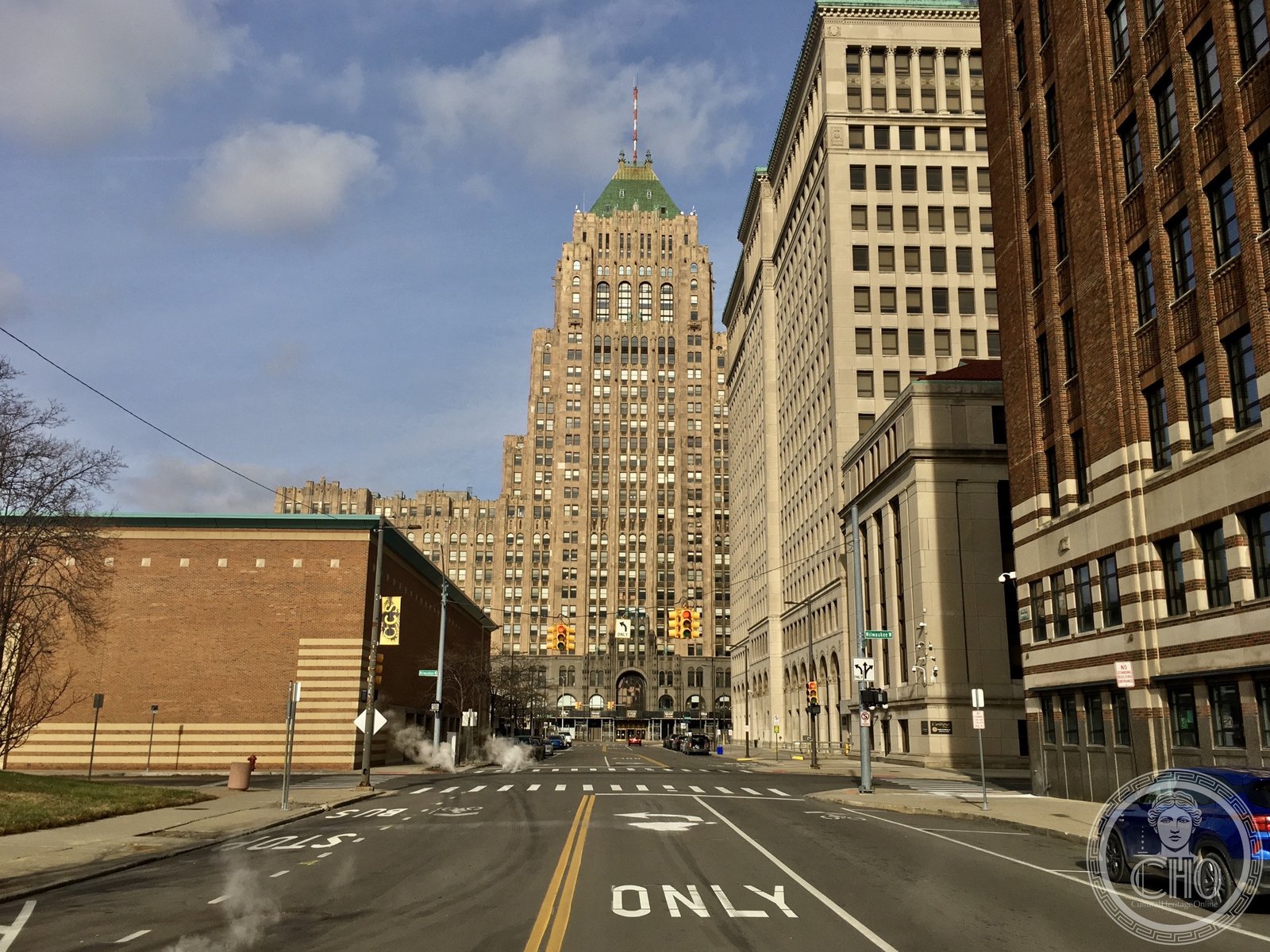

Known as “Detroit’s Most Beautiful Building,” a 28-story Art Deco tower on West Grand Boulevard whose interior arcade of mosaic, marble, and bronze set a standard for commercial magnificence that the city has never surpassed.
At a glance
The Fisher Building stands at 3011 West Grand Boulevard in Detroit’s New Center neighborhood, a 28-story Art Deco tower completed in 1928 to designs by Albert Kahn. Built for the Fisher Brothers — who had made a fortune as body manufacturers for the nascent automobile industry — the building is widely considered the most architecturally distinguished commercial structure in Detroit. Its interior arcade, finished in sixty varieties of marble with a vaulted ceiling of Pewabic tile mosaic and bronze ornamental work on every visible surface, is one of the finest examples of applied decorative arts in American architecture. The building is a National Historic Landmark.
Key facts
- Address: 3011 West Grand Boulevard, Detroit, Michigan 48202
- Completed: 1928
- Architect: Albert Kahn
- Clients: The Fisher Brothers (Frederick, Charles, William, Alfred, Howard, Lawrence, and Edward)
- Height: 28 stories
- Style: Art Deco (Nordic/Gothic influences)
- Interior highlight: Three-story shopping arcade with 60 varieties of marble
- Designation: National Historic Landmark
- GPS: 42.3718°N, 83.0736°W
History
The seven Fisher Brothers — Frederick, Charles, William, Alfred, Howard, Lawrence, and Edward — had founded the Fisher Body Company in 1908 to manufacture closed carriage bodies for the automobile industry. Their contracts with General Motors made them extraordinarily wealthy, and in 1919 General Motors acquired Fisher Body in a transaction that made the brothers among the richest men in the country. Their decision, in the mid-1920s, to commission a commercial building in Detroit worthy of their position produced one of the great private architectural commissions of the American Gilded Age’s last extension into the industrial era.
Albert Kahn — the Detroit architect who had built much of the industrial infrastructure of the American automobile industry, including GM’s factories and Ford’s River Rouge plant — was the natural choice for the commission. Kahn’s design for the Fisher Building brought to a commercial tower the same principles of structural rationality and programmatic clarity that defined his industrial work, but applied them in a context where material richness and ornamental elaboration were not only permitted but expected. The result was a building in which every surface visible to visitors — floors, walls, ceilings, door surrounds, elevator lobbies — was treated as an occasion for applied art.
The Fisher Building opened in 1928 to immediate recognition as one of the finest commercial buildings in the United States. It anchored the New Center development north of downtown Detroit, which the Fisher Brothers and General Motors conceived as a second commercial district for the city. The building’s National Historic Landmark designation, achieved in recognition of both its architectural merit and its importance to Detroit’s cultural heritage, reflects a consensus that persists in the twenty-first century: the Fisher Building remains the most complete surviving expression of Art Deco civic aspiration in the American Midwest.
What you see
The exterior presents a tower of light-colored stone that becomes progressively more elaborate toward the crown. Kahn organized the building in three vertical zones: a base of dressed stone that establishes the building’s relationship to West Grand Boulevard, a shaft of repetitive window bays that carries the building’s height with minimal ornament, and a crown of stepped setbacks and decorative flourishes that marks the building as civic in ambition even as it functions as commercial office space. The building’s form draws on Art Deco’s synthesis of modernist massing with Gothic and Nordic ornamental traditions — the tower reads as vertical not only in its proportions but in the upward pull of its carved stone detail.
The interior arcade, entered from West Grand Boulevard, is the building’s true set piece. A three-story vaulted shopping gallery runs the length of the building, its ceiling covered in a mosaic of Pewabic tile — the Detroit craft pottery whose work appears throughout the city’s finest buildings — and its walls lined with panels of sixty varieties of marble sourced from across Europe and North America. Bronze ornamental work covers the column bases, door surrounds, and shop fronts. The elevator lobbies, at the gallery’s ends, continue the marble and bronze program to a level of finish that makes arrival in the building’s upper floors feel like an anticlimax after the grandeur of the approach.
Practical information
- Interior arcade: Open to the public during building hours (Monday–Friday); shops, restaurants, and the Fisher Theatre accessible
- Fisher Theatre: 2,089-seat theater in the base of the building; check detroitoperahouse.com for current programming
- Best time: Weekday mornings when the arcade is less crowded; midday for the best light in the vaulted ceiling
- Time needed: 45–60 minutes for the arcade and lobby areas; plan longer for a theater visit
Getting there
The Fisher Building is located at 3011 West Grand Boulevard in Detroit’s New Center neighborhood, approximately two miles north of downtown. By QLINE streetcar, the West Grand Blvd stop is directly in front of the building. By car from I-94, take the Lodge/M-10 north to the West Grand Boulevard exit; parking is available in the building’s own surface lot and in adjacent municipal garages. The nearby General Motors headquarters at the Renaissance Center and the Detroit Institute of Arts are both accessible by public transit or a short drive from New Center.
Nearby
- Cadillac Place (former GM Building, 1923) — directly across West Grand Boulevard, another Albert Kahn commission
- Motown Museum — 1.5 miles southwest on West Grand Boulevard; Hitsville USA
- Detroit Institute of Arts — 1.2 miles southeast via Woodward Avenue
- Gem Theatre (1927) — downtown Detroit; Art Deco theater relocated and preserved
Sources
- National Historic Landmark nomination form, Fisher Building (National Park Service)
- Albert Kahn Associates — office archives and documentation of the Fisher Building commission
- Detroit Historical Society — Fisher Brothers and New Center development records (detroithistorical.org)
- Pewabic Pottery — documentation of the Fisher Building tile commission (pewabic.org)
- Detroit Free Press, coverage of the building opening, 1928 (ProQuest Historical Newspapers)
Find it on the map
See this place and what’s around it →Record researched and written by Luigi De Marchi for Cultural Heritage Online, 2026.
📷 Become a Cultural Heritage Online photographer
Share your photos of places: they stay published under your name as the author. The more they're seen, the more you get noticed — and soon a contest will reward the most appreciated photos.
Log in or sign up free to add a photoIs this page about you?
This page is read by travellers and heritage enthusiasts who find it on Google. Tell us how you are connected to this place and we will take it from there.