
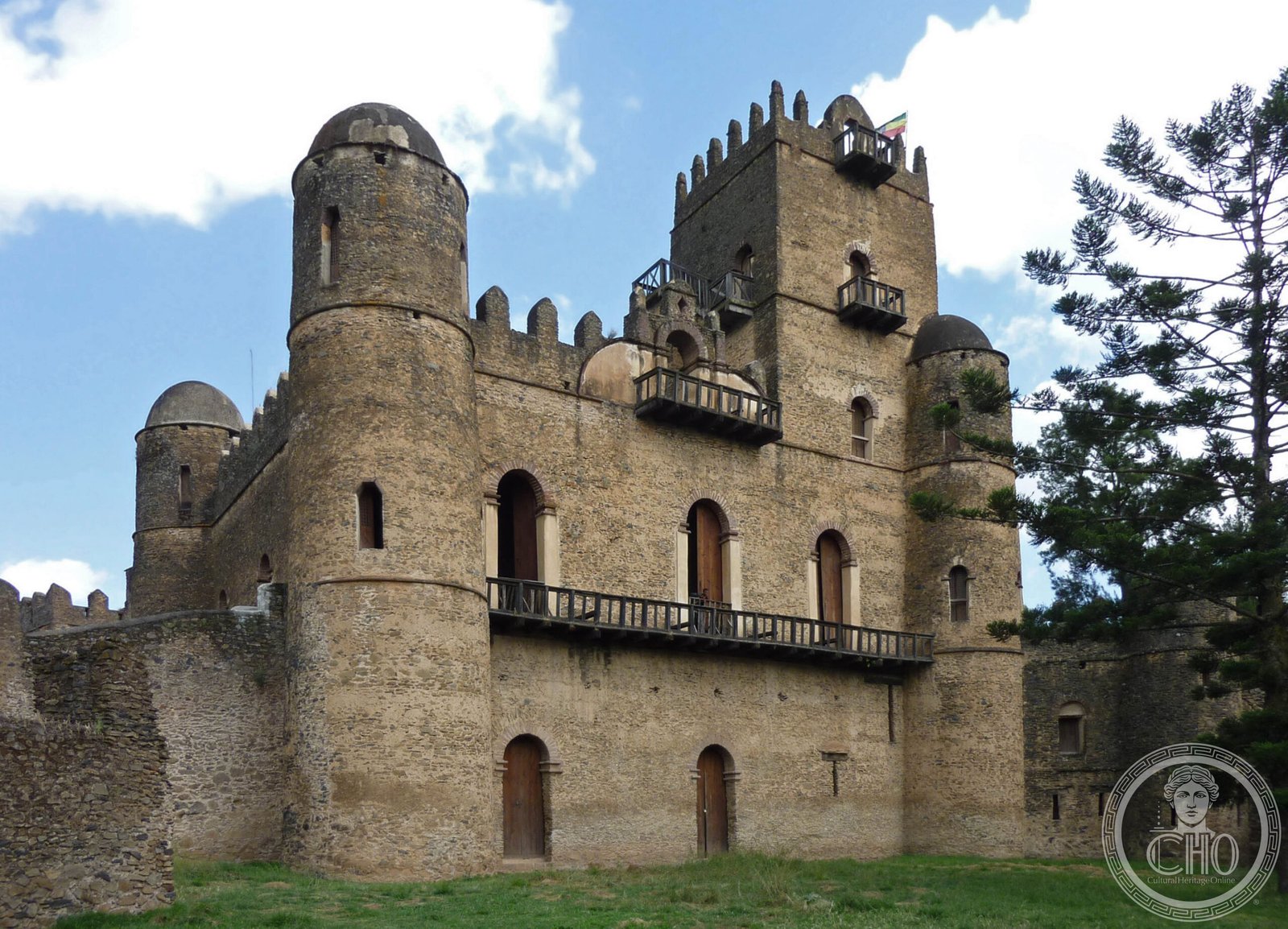
The walled royal enclosure of Gondar – Ethiopia’s imperial capital for over two centuries – contains six palaces, three churches, and a library within 70,000 square metres of battlemented stone walls, built in an extraordinary architectural style that fuses Aksumite Ethiopian tradition with Baroque and Hindu influences absorbed from Portuguese Jesuit missionaries.
At a glance
The Fasil Ghebbi (Royal Enclosure) is a 70,000 m2 walled compound in the city of Gondar, in the Amhara region of northern Ethiopia. It was the seat of the Ethiopian Empire from 1636 to 1864 CE – a period known as the Gondar era – during which successive emperors each added their own palace to the complex, creating a layered architectural ensemble unlike anything else in Africa or the medieval world. UNESCO inscribed Fasil Ghebbi as a World Heritage Site in 1979.
The complex was founded by Emperor Fasilides (r. 1632-1667), whose two-story castle – with its battlements, towers, and corner turrets – remains the most dramatic building in the compound. The distinctively Ethiopian architecture was shaped partly by Portuguese Jesuit missionaries present at the Ethiopian court in the 16th-17th centuries, whose Baroque aesthetic blended with the earlier Aksumite tradition and, through trade connections, with Mughal Indian architectural motifs.
Key facts
- UNESCO inscription: 1979 (one of Africa’s first WHS)
- Period: 1636-1864 CE (Gondar era of Ethiopian Empire)
- Enclosure area: Approximately 70,000 m2
- Structures within compound: 6 palaces, 3 churches, royal stables, baths, library
- Founder: Emperor Fasilides (r. 1632-1667)
- Architectural style: Aksumite-Baroque-Hindu synthesis, unique to Gondar period
- Location: Gondar city, Amhara Region, northern Ethiopia
- Coordinates: 12.6050 N, 37.4680 E
History of the Gondar imperial capital
Before Gondar, Ethiopian emperors moved their courts from place to place in mobile tent-cities, following ancient tradition. Emperor Fasilides broke with this practice around 1636, establishing Gondar as a permanent capital – a decision that would shape Ethiopian history for over two centuries. He chose the site on a plateau above the confluence of two streams, at an elevation of 2,200 metres, commanding fertile agricultural land and important trade routes.
Fasilides built the first castle – a massive two-story stone structure with corner towers and crenellated battlements that resembles a European medieval castle but with distinctly Ethiopian proportions and carved Ethiopian details. Each subsequent emperor who ruled from Gondar added their own palace to the enclosure: Emperor Iyasu I (r. 1682-1706) built the most lavishly decorated palace, with painted ceilings and carved stonework; Emperor Dawit III added banquet halls; Emperor Bakaffa (r. 1721-1730) contributed further buildings. The accumulation of palaces over generations created an organic ensemble rather than a planned complex.
Gondar’s golden age lasted through the late 17th and early 18th centuries. The city grew to an estimated population of 65,000 – making it one of the largest cities in Africa at the time – with 44 churches, a thriving market, and the political centre of the vast Ethiopian empire. Its position on trade routes between the Red Sea and the African interior brought Portuguese, Jesuit, Ottoman, and Indian cultural influences into contact with Ethiopian tradition.
Decline came gradually through the 18th century as the Zemene Mesafint (Era of the Princes) reduced emperors to figureheads controlled by rival noble factions. The decisive blow came in 1888, when Mahdist forces from Sudan invaded and sacked Gondar, burning churches and badly damaging several palaces within the Fasil Ghebbi. The Ethiopian capital subsequently shifted to Addis Ababa.
What you see: the enclosure and its buildings
The Fasil Ghebbi is entered through one of several original gates in its massive stone walls. Inside, the compound feels more like a small town than a single monument – a landscape of towers, churches, bridges, and gardens spread across an irregular site. The architecture across different buildings reflects the reigns of different emperors, each with their preferred style and materials.
Fasilides’ Castle (1636) is the heart of the complex – a two-story rectangular structure with battlemented walls, four corner towers, and a higher central tower. The ground floor served as state rooms; the upper floor as royal apartments. The style is neither purely European nor purely African: the battlements and towers have Gothic echoes (attributed to Portuguese influence), but the proportions, the interior decorative carving, and the ground plan are distinctly Ethiopian.
Iyasu I’s Palace (1690s) is considered the most elaborately decorated building in the compound. Its carved wooden balconies, painted plaster walls (now largely weathered), and finely crafted stonework represented the height of Gondar-period luxury. The palace was connected to a royal bath complex and its own private church.
Outside the main compound, Fasilides’ Bath – a large stone-walled pool in a separate garden enclosure – is believed to still be used once per year for Timkat (Ethiopian Epiphany). On this occasion, the pool is filled with water blessed by priests and the faithful jump in, re-enacting the baptism of Christ. The ritual attracts thousands of pilgrims from across the region.
In the city around the Fasil Ghebbi, Debre Birhan Selassie Church is famous throughout Ethiopia for its interior ceiling painting: over 80 cherub faces arranged in rows covering the entire ceiling, flanked by painted biblical scenes. This image has become one of the most reproduced visual symbols of Ethiopian culture.
Practical information
- Opening hours: Daily, approximately 8:00-18:00; verify locally as hours vary seasonally
- Admission: Entry fee applies (Fasil Ghebbi and Debre Birhan Selassie Church have separate fees)
- Guided tours: Available at the entrance gate; a guide is strongly recommended to navigate the compound and understand the individual palaces
- Photography: Permitted within the compound; some churches restrict interior photography
- Best season: October-March (dry season, after the main rains); avoid main rainy season (June-August) if possible
- Timkat festival: January 19-20 – the most spectacular time to visit Gondar, with Fasilides’ Bath ceremony
Getting there
Gondar is served by Gondar Airport (GDQ), with regular Ethiopian Airlines flights from Addis Ababa (approximately 1.5-hour flight). Overland from Addis Ababa, Gondar is approximately 740 km north via the A2 highway, passing through Debre Markos and Bahir Dar – a journey of approximately 12-14 hours by bus. Bahir Dar (on Lake Tana, 3 hours south) is the more common overland approach for travellers on the Historic Route circuit.
Within Gondar, the Fasil Ghebbi is in the centre of the city, walkable from most hotels. A tuk-tuk or taxi from the bus station takes approximately 10-15 minutes.
Nearby
- Simien Mountains National Park: UNESCO World Heritage Site, approximately 100 km north – dramatic highland scenery and endemic wildlife (gelada baboons, Ethiopian wolves, walia ibex)
- Lake Tana: 70 km south, via Bahir Dar – the source of the Blue Nile; its island monasteries (12th-18th century) contain extraordinary painted manuscript collections
- Bahir Dar: Gateway city to Lake Tana, with the Blue Nile Falls (Tis Issat) 30 km downstream
- Debre Birhan Selassie Church: In Gondar city, 1 km from the Fasil Ghebbi – the painted cherub-ceiling church, one of Ethiopia’s most celebrated interiors
- Kuara district churches: Several medieval rock-hewn churches in the lowlands southwest of Gondar, seldom visited
Sources
- UNESCO World Heritage Centre: Fasil Ghebbi, Gondar Region (List No. 19)
- Pankhurst, Richard. The Ethiopian Royal Chronicles. Oxford University Press, 1967.
- Henze, Paul. Layers of Time: A History of Ethiopia. Palgrave Macmillan, 2000.
- Wikipedia: Fasil Ghebbi
Find it on the map
See this place and what’s around it →📷 Become a Cultural Heritage Online photographer
Share your photos of places: they stay published under your name as the author. The more they're seen, the more you get noticed — and soon a contest will reward the most appreciated photos.
Log in or sign up free to add a photo