
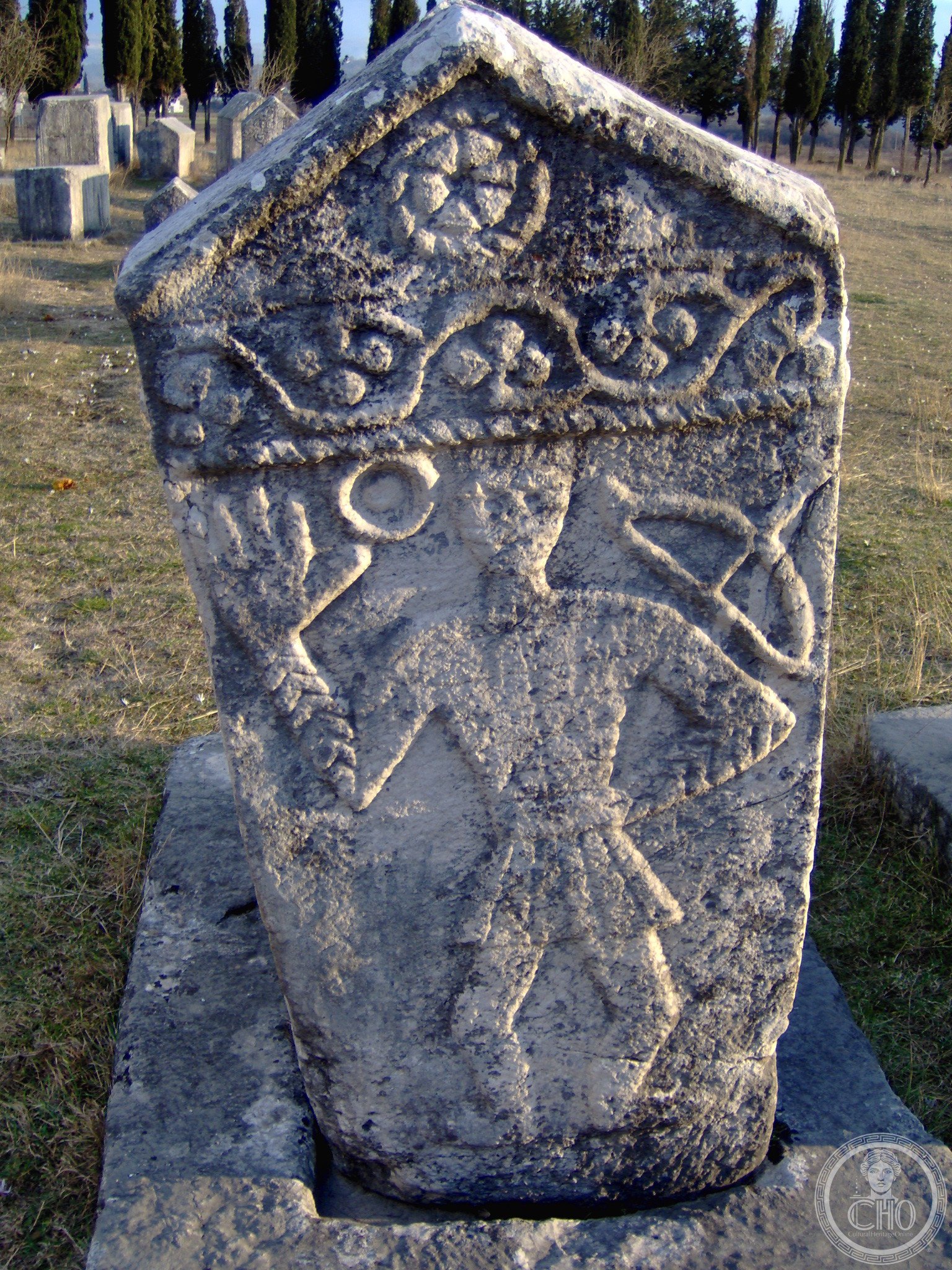
Scattered across Bosnia-Herzegovina, Croatia, Serbia, and Montenegro, over 70,000 decorated medieval tombstones represent one of the most singular artistic traditions in European history – massive carved monoliths produced by a vanished schismatic Christian civilisation unlike anything in Catholic or Orthodox medieval art.
At a glance
Stecaci (singular: stecak) are medieval monolithic tombstones produced between the late 12th and the early 16th centuries in a compact region of the western Balkans. They range from simple flat slabs to elaborately carved chest-tombs, sarcophagi, and obelisks standing up to three metres tall and weighing several tonnes. As a serial transboundary UNESCO World Heritage Site (inscribed 2016), the nomination encompasses 30 necropolises across four modern countries – Bosnia-Herzegovina, Croatia, Serbia, and Montenegro – preserving the most representative examples of a tradition that abruptly ended with the Ottoman conquest.
The largest concentration anywhere is the Radimlja necropolis near Stolac in Herzegovina, where approximately 300 tombstones stand in an open field, their surfaces covered with spirals, fighting knights, hunting scenes, and the circular folk dance known as the kolo. Many bear inscriptions in Bosancica – a Bosnian variant of Cyrillic used by the medieval Bosnian church.
Key facts
- UNESCO inscription: 2016 (serial transboundary, 30 sites, 4 countries)
- Period of production: Late 12th – early 16th century CE
- Total tombstones: Over 70,000 across the region
- Largest necropolis: Radimlja, near Stolac, Herzegovina (~300 stones)
- Material: Local limestone; massive monolithic slabs
- Script on inscriptions: Bosancica (Bosnian Cyrillic)
- Associated culture: Medieval Bosnian Church (schismatic Christian denomination)
- Coordinates: 43.0789 N, 17.4736 E (Radimlja reference point)
History and cultural context
The stecaci tradition emerged in the late 12th century within the medieval Bosnian kingdom, a state that occupied an unusual religious position between Catholic and Orthodox Christianity. The Bosnian Church – sometimes called a heretical or dualist sect by Catholic missionaries, though its exact theology remains debated – developed its own distinct visual and funerary culture, producing tombstones whose iconography cannot be directly derived from either Catholic or Orthodox models.
The artisans who carved the stecaci are unknown – no names survive, and workshops can only be reconstructed through stylistic analysis of recurring motifs. Production continued under successive Bosnian rulers and nobility, with the largest and most elaborate tombs reserved for the aristocracy. The kolo dance scenes, hunting scenes, and tournament imagery suggest a knightly culture with its own codes of honour and celebration.
The Ottoman conquest of Bosnia (completed 1463 CE) abruptly ended the tradition. Within a generation, the ruling class that had commissioned the tombstones had converted to Islam or been displaced. The artisans vanished, the Bosnian Church dissolved, and the necropolises were abandoned in the fields and forests where they still stand. The stecaci thus survive as the sole durable record of a civilisation that otherwise left few written documents.
For centuries the stones were enigmatic to populations living among them. Local traditions called them mramori (marbles) or attributed them to giants. Systematic scholarly study began only in the 19th century, with Marian Wenzel’s 1965 catalogue of decorative motifs remaining the foundation of stecaci scholarship.
What you see: forms and decoration
The tombstones take four main forms: flat slabs (ploca) laid directly on the ground; chest-tombs (sanduk) shaped like raised rectangular sarcophagi; gabled sarcophagi (sljemenjak) with a ridged roof; and upright obelisks (stup). A single necropolis typically contains a mix of all four types, the most elaborate belonging to high-status burials.
The carved decoration is what makes stecaci extraordinary. Recurring motifs include: interlocking geometric patterns (spirals, meanders, interlace) filling entire surfaces; heraldic shields and weapons; processions of horsemen; the kolo – a circular chain dance with linked arms, still performed at folk festivals across the Balkans; hunting scenes with falconers and deer; battle scenes with armed knights; Christian symbols (crosses, roses); and celestial imagery (sun discs, crescent moons). The combination feels simultaneously Roman, Byzantine, Celtic, and entirely its own.
Many stecaci carry inscriptions identifying the deceased. A typical formula reads: Here lies [name], servant of [lord]. Some are defiant: I was great and powerful, and here I am. Such epitaphs are among the most direct surviving voices of medieval Bosnian civilisation.
Practical information
- Access: Most necropolises are in open fields or forests – accessible year-round, free of charge
- Best site for first-time visitors: Radimlja necropolis near Stolac – largest, most accessible, with signage and parking
- Visitor infrastructure: Minimal at most sites; no on-site visitor centre
- Closest museum: National Museum of Bosnia and Herzegovina, Sarajevo
- Photography: Unrestricted at all open-air sites
- Best season: Spring and early autumn; Herzegovina summers are very hot
- Admission: Free at all field sites
Getting there
Radimlja necropolis lies approximately 3 km west of Stolac, accessible via the M17 highway between Mostar and Trebinje. From Mostar (45 km north), follow the M17 south; Radimlja is signposted from the main road. From Dubrovnik, Croatia (approximately 90 km south), take the E65/M17 northward. No public transport serves the necropolis; a taxi from Stolac is the easiest option without a car.
For the broader serial site, other notable necropolises include Mramorje at Boljuni (near Ljubinje) and several sites in Croatia near Imotski. A dedicated itinerary covering five or six necropolises across Herzegovina can be done in two days based in Mostar or Stolac.
Nearby
- Mostar Old Bridge (Stari Most): UNESCO-listed 16th-century Ottoman bridge, 45 km north
- Stolac medieval fortress: Ruined Ottoman hilltop citadel overlooking the Bregava river, in town
- Pocitelj: Preserved Ottoman village on a cliff above the Neretva river, between Mostar and Stolac
- Hutovo Blato nature park: 30 km south – a major wetland bird sanctuary and migratory flyway
- Trebinje: Historic Herzegovinian town with Ottoman old town and Serbian Orthodox churches, 60 km southeast
Sources
- UNESCO World Heritage Centre: Stecaci Medieval Tombstones Graveyards (List No. 1504)
- Wenzel, Marian. Ukrasni motivi na steccima. Sarajevo: Veselin Maslesa, 1965 – foundational scholarly catalogue.
- Fine, John V. A. The Late Medieval Balkans. University of Michigan Press, 1987.
- Wikipedia: Stecaci
Find it on the map
See this place and what’s around it →📷 Become a Cultural Heritage Online photographer
Share your photos of places: they stay published under your name as the author. The more they're seen, the more you get noticed — and soon a contest will reward the most appreciated photos.
Log in or sign up free to add a photo