
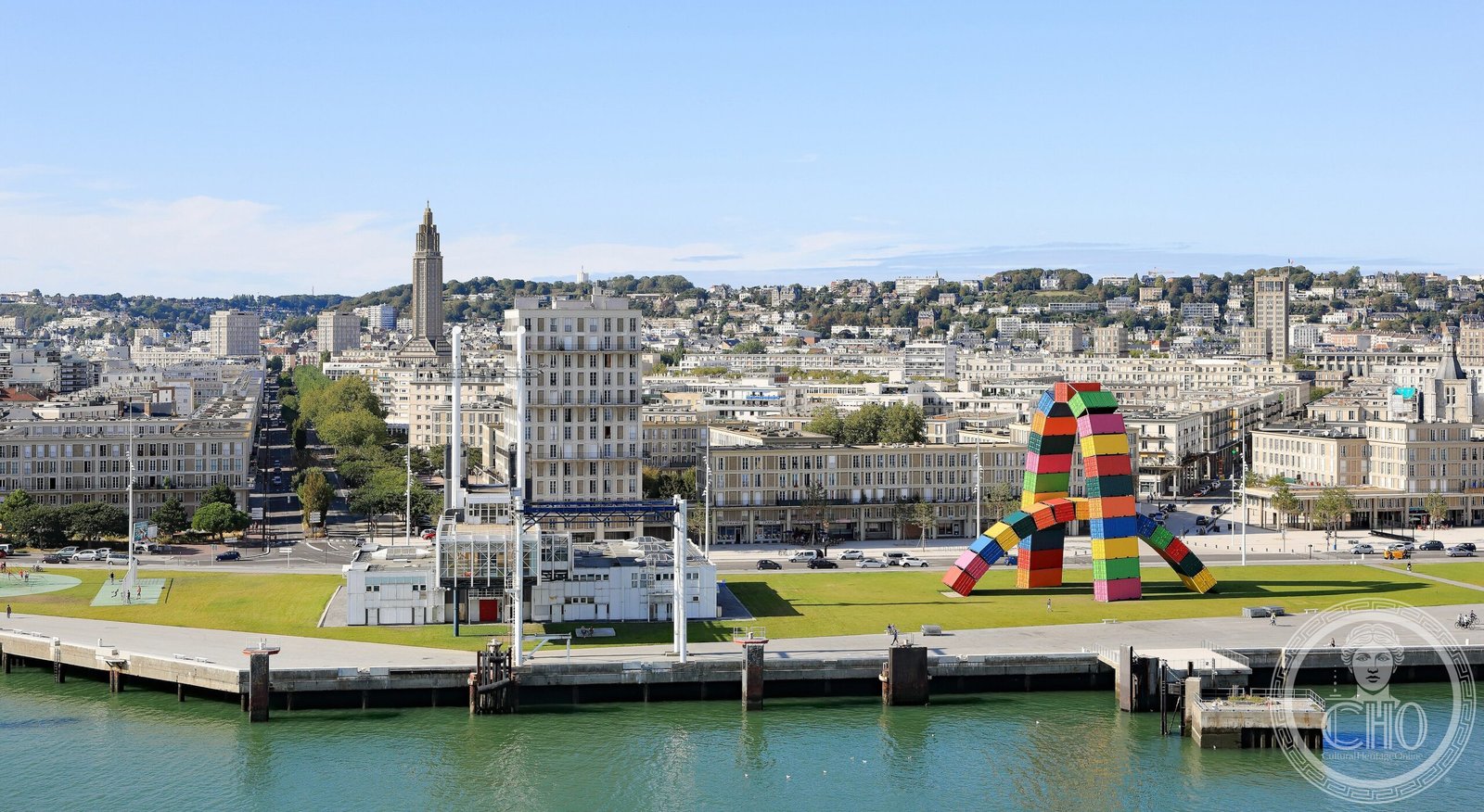
After Allied bombing in 1944 erased the entire city centre, Auguste Perret transformed Le Havre into the most coherent urban expression of reinforced concrete Modernism — a grid of wide boulevards, continuous arcades, and a soaring octagonal church tower suffused with coloured light.
At a glance
Le Havre’s post-war reconstruction is exceptional not for individual buildings but for the completeness and internal logic of the entire city centre as a single designed entity. Between 1945 and 1964, Auguste Perret and a team of 50 architects rebuilt roughly 150 hectares of a major French port city from scratch, applying a single structural module of 6.24 metres to every block, every building, every arcade. The result is an urban landscape of rare harmony: broad 50-metre boulevards framed by six-storey perforated concrete facades, all sharing the same floor heights and window rhythms. The UNESCO inscription of 2005 recognised the district as an outstanding example of post-WWII architecture illustrating the application of modern architectural principles to urban reconstruction at unprecedented scale.
Key facts
- UNESCO inscription: 2005, criteria (ii) and (iv)
- Architect: Auguste Perret (1874–1954), with atelier of 50 architects
- Construction period: 1945–1964
- Structural system: Reinforced concrete frame, standardised module 6.24 m
- Key landmark: Church of Saint-Joseph — 107 m tower, 12,768 coloured glass panes
- Central square: Place de l’Hôtel-de-Ville — largest public square in France
- Area inscribed: 133 hectares core zone + 191 ha buffer zone
- Destruction: September 1944 — Allied bombing and German demolition; 80,000 homeless
History
On 5–11 September 1944, Le Havre suffered the most concentrated bombing of any French city during WWII. Allied aircraft dropped over 10,000 bombs in a six-day campaign to dislodge the German garrison; German forces then demolished what remained. When the smoke cleared, 12,000 buildings had been destroyed and 80,000 people made homeless. The pre-war city of Haussmannian apartment blocks, churches, and port quays had effectively ceased to exist.
The French Reconstruction Ministry chose Auguste Perret, then 70 years old, to lead the rebuilding. Perret was already the pre-eminent master of reinforced concrete in French architecture, having spent forty years arguing that concrete was not a substitute for stone but a structural system with its own aesthetic logic. His 1903 apartment building at 25 bis rue Franklin in Paris pioneered the exposed concrete frame; Notre-Dame de Raincy (1923) established him as France’s foremost architectural modernist. Le Havre would be the culmination of his career.
Perret’s plan was radical in its consistency. He established a single urban module of 6.24 metres and required every building across the entire city centre to conform to it. This produced a standardised structural grid into which varied facades could be inserted: prefabricated concrete panels filled with glass louvres, ceramic tiles, or brick, all within the same structural cage. Ground floors throughout the commercial centre are set back under continuous arcades. Buildings are uniformly six storeys, with additional floors permitted only as setback penthouses.
Construction proceeded from 1945 to 1964. For decades the reconstruction was criticised as inhuman and monolithic. The UNESCO inscription of 2005 marked the definitive rehabilitation of Perret’s achievement, now recognised as the most complete expression of architectural Modernism at urban scale.
What you see
Walking the rebuilt city centre, the first impression is of width and light. The central axis, Avenue Foch, runs 400 metres wide from the station to the sea, framed by six-storey concrete buildings whose facades are a rhythm of vertical window strips and horizontal string courses. Ground-floor arcades are continuous on both sides, creating covered galleries that shelter pedestrians and anchor commercial life.
The centrepiece is the Church of Saint-Joseph (1951–1957). Its 107-metre octagonal concrete tower rises from the surrounding city like a secular campanile. The interior is one of the great spatial experiences of 20th-century architecture: the tower is filled with 12,768 individual panes of coloured glass — arranged in a gradient from dark blues at the base to pale yellows at the apex — creating a constantly shifting luminosity that recalls Gothic interiors while being built entirely from industrial materials.
The Place de l’Hôtel-de-Ville is the largest public square in France — 300 metres long, framed by the town hall’s colonnade and Perret’s commercial facades. The town hall (1958) by Perret’s atelier features a detached 72-metre clock tower. Closer inspection of the facades reveals the sophistication concealed beneath apparent uniformity: each building owner could choose infill panels from a palette of concrete grilles, louvred glass, ceramic tiles, and coloured concrete — all held together by the common module and floor heights.
Practical information
- Location: Le Havre city centre, Seine-Maritime, Normandy, France
- Access: The UNESCO district is an open, walkable city — no entrance fee
- Must-see: Church of Saint-Joseph (interior open daily, free), Place de l’Hôtel-de-Ville, Avenue Foch, MuMa museum
- Guided tours: Le Havre Tourist Office offers architect-led walking tours of the Perret district
- Best time: Morning light on east-facing facades; late afternoon for the full coloured-glass effect inside Saint-Joseph
Getting there
Direct TGV trains from Paris Saint-Lazare (approximately 2 hours 10 minutes). The city centre is a 10-minute walk from Le Havre station, itself a Perret building (1958). By road: 200 km from Paris via the A13 and A29. Ferries run from Portsmouth to Le Havre (Brittany Ferries, approximately 3.5–8 hours).
Nearby
- Étretat — 30 km north: the chalk-cliff arches painted by Monet and Courbet
- Honfleur — 20 km south via the Pont de Normandie: medieval fishing port, Eugène Boudin birthplace
- Rouen — 85 km east: Gothic cathedral, Joan of Arc, Flaubert museum
- D-Day beaches — 80–120 km south-west: Normandy American Cemetery, Omaha Beach
Sources
- UNESCO WHC: Le Havre, the City Rebuilt by Auguste Perret
- Wikipedia: Le Havre
- Wikipedia: Auguste Perret
- Wikipedia: Church of Saint-Joseph, Le Havre
Find it on the map
See this place and what’s around it →📷 Become a Cultural Heritage Online photographer
Share your photos of places: they stay published under your name as the author. The more they're seen, the more you get noticed — and soon a contest will reward the most appreciated photos.
Log in or sign up free to add a photo