
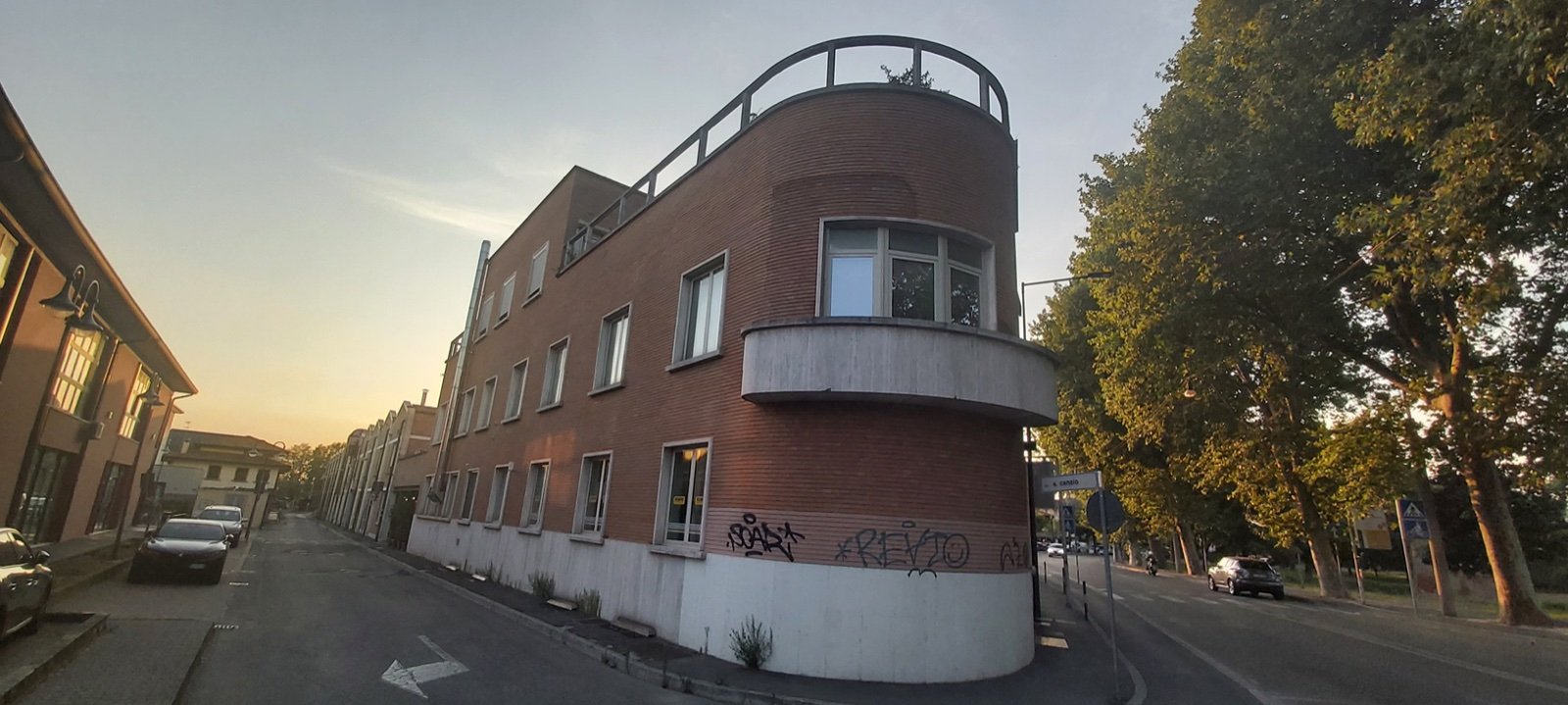
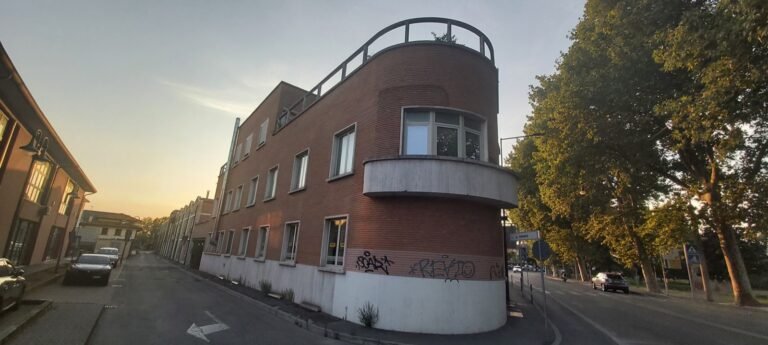
Padua: the streamline-moderne corner building of the former Kofler perfume, powder and soap works, which gave the San Giuseppe quarter its "Borgo del Talco" identity. Exact date and architect are not documented.
At a glance
On a corner of Via Bronzetti, in Padua’s San Giuseppe quarter, stands a building that curves. Its rounded end reads like the prow of a ship, wrapped by a ribbon window and topped by a tubular railing — the streamline vocabulary of the 1930s. This was the Kofler works, the perfume, powder and soap factory whose talc-scented air once gave the whole district its nickname, the Borgo del Talco, the borough of talc.
Key facts
- Founder: Iginio Kofler — Alpine officer, industrialist, president of Confindustria Padova
- Made here: perfumes, face powders, talc and delicate cosmetics
- Style: streamline moderne / Rationalist, rounded corner and ribbon window
- Date & architect: not documented in available sources (see note below)
- Address: Via Pilade Bronzetti 30, Padua (San Giuseppe)
- Today: the Centro Kofler, a commercial and business centre occupying the former works
History
Iginio Kofler was one of those industrialists whose reach ran well past the factory gate: an officer of the Alpini, president of Confindustria Padova, and a patron who in 1955 bought and restored Villa Molin, the Scamozzi villa on the Bacchiglione, and later the Egyptian Room of the Caffè Pedrocchi. His name, though, belonged first to scent. The Kofler works on Via Bronzetti turned out perfumes, powders and above all talc, and for decades the surrounding streets carried the smell of it — a sensory brand so strong that the neighbourhood still calls itself the Borgo del Talco.
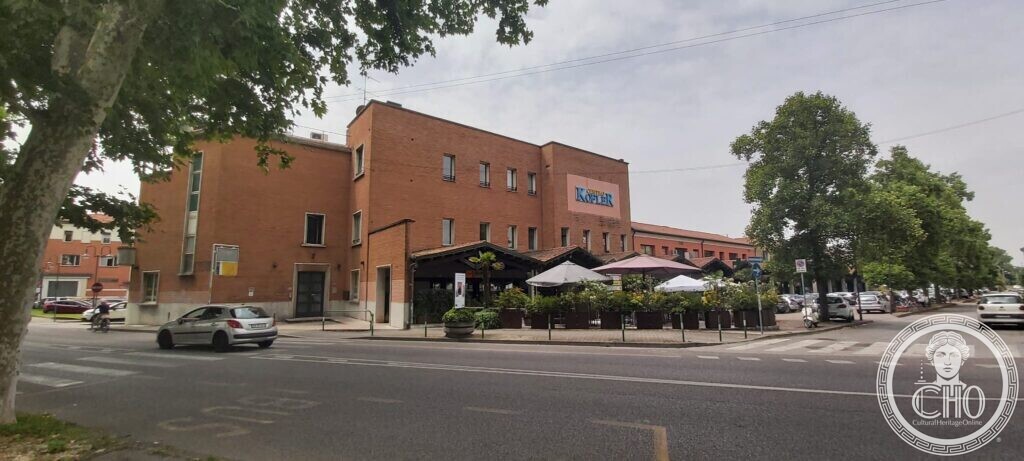
The factory closed long ago and the building now houses the Centro Kofler, a commercial and business centre, but its shape survived the change. It remains the most legible industrial landmark of a quarter that Padua developed across the interwar decades.
What you see
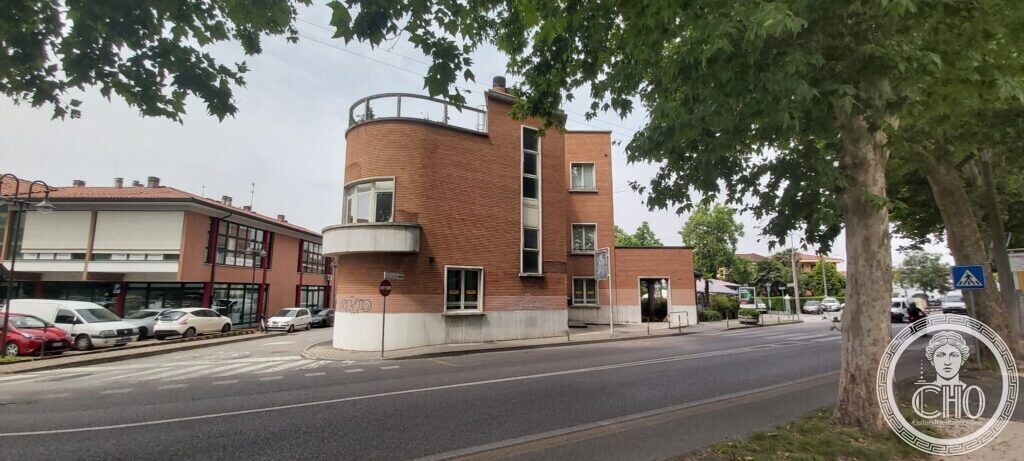
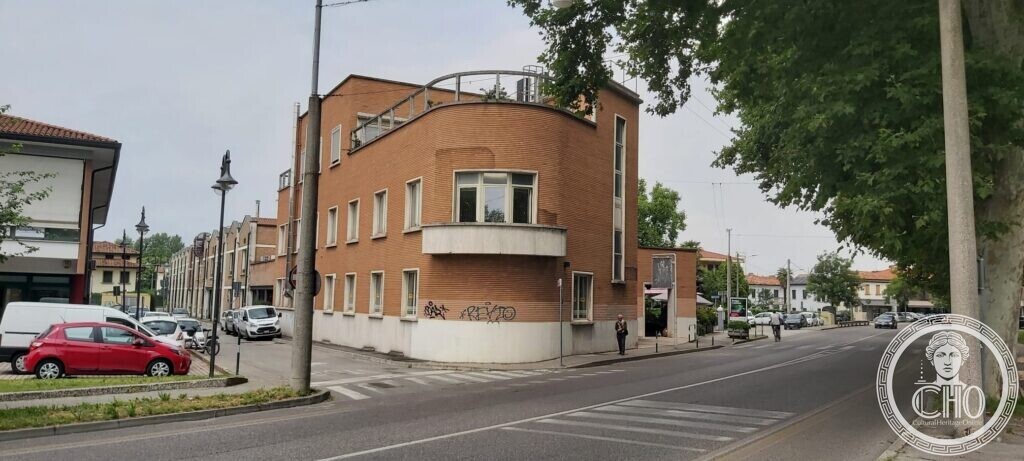
The building is organised around its corner. Where two streets meet, the wall does not turn a sharp angle but sweeps round in a full curve, faced in brick and carried up through two floors to a flat roof edged with a slender metal railing that reads as a ship’s deck. A continuous band of windows follows the curve; a shallow balcony rings the first floor. It is the language of streamline moderne — speed and horizontality borrowed from ocean liners and aircraft — applied here to a small Paduan factory.
A note on dating
Cultural Heritage Online records this building for its architecture, but with a caveat: no public source we have consulted gives its exact year of construction or names its architect. The oldest document we could trace is a 1953 postcard of the works already in operation. On the strength of its streamline-moderne form and its place in the interwar growth of the San Giuseppe quarter, and on the field documentation of Stefano Vigolo, we group it with the architecture of the years around 1922–1944 — while stating plainly that the precise date and authorship remain to be confirmed.
Getting there
The building stands in the San Giuseppe quarter, south-west of Padua’s centre, a short ride from the railway station. It is on a public street and is seen from the pavement; the interior is in private commercial use as the Centro Kofler.
Gallery
Sources
- Borgo del Talco — neighbourhood history of the Kofler works and Iginio Kofler (Via Bronzetti, San Giuseppe).
- Historic advertising postcard, Antico Stabilimento Kofler, Profumi e Saponi, Via Bronzetti 30, Padua, 1953.
- Field documentation by Stefano Vigolo, 2026 (location, current state, photographs).
Find it on the map
See this place and what’s around it →Record researched and written by Stefano Vigolo for Cultural Heritage Online, 2026.
📷 Become a Cultural Heritage Online photographer
Share your photos of places: they stay published under your name as the author. The more they're seen, the more you get noticed — and soon a contest will reward the most appreciated photos.
Log in or sign up free to add a photoRequest to use these images
Each photograph is by the person named on it. Cultural Heritage Online is the seller: it runs the payment, handles tax and delivers the file, and the photographer receives 70% of the price net of tax. Buying gives you the right to use the image in your own project — a website, an article, a presentation — with the file and a written licence. Read the Terms of Sale.
What you receive. The file as it is held in our archive: the photographer's own original, without the Cultural Heritage Online watermark, unretouched and not enlarged. This is a working archive built over many years by many people, so the files differ — some were taken recently, others years ago with the equipment of their time. Older pictures are usually smaller: a camera from fifteen or twenty years ago simply recorded fewer pixels than a phone does today, so the resolution is lower and the print comes out smaller. We say so rather than hide it. The size, weight, format and year of each one are printed below it, and the print size is given at 300 dpi. Nothing is upscaled to make a number look better. Where the picture on this page has been cropped for the layout, the file you receive is the full frame, which may be wider or taller than what you see here.

The former Kofler perfume and talc works on Via Bronzetti, Padua. Photo: Stefano Vigolo, 2026.
Photo: Stefano Vigolo
€3.00
1600 × 719 px · JPG · 342.2 KB
prints 14 × 6 cm at 300 dpi · taken 2026
Is this page about you?
This page is read by travellers and heritage enthusiasts who find it on Google. Tell us how you are connected to this place and we will take it from there.