
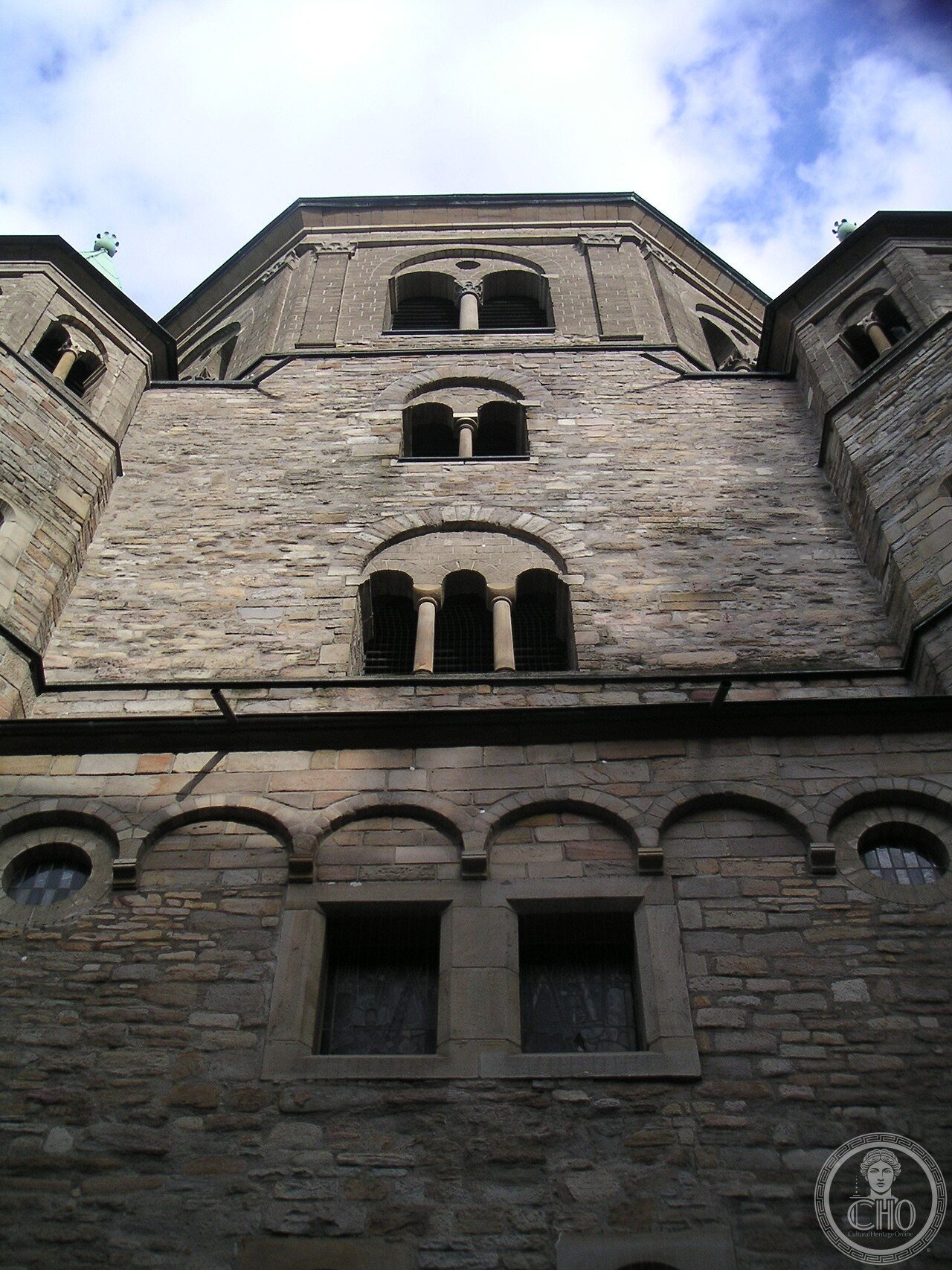
Until 1803 Essen Cathedral was the church of an unusual abbey: not nuns under the Rule of Saint Benedict, but secular canonesses, led by an abbess who exercised almost episcopal functions over the abbey’s vast estates, with no ecclesiastical superior but the pope. Around 980 the abbess Mathilde commissioned the Golden Madonna, the oldest fully three-dimensional sculpture of Mary known in the world.
About Essen Cathedral
Essen Minster was established around 845, when Bishop Altfrid of Hildesheim founded a community of secular canonesses on his estate of Asnide (Essen). Unlike a Benedictine convent, the canonesses of Essen did not follow monastic rule, and their abbess exercised near-episcopal authority — barring the sacraments themselves — as ruler over the abbey’s extensive estates, answerable to no clerical superior except the Pope. The original basilica burned in 946 (“Astnide cremabatur,” Essen burnt down, as recorded in the Cologne Annals), and the rebuilt Ottonian church that followed featured an outer crypt, a distinctive westwork with an octagonal belfry, and a chapel dedicated to St John the Baptist. Under Abbess Mathilde, granddaughter of Emperor Otto the Great, who governed from 971 to 1011, the abbey entered its richest period of artistic patronage, commissioning the treasures that still define its Domschatz today — most famously the Golden Madonna, a gilded poplar figure 74 cm tall, dated to around 980 and recognised as the oldest fully sculptural, free-standing statue of Mary anywhere in the world, alongside a seven-armed bronze candelabrum of 46 cast pieces, 2.26 metres high, made between 973 and 1011. A second fire in 1275 required another full rebuilding, this time in Gothic hall-church style; the architect Master Martin of Burgundy led the project until disputes with Abbess Beatrix von Holte forced his departure in 1305, and the whole complex was finally consecrated on 8 July 1316 — a date still celebrated as the minster’s anniversary. The crypt, in three sections, carries a date of 1051 based on a surviving inscription. Devastated by a 1943 RAF bombing raid, the minster was rebuilt from 1951, and became the seat of the newly created Diocese of Essen in 1958, only then formally becoming a cathedral.
Key facts
- Foundation: c. 845, by Bishop Altfrid of Hildesheim, for a community of secular canonesses (not Benedictine nuns)
- Abbess’s authority: near-episcopal rule over the abbey’s extensive estates, answerable only to the Pope
- 946 fire: destroyed the original basilica, recorded in the Cologne Annals
- Ottonian rebuilding: distinctive westwork with octagonal belfry; crypt dated 1051 by inscription
- Abbess Mathilde (971-1011): granddaughter of Otto the Great; commissioned the Golden Madonna (c. 980) and the seven-armed candelabrum (973-1011)
- Golden Madonna: gilded poplar, 74 cm tall, the oldest fully sculptural free-standing statue of Mary in the world
- 1275 fire and Gothic rebuild: led initially by Master Martin of Burgundy; whole complex consecrated 8 July 1316
- Modern status: devastated in a 1943 RAF raid, rebuilt from 1951; seat of the Diocese of Essen since 1958
History
Essen’s foundation as a community of secular canonesses rather than a strict monastic order reflects a specific and historically significant category of medieval religious institution — the Frauenstift or women’s collegiate foundation — that offered aristocratic women, particularly those from the highest imperial families, a form of religious life combining genuine devotional purpose with continued engagement in worldly affairs, property management, and even political authority unavailable to cloistered nuns under full monastic rule. Abbess Mathilde’s status as Otto the Great’s own granddaughter placed Essen’s leadership at the very heart of Ottonian imperial politics, and her three-decade tenure’s exceptional artistic patronage — producing both the Golden Madonna and the seven-armed candelabrum — reflects the substantial resources and connections such an imperially connected abbess could command.
The Golden Madonna’s status as the oldest surviving fully sculptural, free-standing Marian statue anywhere gives it genuinely unique art-historical significance, predating by roughly two centuries the wider medieval European tradition of large-scale devotional Marian sculpture that would later become commonplace across Gothic church architecture — making the Essen figure a documented point of origin for an entire subsequent tradition rather than merely an early surviving example of it. The 1943 RAF bombing raid’s destruction and the minster’s subsequent 1951 reconstruction, followed by its 1958 elevation to full cathedral status as seat of the newly created Diocese of Essen, situates the building within the broader 20th-century pattern of German ecclesiastical institutions rebuilding and often gaining elevated administrative status in the postwar reorganisation of the Catholic Church across the industrial Ruhr region.
What you see
The Golden Madonna and the seven-armed candelabrum, both housed in the Domschatz (cathedral treasury), are the essential single destination for visitors, offering direct access to two of the most significant surviving objects of Ottonian-era religious art anywhere in Germany. The westwork, with its octagonal belfry and pyramidal roof flanked by octagonal side towers, remains the building’s most architecturally distinctive exterior feature, a direct legacy of the post-946 Ottonian rebuilding. The three-part crypt, dated by inscription to 1051, extends the site’s continuously documented building history back nearly a millennium.
Practical information
- Opening hours: generally open daily, check current hours before visiting; Domschatz treasury has separate admission
- Address: Burgplatz 2, 45127 Essen
Getting there
Essen has direct rail connections from Düsseldorf (approximately 20 minutes) and Dortmund (approximately 25 minutes). By car, Essen sits on the A40/A52 motorway network. The cathedral stands in Essen’s city centre near Kettwiger Straße. GPS: 51.4556° N, 7.0132° E.
Nearby
- Zollverein Coal Mine Industrial Complex — a UNESCO World Heritage Site a short distance away, symbol of the Ruhr’s industrial heritage
- Essen city centre — the surrounding shopping and pedestrian district, including Kettwiger Straße
- Museum Folkwang — a major modern and contemporary art museum in central Essen
Sources
- Wikipedia — “Essen Minster” and “Golden Madonna of Essen” (en.wikipedia.org)
- Daily Art Magazine — “The Medieval C-3PO?: Golden Madonna of Essen” (dailyartmagazine.com)
- World Heritage Journeys of Europe — “The Treasury of Essen Cathedral” (visitworldheritage.com)
Find it on the map
See this place and what’s around it →📷 Become a Cultural Heritage Online photographer
Share your photos of places: they stay published under your name as the author. The more they're seen, the more you get noticed — and soon a contest will reward the most appreciated photos.
Log in or sign up free to add a photo