
In 1697 the Italian organ builder Eugenio Casparini completed for this church an organ with a front of 17 pipes arranged in a golden fan, the “suns” that give it its name. Johann Sebastian Bach, who tried it himself, complained that it took the strength of a horse to press down its keys.
About St. Peter and Paul Church, Görlitz
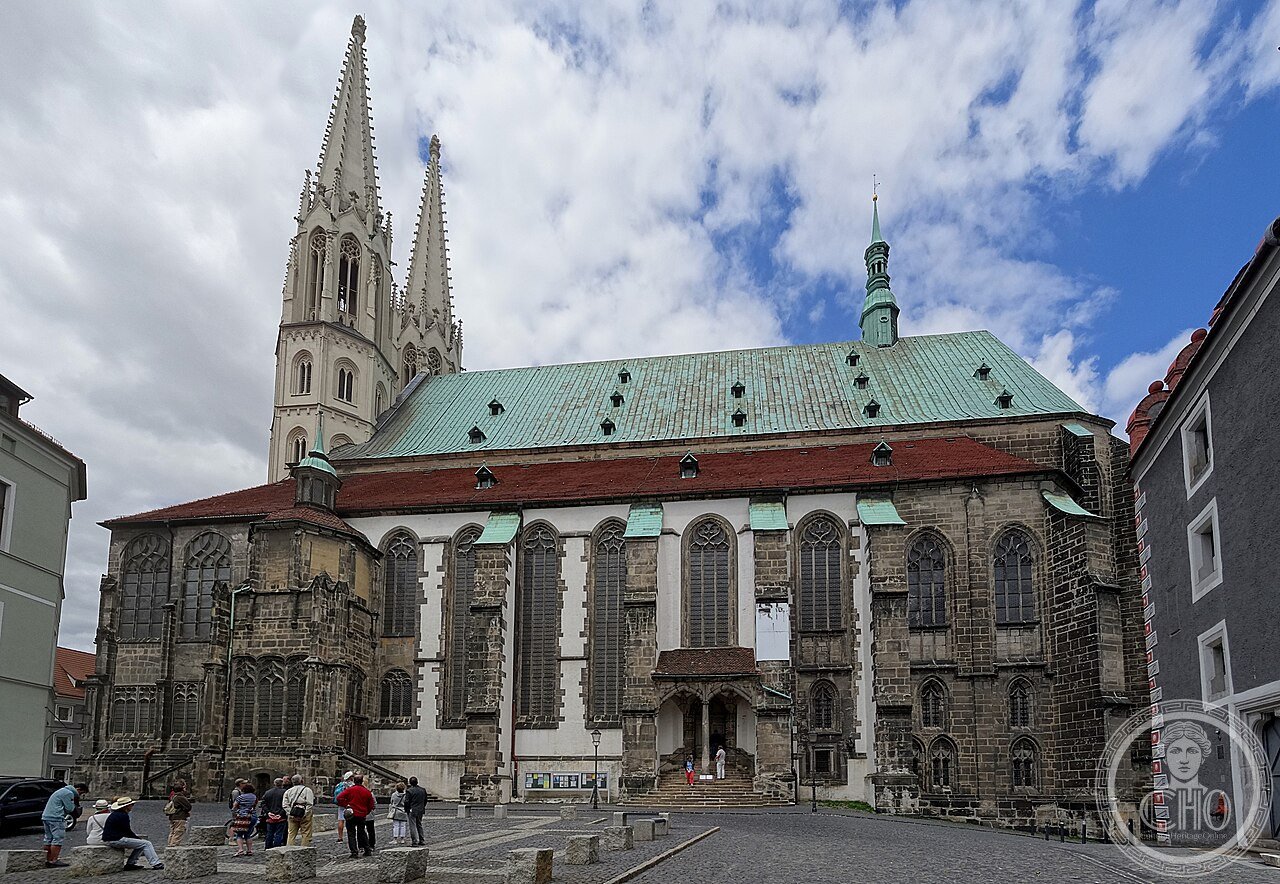
The Peterskirche (Parish Church of St. Peter and Paul) originated as an 11th-century castle church on a hill above the Neisse river, and as Görlitz developed into an urban municipality in the early 13th century, the church rose to become the city’s main parish church, achieving sole status as Görlitz’s principal church in 1372. During the Gothic period, in 1423, the building was completely rebuilt into a mighty five-aisled hall church, work substantially complete by the late 15th century — the result is widely described as the oldest and largest church in Saxony, and one that served as an architectural model for numerous other sacred buildings across the region. Its single most celebrated feature is the “Sun Organ” (Sonnenorgel), completed in 1697 by the Italian imperial court organ builder Eugenio Casparini, its facade designed by architect Johann Conrad Büchau and featuring 17 radially arranged golden pipe “suns” alongside a spectacular register of special effects, including imitation animal voices. The organ’s exceptionally stiff tracker action was notorious enough that Johann Sebastian Bach, who played it personally, complained it required the strength of a horse to press the keys. Adjoining the church, a medieval ensemble including a Way of the Cross and a Holy Sepulchre reproduces the most important elements of the Church of the Holy Sepulchre in Jerusalem, donated by Georg Emmerich, son of a Görlitz merchant, following his own pilgrimage to the Holy Land.
Key facts
- Origins: 11th-century castle church on a hill above the Neisse; became Görlitz’s sole main parish church in 1372
- Gothic rebuilding: begun 1423, producing a five-aisled hall church, complete by the late 15th century
- Significance: the oldest and largest church in Saxony, an architectural model for the wider region
- Sun Organ (Sonnenorgel): completed 1697 by Eugenio Casparini, case by Johann Conrad Büchau; 17 golden pipe “suns,” animal-voice registers; famously stiff action, criticised by J.S. Bach
- Holy Sepulchre ensemble: medieval reproduction of Jerusalem’s Church of the Holy Sepulchre and its Way of the Cross, donated by merchant’s son Georg Emmerich after his own pilgrimage
- 14th-century baptismal bell: a surviving bronze casting from the church’s medieval period
History
Görlitz’s Holy Sepulchre ensemble, among the most complete European reproductions of Jerusalem’s holiest Christian site, situates the Peterskirche within a broader late-medieval European tradition of “replica” pilgrimage architecture, in which wealthy patrons who had themselves completed the increasingly difficult and dangerous journey to Jerusalem funded detailed physical reproductions of its holy sites back home, allowing local congregations unable to make the pilgrimage themselves a tangible connection to the same sacred geography — Georg Emmerich’s specific donation reflecting both genuine personal piety and the kind of civic-religious patronage wealthy merchant families across late medieval German trading towns frequently used to cement their social and spiritual standing.
Eugenio Casparini’s Sun Organ, built at the height of Baroque organ-building ambition, situates Görlitz within the broader European tradition of increasingly spectacular, mechanically elaborate church organs during this period — instruments whose visual and acoustic theatricality (golden sunburst facades, imitation animal sounds) were explicitly intended to awe congregations as much as to serve conventional liturgical accompaniment. J.S. Bach’s specific documented complaint about the instrument’s punishingly stiff action, delivered by a composer and organist whose own technical standards were exceptionally demanding, adds a genuinely well-attested and memorably specific anecdote to the organ’s broader reputation, illustrating how even celebrated instruments of the period could carry serious practical playing drawbacks alongside their visual and acoustic splendour.
What you see
The Sun Organ, with its 17 golden pipe suns and elaborate registers, is the church’s essential single destination, rewarding visitors who can catch it in use during a service or recital. The five-aisled Gothic hall church interior, dating substantially to the 1423 rebuilding, offers an unusually spacious example of the type for a parish rather than cathedral church. The adjoining Holy Sepulchre ensemble and Way of the Cross extend the site’s significance into an entirely separate devotional tradition connected to Jerusalem pilgrimage.
Practical information
- Opening hours: generally open daily, check current hours before visiting; free admission
- Address: Bei der Peterskirche 7, 02826 Görlitz
Getting there
Görlitz has direct rail connections from Dresden (approximately 1.5 hours). By car, Görlitz sits on the B99/A4 road network at the German-Polish border. The church stands above the Neisse river in Görlitz’s historic old town. GPS: 51.1583° N, 14.9922° E.
Nearby
- Görlitz Altstadt — one of Germany’s best-preserved historic town centres, largely spared WWII destruction
- Zgorzelec — the Polish town directly across the Neisse river, historically part of Görlitz before the post-WWII border change
- Dresden — approximately 1.5 hours by train; Saxony’s state capital
Sources
- Places of Germany — “Goerlitz Parish Church of St. Peter and Paul” (placesofgermany.de)
- From Place to Place — “St. Peter’s Church – a landmark of Görlitz” (fromplacetoplace.travel)
- Sonus Paradisi — “Goerlitz Sonnenorgel” (sonusparadisi.cz)
- Visit Görlitz — “Sacred Sites of Görlitz” (visit-goerlitz.com)
Find it on the map
See this place and what’s around it →📷 Become a Cultural Heritage Online photographer
Share your photos of places: they stay published under your name as the author. The more they're seen, the more you get noticed — and soon a contest will reward the most appreciated photos.
Log in or sign up free to add a photo