
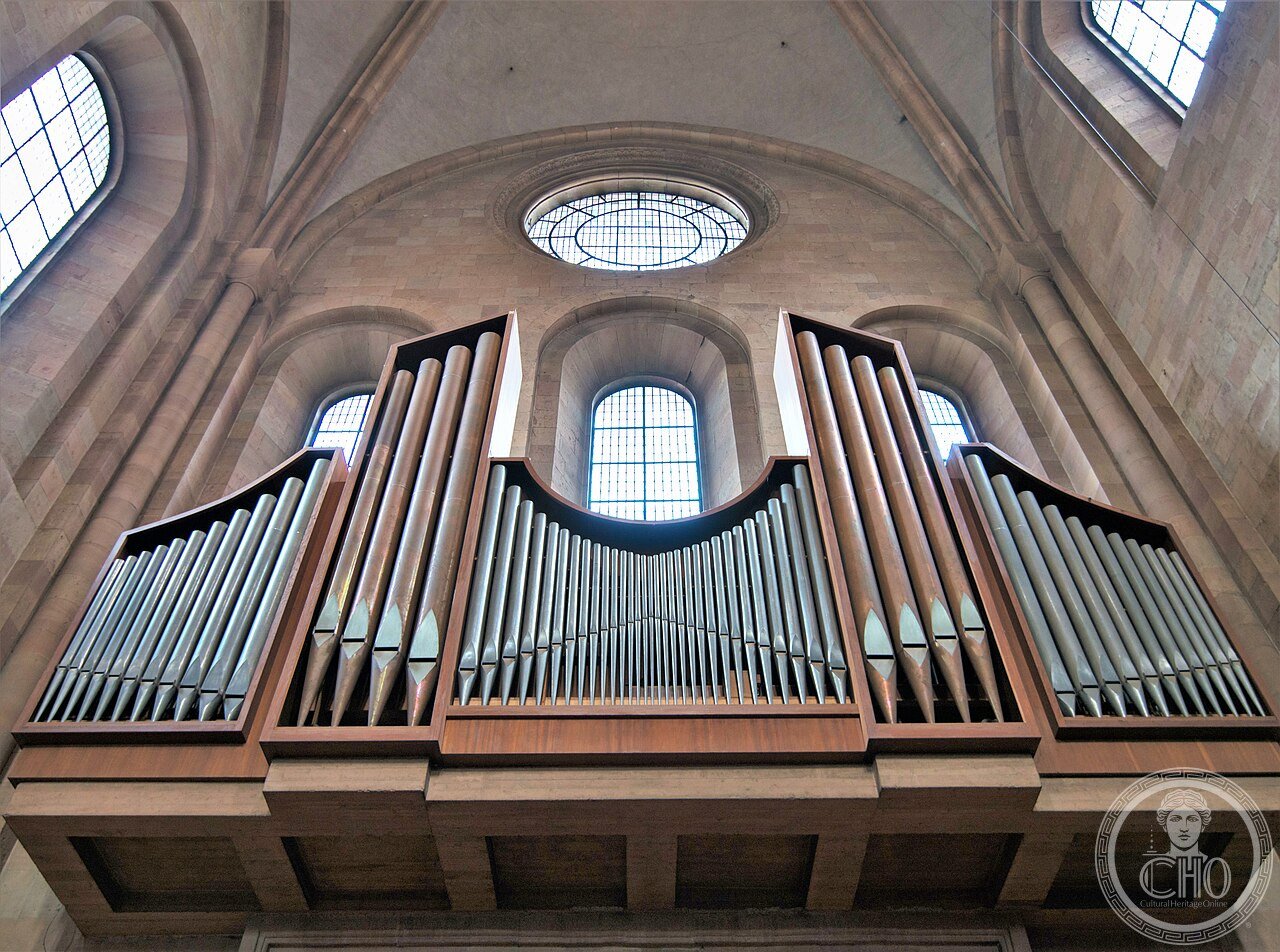
In 975 Archbishop Willigis began a cathedral modelled on St Peter’s in Rome, worthy of the imperial rank of his see. On 29 August 1009, on the very day of its consecration, a fire destroyed it. It took almost three decades to rebuild: and that was only the first of seven fires Mainz Cathedral would come through over the centuries, surviving even the bombing of the Second World War.
About Mainz Cathedral
Mainz Cathedral (Hoher Dom St. Martin) was ordered built by Archbishop Willigis in 975-976 in the Ottonian architectural style, modelled explicitly on St. Peter’s in Rome and designed with a transept and dual choirs to reflect the archbishopric’s imperial stature. On 29 August 1009, the very day of its consecration, the cathedral suffered extensive fire damage; reconstruction under Archbishop Bardo took nearly three decades, with the main portions complete and the building usable again by 1036. A second major fire in 1081 required further rebuilding, with Emperor Henry IV supporting reconstruction efforts from around 1100. Gothic belfries were added to the crossing towers in 1361 (east) and 1418 (west), each topped with a pyramid roof, and the building today combines its original Romanesque core with later Gothic chapels and towers and Baroque roof elements. The cathedral burned a total of seven times across the centuries, was rebuilt after each, and survived even the bombing raids of World War II. Since the Middle Ages, the Archbishop of Mainz held the right to crown German kings and queens, and the cathedral hosted the coronations of seven German kings. It now holds the tombs and funerary monuments of numerous former Electoral prince-archbishops, and the printer Johannes Gutenberg — a native of Mainz — is buried here alongside Archbishop Bardo, who oversaw the cathedral’s first reconstruction.
Key facts
- Foundation: ordered by Archbishop Willigis, 975-976, modelled on St. Peter’s in Rome
- 1009 fire: destroyed the cathedral on the very day of its consecration, 29 August 1009; rebuilt under Archbishop Bardo, usable again by 1036
- 1081 fire: required further reconstruction, supported by Emperor Henry IV from c. 1100
- Gothic towers: belfries added 1361 (east crossing tower) and 1418 (west crossing tower), pyramid roofs
- Seven fires total: across the centuries, each followed by reconstruction; survived WWII bombing
- Archbishop-electors: held the right to crown German kings and queens; seven royal coronations held here
- Notable burials: Johannes Gutenberg and Archbishop Bardo, among numerous Electoral prince-archbishops
History
Archbishop Willigis’s explicit modelling of his new cathedral on St. Peter’s in Rome reflects Mainz’s genuinely exceptional status within the medieval Holy Roman Empire: as one of the empire’s most senior ecclesiastical princes and, from the mid-14th century Golden Bull onward, formally the presiding Archbishop-Elector among the seven electors who chose the German king, the Archbishop of Mainz required a cathedral whose scale and prestige matched an office with genuine imperial-level authority — a status the building’s repeated, determined reconstruction after seven separate fires across the centuries only reinforces, since each rebuilding represented a conscious institutional refusal to let the see’s premier church remain diminished.
The cathedral’s role hosting seven German royal coronations situates Mainz directly within the empire’s core constitutional machinery, the Archbishop of Mainz’s coronation privilege giving the city a formal, recurring role in the transfer of royal power comparable to few other German ecclesiastical seats. Johannes Gutenberg’s burial within the cathedral connects the building to one of the most consequential technological developments in world history — movable-type printing, invented in Mainz itself in the 1440s — giving the cathedral a further layer of significance entirely independent of its ecclesiastical and dynastic history.
What you see
The cathedral’s layered combination of Romanesque core, Gothic chapels and crossing towers (1361 and 1418), and later Baroque roof elements offers a legible thousand-year architectural record surviving seven separate fires. The tombs and funerary monuments of the Electoral prince-archbishops, concentrated within the cathedral, give visitors a dense record of Mainz’s medieval and early modern ecclesiastical-political elite. Johannes Gutenberg’s tomb adds a further specific point of interest connecting the building to the invention of European printing.
Practical information
- Opening hours: generally open daily, check current hours before visiting; free admission, Cathedral Museum has separate admission
- Address: Liebfrauenstraße 4, 55116 Mainz
Getting there
Mainz has direct rail connections from Frankfurt (approximately 35 minutes) and Wiesbaden (approximately 10 minutes). By car, Mainz sits on the A60/A63 motorway network. The cathedral stands in the historic centre near the Markt. GPS: 49.9989° N, 8.2738° E.
Nearby
- Gutenberg Museum — a short walk from the cathedral, dedicated to the history of printing
- Mainz old town — surrounding the cathedral, with the historic Markt and half-timbered Kirschgarten quarter
- St. Stephan’s Church — a short walk away; known for its stained-glass windows by Marc Chagall
Sources
- Wikipedia — “Mainz Cathedral” (en.wikipedia.org)
- Mainz Tourismus — “Cathedral” (mainz-tourismus.com)
- State capital Mainz — “St. Martin’s Cathedral” (mainz.de)
Find it on the map
See this place and what’s around it →📷 Become a Cultural Heritage Online photographer
Share your photos of places: they stay published under your name as the author. The more they're seen, the more you get noticed — and soon a contest will reward the most appreciated photos.
Log in or sign up free to add a photo